Flygt pump mechanical seals commonly use two sealing positions to protect the motor from pumped liquid. Technicians often call them the upper seal and lower seal. However, Flygt technical documents usually describe them as the inner seal and outer seal.
The lower seal normally sits closer to the impeller. In contrast, the upper seal sits closer to the motor. A buffer-fluid chamber separates the two positions.
Understanding this arrangement helps buyers avoid ordering a seal for the wrong position. You can also review our Flygt seal replacement range when comparing available configurations.
What Do Upper and Lower Flygt Seals Mean?
In a typical vertical submersible pump, the lower seal corresponds to the outer seal. It separates the pumped medium from the buffer-fluid chamber. Meanwhile, the upper seal corresponds to the inner seal and separates the buffer fluid from the motor side.
The normal arrangement follows this order:
- Pumped liquid and impeller
- Lower or outer mechanical seal
- Buffer-fluid chamber
- Upper or inner mechanical seal
- Inspection chamber or motor housing
The official Flygt seals user guide describes the outer and inner seals as two independent seals with different functions. Therefore, buyers should not view them only as a primary seal and a backup seal.
Moreover, “upper” and “lower” are workshop terms rather than complete specifications. Always check the pump orientation, model variant, motor version, and exploded drawing.
How Flygt Pump Mechanical Seals Work Together
The two seals form a double mechanical seal system. Between them, the seal housing contains oil or another specified buffer fluid. This fluid lubricates the faces and carries away heat.
First, the lower seal restricts wastewater, slurry, or drainage water from entering the chamber. At the same time, the upper seal restricts buffer fluid from moving toward the motor.
The Flygt N 3085 product page provides one practical example of two mechanical shaft seals that work independently. However, the exact seal arrangement and materials can vary between pump versions.
One seal cannot protect the pump indefinitely after the other seal fails. Contaminated fluid may carry particles toward the upper seal. As a result, face wear and heat can increase quickly.
Some pumps use separate conventional seals. In contrast, other designs use a Plug-In unit that combines both sealing positions in one assembly. The Flygt Plug-In Seals brochure explains how two independent seals can be mounted in one ready-to-install unit.
Therefore, technicians must confirm the construction before ordering parts. They should not assume that every Flygt pump allows separate replacement of the upper and lower seals.
What Does the Lower Mechanical Seal Do?
The lower seal works beside the pumped medium. Consequently, it usually faces the harsher environment.
Wastewater may contain sand, fibers, grit, and other solids. Industrial liquids may also cause corrosion or poor lubrication. Therefore, the lower seal needs strong faces and durable secondary sealing components.
Hard face materials commonly serve this position. Depending on the application, options may include silicon carbide or tungsten carbide. The final choice depends on the liquid, particle size, temperature, pressure, and pump design.
Common signs of lower-seal trouble include:
- Water or solids in the buffer fluid
- Milky or contaminated oil
- Scratched sealing faces
- Worn or swollen elastomers
- Deposits around the springs
- Severe seal-cavity wear
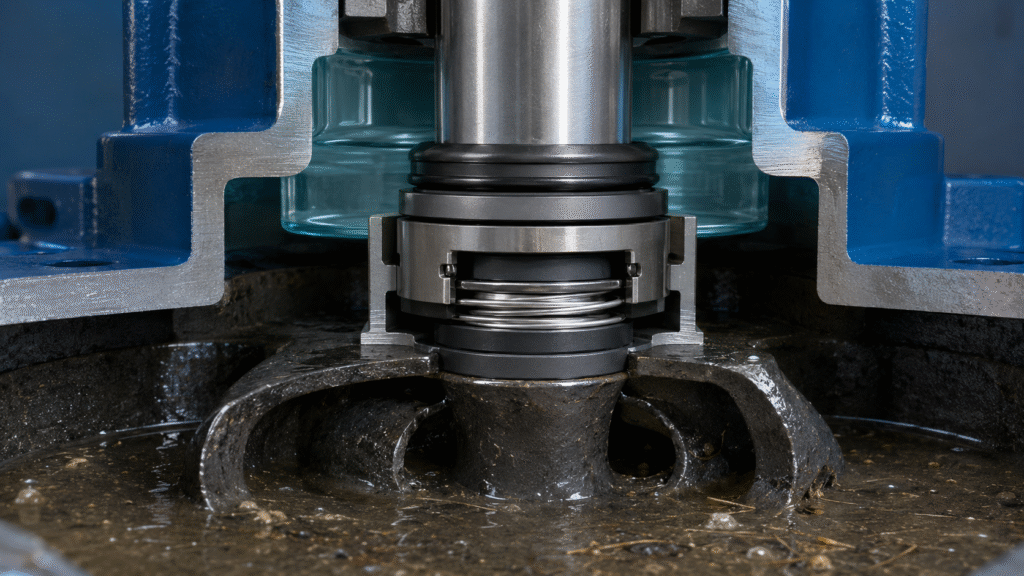
The FKL-35mm lower mechanical seal provides one replacement example for selected Flygt pump models. However, its application list must match the complete pump variant.
What Does the Upper Mechanical Seal Do?
The upper seal works between the buffer chamber and the motor side. Therefore, it normally operates in a cleaner environment than the lower seal.
Its main task is to prevent buffer fluid from reaching the stator housing. In some designs, an inspection chamber collects leakage before it reaches sensitive motor components. A sensor may also warn the operator when fluid enters this chamber.
Possible signs of upper-seal trouble include:
- Buffer fluid in the inspection chamber
- A leakage-sensor alarm
- A falling buffer-fluid level
- Oil near the motor-side seal
- Damaged faces or O-rings
- Moisture approaching the stator housing
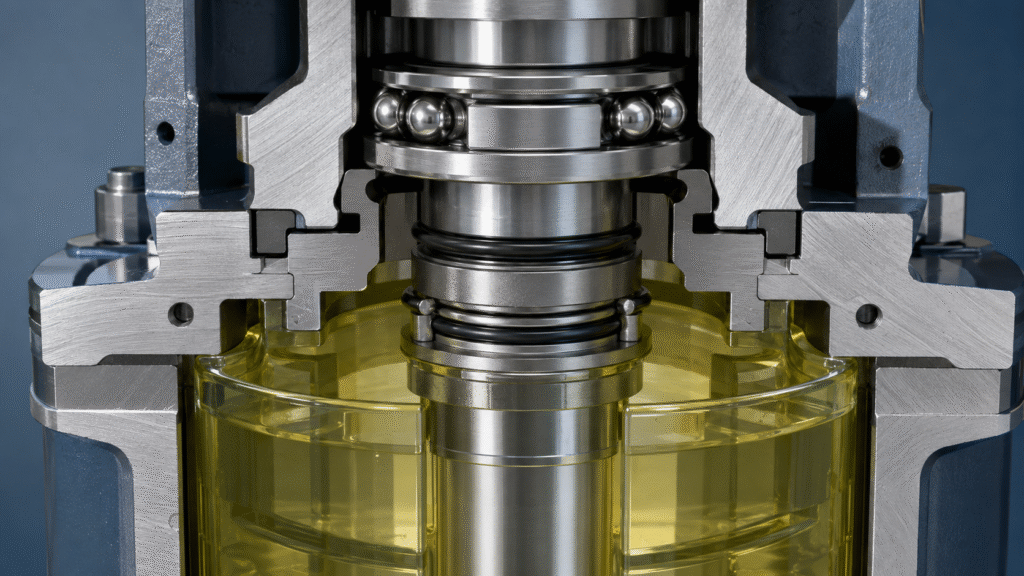
Although the upper position faces fewer abrasive particles, it still needs correct lubrication and cooling. Shaft movement, poor installation, or incorrect fluid can damage it.
The FSU-90mm upper mechanical seal shows one upper-position option for selected larger Flygt pumps and motor units. Nevertheless, buyers must verify its dimensions and compatibility.
Upper Seal vs Lower Seal: Main Differences
The lower seal sits closer to the impeller and faces the pumped medium. Therefore, it must handle solids, fibers, abrasion, chemical exposure, and pressure changes.
In comparison, the upper seal sits closer to the motor. It works beside the buffer fluid and provides the final sealing boundary before the motor area.
The key differences are:
- Lower seal: protects the buffer chamber from pumped liquid
- Upper seal: protects the motor side from buffer fluid
- Lower seal: usually requires hard, wear-resistant faces
- Upper seal: may use hard faces or a carbon-to-hard-face pairing
- Lower seal: experiences more contamination and abrasion
- Upper seal: operates in a cleaner but still critical environment
The two positions are not interchangeable. Their faces, working lengths, seats, springs, elastomers, and installation directions may differ.
Materials Used in Flygt Pump Mechanical Seals
Flygt pump mechanical seals do not all use the same face combination. The lower position generally requires excellent wear resistance, heat transfer, and chemical compatibility.
Silicon carbide offers high hardness and strong corrosion resistance. It performs well against many fine abrasive particles. However, it is relatively brittle and requires careful handling.
Tungsten carbide provides high strength and impact resistance. Therefore, it often suits heavy-duty conditions. Nevertheless, its chemical compatibility depends partly on the binder grade.
The upper position may use a less aggressive face pairing because the buffer fluid creates a cleaner environment. For example, some designs use carbon against a hard mating face.
Elastomers also matter. NBR, FKM, and other compounds have different limits for oil, heat, and chemicals. Therefore, buyers must confirm both face and elastomer materials.
How to Select Replacement Flygt Pump Mechanical Seals
Start with the complete pump nameplate. A four-digit model may not identify every seal because one model can have several variants and motor versions.
Next, confirm whether you need the upper seal, lower seal, or a complete double-seal unit. If you have removed the old parts, keep the components from each position separate.
Provide the following information to your supplier:
- Complete pump model and variant
- Product or serial number
- Motor power and version
- Upper or lower installation position
- Shaft or sleeve diameter
- Stationary-seat dimensions
- Rotating-unit working length
- Old seal markings
- Clear photographs of every component
- Pumped liquid and solids content
- Operating temperature
- Existing face and elastomer materials
In addition, photograph the nameplate and assembled seal before cleaning the components. These images may reveal the original position, spring arrangement, and installation direction.
You can follow our guide to identify the correct pump seal when the old code is missing. Finally, compare every critical dimension before installation.
Should Both Seals Be Replaced Together?
The answer depends on the design and failure condition. If the pump uses a combined Plug-In unit, technicians normally replace the complete assembly.
For conventional separate seals, inspect both positions first. A leaking lower seal may contaminate the buffer fluid and damage the upper faces. Therefore, replacing only the lower part can lead to another failure.
Likewise, an upper-seal leak may indicate poor lubrication, worn bearings, or excessive shaft movement. A new upper seal will not correct these pump problems.
During a major overhaul, replacing both seals may reduce repeated labor. However, always follow the manual for the exact pump variant.
Installing Flygt Pump Mechanical Seals Correctly
Before installing Flygt pump mechanical seals, clean the shaft, sleeve, seal chamber, and O-ring grooves. Remove deposits without scratching any mounting surface.
Keep the lapped faces clean. Even a fingerprint, fiber, or small particle may disturb the lubricating film. Moreover, apply pressure evenly when fitting a brittle stationary face.
Replace damaged O-rings and confirm their chemical compatibility. In addition, inspect the bearings, shaft sleeve, and seal cavity for wear.
Next, fill the chamber with the specified buffer fluid and quantity. Remove trapped air when the service procedure requires it.
Finally, rotate the shaft by hand and inspect all plugs. Test the leakage sensor when fitted. During startup, monitor vibration, noise, current, and leakage.
Frequently Asked Questions
Are Upper and Lower Flygt Pump Mechanical Seals Interchangeable?
No. The two positions may use different dimensions, faces, springs, elastomers, and installation directions. Therefore, always order by the exact model variant and seal position.
Which Seal Usually Wears Faster?
The lower seal often faces more abrasion and contamination. Consequently, it may experience faster wear. However, poor lubrication, vibration, or installation errors can damage either position.
Can the Buffer Fluid Show Which Seal Failed?
Water or solids in the buffer fluid may indicate lower-seal leakage. In contrast, buffer fluid in the inspection chamber may indicate an upper-seal problem. Nevertheless, technicians should also inspect plugs, O-rings, and other static seals.
Is the Pump Model Enough to Order a Seal?
Not always. The supplier may also need the pump variant, motor version, serial number, dimensions, old-part photographs, and operating medium.
Final Selection Advice
Upper and lower seals perform different tasks within the same system. The lower seal controls entry from the pumped medium, while the upper seal protects the motor side.
Therefore, never select a replacement by shaft diameter alone. Confirm the pump variant, installation position, construction, materials, and dimensions. Complete information makes Flygt pump mechanical seals easier to identify and helps prevent repeated pump failure.