Cartridge Seal vs Mechanical Seal: Key Differences, Costs & Selection Guide
When maintenance engineers and procurement teams compare a cartridge seal vs mechanical seal, the first point to clarify is terminology: a cartridge seal is a mechanical seal. In industrial pump maintenance, however, people frequently use the term “mechanical seal” as shorthand for a traditional, multi-piece component mechanical seal, contrasting it with a pre-assembled cartridge seal.
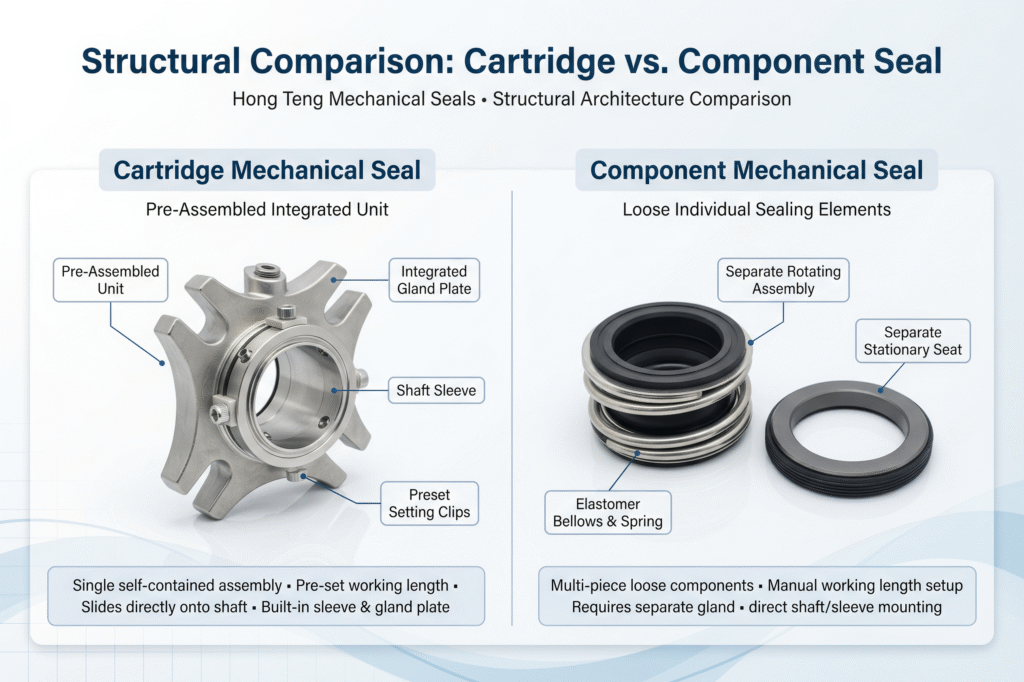
The core difference comes down to assembly and installation geometry. A component mechanical seal arrives as separate parts—such as the rotating assembly, stationary seat, springs or bellows, and secondary O-rings—that a technician must measure, position, and assemble directly onto the pump shaft and housing. A cartridge mechanical seal integrates those same sealing elements onto its own shaft sleeve and gland plate, held at the preset working length by removable setting clips so it slides onto the pump as a single unit.
Choosing between a cartridge seal vs component seal depends on your installation environment, maintenance labor skills, downtime sensitivity, pump chamber geometry, and budget. This guide breaks down the structural differences, cost trade-offs, and practical selection criteria so you can specify the right option for your equipment.
What Is a Component Mechanical Seal vs. a Cartridge Mechanical Seal?
Both designs rely on the same fundamental sealing principle: a precision-lapped rotating face runs against a stationary mating face across a microscopic lubricating fluid film, while secondary sealing elements block leakage along the shaft and housing. As outlined by the Fluid Sealing Association (FSA), every mechanical seal combines primary sealing faces, dynamic and static secondary seals, drive elements, and load elements (springs or bellows).
It is important not to confuse packaging format (cartridge vs. component) with internal seal engineering. Both cartridge and component seals can be manufactured in single or double (dual) arrangements, balanced or unbalanced hydraulic designs, pusher (sliding O-ring/wedge) or non-pusher (elastomer or metal bellows) constructions, and single-spring or multiple-spring configurations. The real distinction lies in how adaptive hardware is packaged.
Component Mechanical Seal Structure
A component mechanical seal (often called a conventional mechanical seal) supplies the core sealing parts individually without an integrated sleeve or pre-fitted gland plate:
- Rotating assembly: Primary face, spring or bellows loading element, retainer, drive mechanism (set screws, pins, or friction drive), and dynamic secondary seal.
- Stationary seat: Mating face with its static O-ring, cup, or gasket, which installs separately into the pump’s existing gland plate or seal housing bore.
- Existing pump hardware: The seal relies directly on the pump’s original shaft (or separate pump sleeve) and existing gland plate. The technician manually establishes the seal’s working length (spring compression) during pump seal installation.
Cartridge Mechanical Seal Structure
A pre-assembled cartridge seal packages the sealing elements together with dedicated adaptive hardware into one self-contained unit:
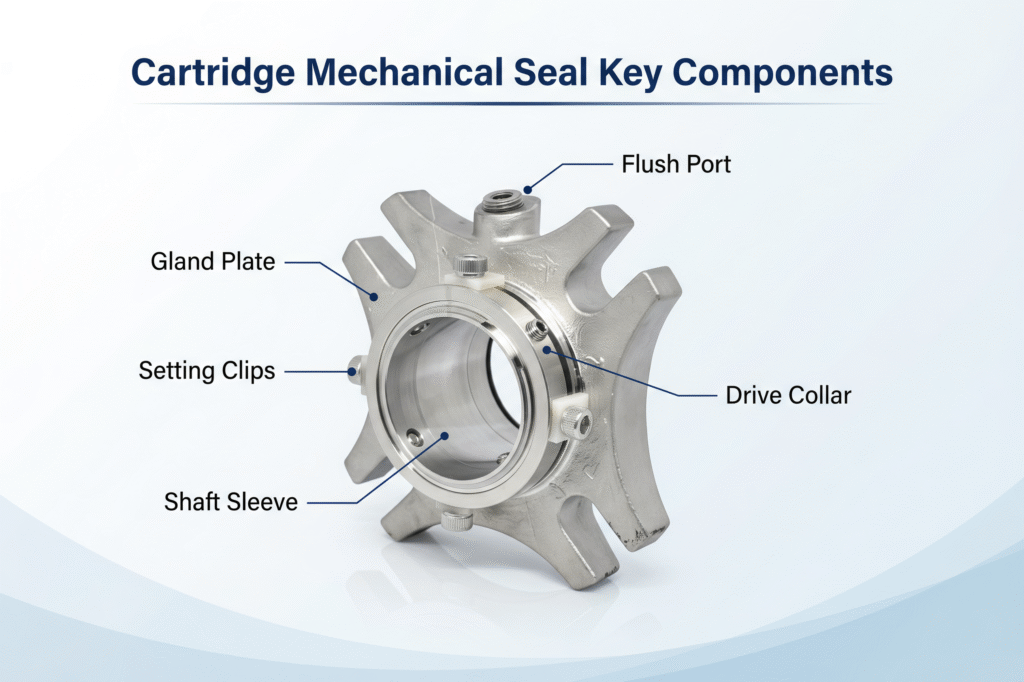
- Shaft sleeve: A dedicated shaft sleeve mechanical seal component carries the rotating assembly and slides over the pump shaft, sealed statically to the shaft by an O-ring or gasket. This also protects the underlying pump shaft from fretting or set-screw damage.
- Gland plate: The stationary seat is pre-installed inside a matched gland plate with built-in flush, quench, drain, or barrier-fluid ports as required by the seal arrangement.
- Drive collar: An external collar locks the cartridge sleeve to the pump shaft once the pump rotor is in its final axial position.
- Setting clips (centering tabs): Removable spacers hold the rotating and stationary components concentrically aligned and locked at the factory-preset working length until final bolt-up is complete.
Cartridge Seal vs Mechanical Seal: Side-by-Side Comparison
Comparing a cartridge mechanical seal vs conventional mechanical seal side by side highlights where each design delivers value and where trade-offs appear.
| Comparison Factor | Cartridge Mechanical Seal | Component Mechanical Seal |
| Structure & Assembly | Pre-assembled unit integrating faces, secondary seals, shaft sleeve, gland plate, drive collar, and setting clips. | Separate rotating assembly and stationary seat installed onto the pump’s existing shaft/sleeve and housing. |
| Installation Difficulty | Lower; slides onto the shaft as one unit with no manual working-length measurement required. | Higher; requires manual measurement of working length, careful face handling, and precise seating inside the seal chamber. |
| Axial Positioning Error Risk | Low, provided setting clips remain engaged until the gland is tightened and the rotor is positioned. | Moderate to high; slight errors in spring compression or seat alignment can cause premature face wear or leakage. |
| Initial Purchase Cost | Higher upfront unit price due to included sleeve, gland plate, and pre-assembly hardware. | Lower upfront unit price, making it economical for basic stock replenishment and budget-sensitive repairs. |
| Downtime & Maintenance Cost | Lower during repeat replacements; faster changeout and fewer installation-induced startup failures. | Potentially higher in critical processes if field installation takes longer or requires rework after startup leakage. |
| Typical Operating Conditions & Applications | Industrial process pumps, chemical transfer, wastewater, high-uptime utilities, and dual-seal upgrades where space allows. | Standard water pumps, HVAC circulation pumps, OEM-specific compact pumps, and budget-conscious general utility services. |
Key Factors When Choosing Between Cartridge and Component Seals
Evaluating cartridge seal vs mechanical seal performance requires looking beyond catalog pricing to how the seal will actually be installed, operated, and maintained at your facility.
Installation & Alignment
Installation accuracy is one of the most frequent drivers of premature seal failure. With a component seal, technicians must work inside tight seal chambers, slide elastomers past shaft shoulders or keyways, and manually set axial spring compression. As noted in technical guidance from Pumps & Systems, improper seating or incorrect spring tension during field assembly is a leading cause of early component seal leakage.
A cartridge seal reduces field-setting errors because the faces are already seated and protected inside the pre-assembled sleeve and gland. Setting clips preserve the internal working length until the gland bolts and drive collar are secured. However, a cartridge seal is not a cure for mechanical pump defects—excessive shaft runout, worn bearings, or incorrect clip removal sequence will still damage the faces. For detailed step-by-step field precautions, review our cartridge seal installation guide.
Initial Cost vs. Total Cost of Ownership
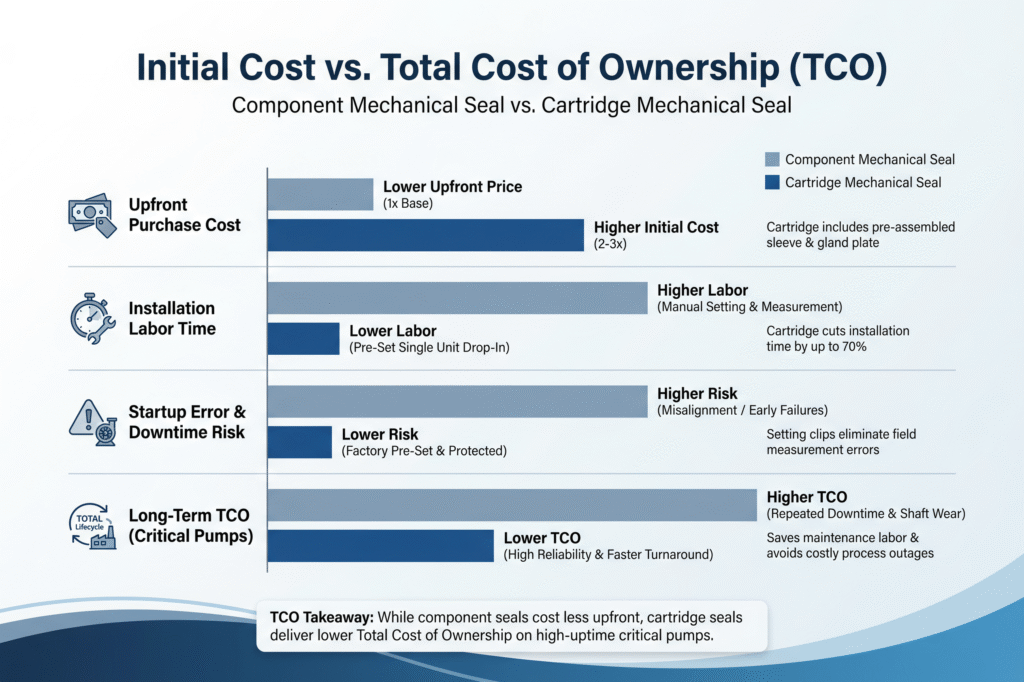
From a pure purchase-order standpoint, a cartridge seal typically costs significantly more upfront than an equivalent component seal—often two to three times as much depending on shaft size, metallurgy, and whether it is a single cartridge mechanical seal or a dual assembly.
When evaluating true mechanical seal replacement cost, however, procurement and reliability teams should factor in Total Cost of Ownership (TCO):
- Maintenance labor hours: Faster installation reduces wrench time during planned turnarounds and emergency outages.
- Unplanned downtime: In continuous chemical, power, or municipal water plants, a single installation error on a component seal can cost far more in lost production than the price difference of a cartridge unit.
- Shaft protection: Because the cartridge’s rotating seal rides on its own replaceable sleeve, the pump shaft itself is shielded from dynamic O-ring fretting and set-screw scoring.
On non-critical, easily accessible standby pumps serviced by experienced technicians, a component seal often remains the lowest-TCO choice. On critical or hard-to-service process pumps, cartridge seals frequently pay back their higher initial price over one or two maintenance cycles.
Space Constraints & Retrofit Compatibility
Not every pump can accept a cartridge mechanical seal without modification. Before upgrading from a component seal to a cartridge design, verify the pump’s physical geometry:
- Seal chamber envelope: Cartridge seals require sufficient radial clearance around the shaft and axial room between the seal chamber face and the bearing housing to accommodate the external gland plate and drive collar.
- Wet-side vs. dry-side access: Pumps whose seals install from the wet side (behind the impeller), including many compact OEM water pumps and standard submersible pumps built for component seals, generally cannot be retrofitted with universal external cartridge seals unless a pump-specific cartridge replacement exists.
- Impeller adjustment: On pumps with semi-open impellers that require periodic axial impeller clearance adjustments, cartridge seals with reusable setting clips allow technicians to reset seal tension externally without full pump disassembly.
- Packing-to-seal conversions: When converting an older gland-packed pump to a mechanical seal, a cartridge seal often simplifies the retrofit by replacing the packing gland follower directly on the existing stud pattern.
Maintenance & Spare Parts Availability
Spare parts standardization directly impacts inventory budgets and emergency response times. Component mechanical seals are widely standardized across standard centrifugal, multistage, and general utility pumps, making it straightforward to keep common shaft sizes and face/elastomer combinations on the shelf for rapid dispatch.
Cartridge seals—especially dual cartridge assemblies or pump-specific replacement cartridges—require careful verification of gland bolt patterns, sleeve bores, axial step lengths, and flush port orientations before ordering. Regardless of which type you run, confirming the pump nameplate, old seal geometry, and stationary seat dimensions prevents costly ordering errors. If you are matching an existing unit, follow our step-by-step guide on how to identify the correct mechanical seal for a pump.
When to Choose a Cartridge Seal vs. a Component Seal
Use the practical decision checklist below to match the seal format to your application.
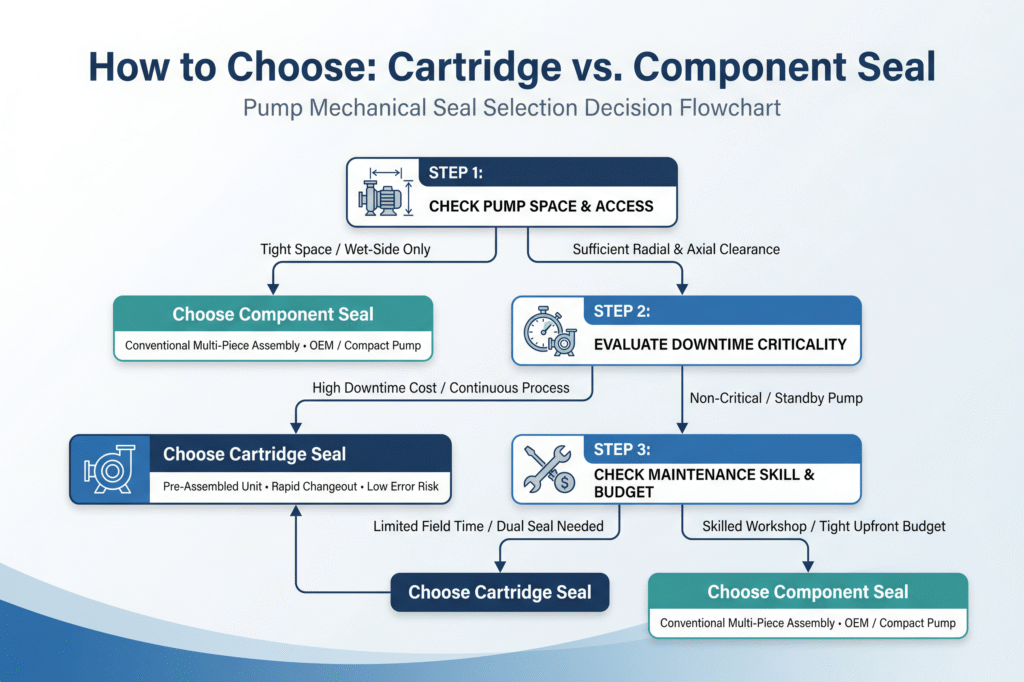
Choose a Cartridge Mechanical Seal When:
- Downtime is expensive: The pump runs in continuous or critical service where rapid, repeatable changeout minimizes production loss.
- Field installation conditions are challenging: Maintenance must be performed in tight, poorly lit, or high-pressure outage conditions where manual working-length setup increases error risk.
- You need a dual seal upgrade: Fitting a dual (double) cartridge seal for hazardous, abrasive, or high-temperature media is typically far more practical than engineering a dual component seal into an existing chamber.
- Frequent impeller adjustments are required: Semi-open impeller pumps benefit from external drive-collar unlocking and reusable setting clips.
- Converting from gland packing: A cartridge unit streamlines the transition from braided packing to a mechanical seal while protecting the shaft with a dedicated sleeve.
To explore single, double, and pump-specific pre-assembled options, browse our cartridge mechanical seal range.
Choose a Component Mechanical Seal When:
- Initial budget is the primary constraint: Standard utility, clean water, HVAC, or standby pumps where lower unit purchase cost is prioritized.
- Pump space is tightly restricted: Compact OEM pumps, close-coupled end-suction pumps, or wet-side-installed designs that lack radial or axial clearance for a cartridge gland.
- Skilled technicians handle repairs in a workshop: Controlled overhaul environments where experienced mechanics can accurately measure working length and seat stationary faces.
- High-volume standardized fleets: Facilities running large numbers of identical standard pumps where economical component spare kits are already stocked and familiar to the crew.
For general centrifugal, water, and process pump replacements across common shaft sizes, explore our pump mechanical seal catalog.
Frequently Asked Questions (FAQ)
1. Is a cartridge seal a type of mechanical seal?
Yes. A cartridge seal is a mechanical seal whose rotating and stationary sealing elements are pre-assembled onto a shaft sleeve and gland plate. In everyday maintenance discussions, “mechanical seal” is often used informally to refer to a traditional multi-piece component mechanical seal when comparing the two styles.
2. Can I replace a component mechanical seal with a cartridge seal on any pump?
No. Upgrading from a component seal to a cartridge seal depends on available radial bore clearance, axial distance between the seal chamber and bearing frame, gland bolt circle dimensions, and whether the seal installs from the dry side. Always verify dimensional drawings against the pump chamber before ordering a retrofit cartridge.
3. Why do cartridge mechanical seals cost more upfront than component seals?
A cartridge seal includes precision-machined adaptive hardware—specifically a shaft sleeve, gland plate, drive collar, and setting clips—in addition to the seal faces, springs/bellows, and elastomers, plus factory pre-assembly. While the purchase price is higher, total lifecycle cost can be lower in critical pumps due to faster installation and fewer setup errors.
4. Does a cartridge seal eliminate all installation failures?
No. A cartridge seal eliminates manual working-length measurement and reduces face-handling mistakes, but it cannot compensate for mechanical pump issues such as excessive shaft runout, worn bearings, misaligned couplings, dry running, or improper flush piping. Technicians must also follow the exact tightening and clip-removal sequence.
5. What should I check before ordering a replacement cartridge or component seal?
Never order based on shaft diameter alone. Confirm the full pump brand and model, shaft or sleeve diameter, seal chamber bore and depth, bolt pattern (for cartridge glands), stationary seat dimensions (for component seals), and full operating conditions including pumped fluid, temperature, pressure, and shaft speed.
Need Help Selecting or Sourcing the Right Replacement Pump Seal?
Whether your facility runs standardized component seals or pre-assembled cartridge units, selecting the right replacement starts with accurate matching and reliable supply. Hong Teng supports overseas maintenance teams, pump repair workshops, and distributors with a broad inventory of ready-to-ship mechanical seals, extensive replacement models for major industrial pumps, and dedicated technical selection support.
To get fast cross-referencing and a quotation, share your pump brand and model, shaft diameter, pumped medium, operating temperature, and pressure (along with photos or dimensions of the removed seal if available). Contact the Hong Teng team today to confirm stock availability and find the right sealing solution for your equipment.