A mechanical seal face is one of the most important working surfaces inside a pump mechanical seal. The rotating and stationary faces run against each other with a very thin fluid film between them, creating the primary sealing interface between the rotating shaft and stationary pump casing.
When a mechanical seal begins to leak, the condition of these faces can provide valuable evidence. Scratches, chips, cracks, deposits, heat marks and uneven wear may help maintenance teams determine whether the problem came from contamination, poor lubrication, installation damage, shaft movement or another operating condition.
This guide explains how mechanical seal faces work, what normal face contact may look like, how common wear patterns develop and what to inspect after removing a failed seal from a pump.
What Is a Mechanical Seal Face?
A mechanical seal normally has two precision mating surfaces that form its primary sealing interface. These are commonly called the rotating seal face and stationary seal face.
One face rotates with the shaft or sleeve, while the other remains stationary in the pump housing or seal gland. Springs and hydraulic forces help maintain controlled closing force between the two surfaces.
Although the faces appear to contact each other, a correctly operating liquid-service seal is not simply two dry surfaces rubbing together. A microscopic fluid film at the interface plays an important role in lubrication and heat removal.
Manufacturers commonly produce mechanical seal faces from carbon, ceramic, silicon carbide, tungsten carbide and other engineered materials. However, face material should not be selected from hardness alone. Fluid properties, solids, temperature, pressure, speed, lubrication and seal design all matter.
For more information about choosing face and secondary seal materials for different services, see our Mechanical Seal Material Selection Guide.
Rotating vs Stationary Seal Face
The two mechanical seal faces perform the same basic sealing function but operate differently inside the seal assembly.
The rotating seal face rotates with the shaft or sleeve. During inspection, check its running track for scoring, cracks, chips, deposits and signs of uneven contact.
The stationary seal face remains fixed in the gland, housing or stationary-seat position. Inspect its running surface as well as its seating condition, edges and surrounding deposits.
The exact construction depends on the mechanical seal design. The appearance of a component alone should therefore not be used to determine its function. For failure analysis, it is more useful to identify which component rotates and which remains stationary.
Both mechanical seal faces should also be inspected as a mating pair. Damage found on one face may correspond with marks on the other.
How Two Mechanical Seal Faces Create a Seal
The sealing interface must perform two seemingly opposite tasks: restrict process-fluid leakage while allowing one surface to rotate against another.
When the pump operates, closing forces keep the faces together while a very thin fluid film can develop between them. This interface controls leakage while helping reduce direct friction between the mating surfaces.
The condition of this interface depends on more than the faces themselves.
Face flatness, surface condition, spring loading, hydraulic loading, shaft stability, fluid properties, contamination and operating conditions can all influence how the faces run.
This is why replacing visibly damaged seal faces without investigating the pump may not solve a repeated mechanical seal problem.
Why a Microscopic Fluid Film Matters
The very thin fluid film between the rotating and stationary seal faces plays an important role in controlling friction, heat and face wear.
It helps lubricate the sliding interface and carry heat away from the faces. If that film becomes unstable or disappears, friction and local heating can increase. Conversely, contamination or solids entering the interface can disturb the film and damage the precision surfaces.
Conditions that can affect face lubrication include:
- Dry starting or insufficient liquid at the seal
- Loss of prime
- Air or gas entering the seal chamber
- Fluid flashing or vaporizing near the faces
- Poor circulation around the seal
- Suspended abrasive particles
- Deposits or crystallized product
- Unstable pump operation
For this reason, a damaged mechanical seal face should not automatically be interpreted as a defective face material.
The operating environment around the faces should also be investigated.
What Does a Normal Seal Face Wear Track Look Like?
When evaluating mechanical seal face contact patterns, technicians should compare the complete 360-degree running track rather than judging the face from one isolated mark.
A used mechanical seal face will not necessarily look identical to a new one.
A visible running or wear track can develop where the two mating surfaces operate together. Its presence alone does not necessarily indicate a failure.
During inspection, look for a relatively consistent circumferential contact pattern without obvious deep scratches, severe localized damage, broken edges or major differences in wear around the circumference.
The important questions are:
- Is the wear track reasonably uniform?
- Is it centered where expected?
- Is one part of the circumference more heavily worn?
- Are there deep grooves or scratches?
- Are there cracks or chips?
- Are deposits concentrated in a particular area?
- Does the mating face show a corresponding pattern?
A wear track alone does not prove that a mechanical seal has failed. Its shape, position and uniformity often provide more useful information than simply whether a polished or discolored ring is visible.
Photograph both faces immediately after disassembly and before cleaning them. Cleaning can remove deposits and other evidence that may help diagnose the failure.
Common Mechanical Seal Face Wear Patterns
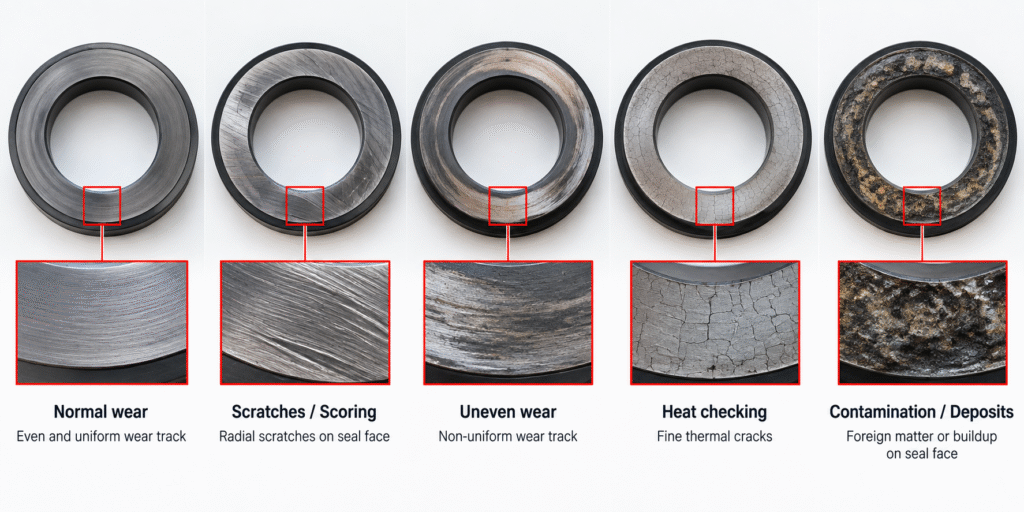
Different seal face wear patterns can provide clues about what happened inside the pump.
However, a wear pattern should be treated as diagnostic evidence rather than proof of one specific failure mechanism.
Scratches and Scoring
Fine scratches or deeper circumferential grooves may indicate that particles entered the interface between the mechanical seal faces.
Possible sources include process solids, corrosion products, dirt introduced during assembly, crystallized material or contamination circulating through the pump.
When scoring is found, inspect both mating surfaces.
A hard particle trapped between the faces can mark one or both surfaces. Also inspect the surrounding seal chamber for deposits or debris instead of replacing only the damaged ring.
Chipping
Small pieces missing from the edge of a seal face can result from impact, improper handling, difficult installation or mechanical contact.
Chipping found on a newly installed mechanical seal should prompt a review of installation and handling practices.
Some hard face materials can be relatively brittle and should therefore be protected from impact during storage, handling and assembly.
A visibly damaged face should not be installed simply because most of its running surface still appears intact.
Cracking
A cracked mechanical seal face should be investigated carefully.
Cracking may be associated with thermal stress, mechanical stress, impact, incorrect assembly or abnormal operating conditions.
Record where the crack begins and how it travels through the face.
Also inspect the mating component, drive features, stationary seat mounting and surrounding components for evidence of distortion or impact.
A crack should not automatically be attributed to “bad material” without checking how the seal was installed and operated.
Heat Checking / Thermal Damage
Fine surface cracks, glazing, discoloration or other heat-related changes may indicate that the faces experienced abnormal thermal conditions.
Possible contributors include inadequate lubrication, dry running, interrupted fluid supply, vapor formation, excessive face loading or unstable operation.
If thermal damage is suspected, investigate what happened before the leak began.
Startup conditions can be particularly important because a seal may experience poor lubrication before stable pump operation is established.
Uneven Wear
A wear track that is noticeably heavier on one part of the circumference can suggest that the faces were not operating in a stable, square relationship.
Possible contributors include:
- Shaft runout
- Misalignment
- Bearing condition
- Vibration
- Incorrect stationary seat installation
- Distortion
- Other abnormal mechanical movement
Repeated uneven mechanical seal face wear is therefore a reason to inspect the pump rather than simply installing another seal.
For further troubleshooting, see our Shaft Runout and Misalignment guide.
Deposits and Contamination
Deposits may appear as scale, crystallized product, sludge or other material attached to the seal faces and surrounding components.
These deposits can interfere with the fluid film or prevent seal components from moving freely. They may also hold abrasive particles close to the running interface.
Before cleaning a failed mechanical seal, photograph the deposits and record their location.
The location and appearance of the contamination may provide useful information about conditions inside the seal chamber.
What Causes Mechanical Seal Face Damage?
Mechanical seal face damage is often the result of interacting conditions rather than one isolated cause.
Common areas to investigate include:
Poor lubrication
Dry running, loss of prime or inadequate liquid around the sealing interface can interfere with lubrication and heat removal.
Contamination
Solids, dirt, corrosion products or crystallized process material can enter the interface and scratch or disturb the faces.
Mechanical movement
Shaft runout, misalignment, vibration or worn bearings may prevent the faces from maintaining stable contact.
Installation damage
Precision faces can be damaged by poor handling, contamination, incorrect seat installation or incorrect seal setting.
Thermal conditions
Loss of lubrication, vapor formation or unstable operating conditions may create abnormal heating at the sealing interface.
Incorrect seal selection
The seal design, dimensions or materials may not match the actual pump and service conditions.
Process changes
Changes in fluid, solids, operating conditions, cleaning procedures or startup sequences can affect a seal that previously operated normally.
If a newly installed seal begins leaking immediately or shortly after startup, see Mechanical Seal Leaking After Installation for a systematic installation and startup troubleshooting process.
How to Inspect Mechanical Seal Faces After Removal
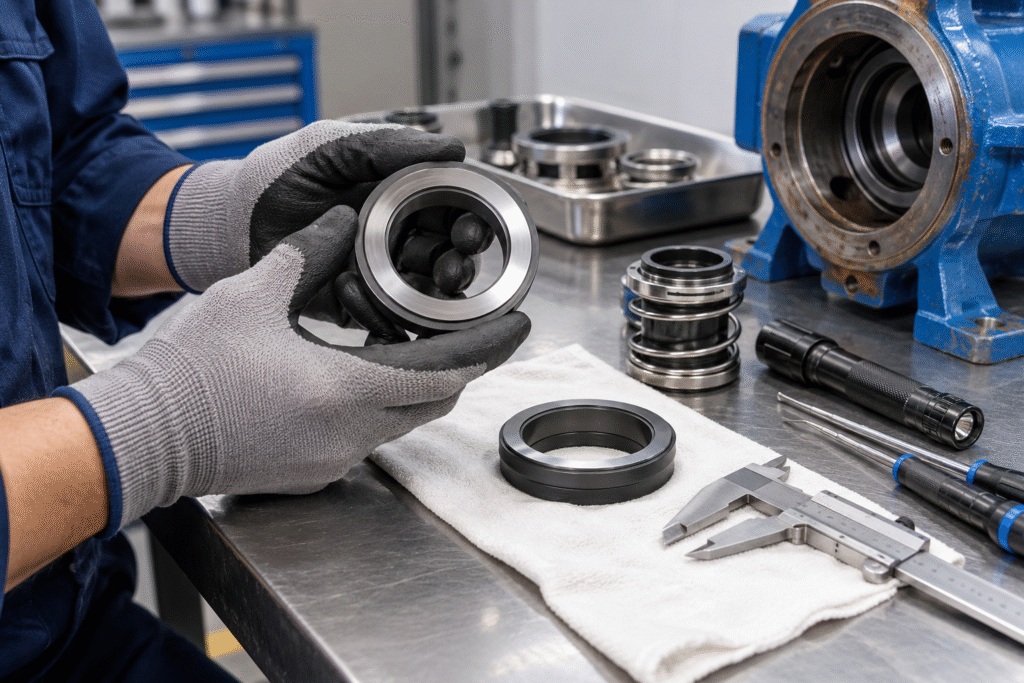
A failed mechanical seal should be treated as evidence.
Do not immediately clean the components or throw damaged parts away.
A practical inspection can follow these steps.
Document the Seal Before Cleaning
1. Photograph the seal as removed
Take photographs of the complete mechanical seal, rotating assembly, stationary seat, faces, elastomers and visible deposits before cleaning anything.
2. Keep the mating faces together
Do not mix the rotating and stationary faces with components removed from another pump.
Keeping the original pair together makes comparison much easier.
3. Identify the rotating and stationary face
Record which component rotated with the shaft and which remained stationary.
If possible, also record their original orientation.
Inspect the Mechanical Seal Face Wear Pattern
4. Inspect the wear track
Look at the width, position and consistency of the running track around the entire circumference.
A localized or uneven track may provide important diagnostic information.
5. Check for scratches and scoring
Record whether marks are light or deep and whether they are radial, circumferential or concentrated in one location.
Do not simply record “face scratched.”
The pattern is often more useful than the presence of a scratch alone.
6. Inspect the edges
Look for chips, impact marks and broken sections around the face.
Also consider whether the damage could have occurred during removal.
7. Look for cracks or thermal evidence
Check for fine cracking, glazing, unusual discoloration or other surface changes.
Photograph unusual patterns at close range.
8. Record deposits before removing them
Do not immediately wipe deposits away.
Record their color, texture and location because they may provide information about contamination or process buildup.
9. Compare both mechanical seal faces
A mark on the rotating face may correspond with damage on the stationary face.
Looking at only one component can therefore give an incomplete picture.
10. Inspect the rest of the mechanical seal
The faces should not be analyzed in isolation.
Inspect springs, drive features, elastomers, retainers and the stationary seat mounting condition.
Check the Pump and Operating History
11. Check the pump when necessary
Repeated uneven wear should lead to inspection of shaft runout, alignment, bearings, vibration and other pump conditions.
12. Compare the findings with operating history
Ask what happened immediately before the leak began.
Was there a dry start?
Did the pump lose prime?
Was there a process upset?
Was maintenance recently performed?
Did the pumped fluid or operating condition change?
This information can make the physical evidence on the seal faces much more meaningful.
For critical equipment or formal root-cause analysis, visual inspection alone may not be sufficient. Face flatness, pump geometry and other conditions may require appropriate measurement procedures or manufacturer guidance.
When Should Mechanical Seal Faces Be Replaced?
Mechanical seal faces should not be judged only by whether they look shiny or dull.
Replacement is generally appropriate when inspection finds damage that could compromise the sealing interface, such as significant cracking, chipping, deep scoring or other deterioration that prevents the mating surfaces from operating correctly.
However, replacing damaged faces addresses the damaged components—not necessarily the reason they became damaged.
If the same pump repeatedly damages mechanical seals, investigate the pump, installation and operating conditions before installing another replacement.
Otherwise, new mechanical seal faces may eventually develop the same wear pattern.
When the complete mechanical seal needs to be changed and the correct replacement is uncertain, use our Mechanical Seal Selection Guide to confirm pump information, dimensions, operating conditions and replacement configuration.
For applications where the face material itself may be unsuitable, refer separately to the Mechanical Seal Material Selection Guide rather than selecting a material based only on the appearance of the failed face.
What Information Should Be Recorded After a Seal Failure?
Good failure records can make future troubleshooting much easier.
For each mechanical seal failure, consider recording:
Pump identification
- Pump manufacturer
- Pump model
- Equipment number
- Service location
Mechanical seal identification
- Seal type
- Seal dimensions
- Part number, if known
- Original seal manufacturer, if known
Seal face condition
- Wear track
- Scratches
- Scoring
- Chips
- Cracks
- Deposits
- Discoloration
- Uneven wear
Rotating vs stationary face
- Which face contains each damage pattern
- Whether corresponding marks appear on the mating face
Process fluid
- Actual pumped fluid
- Known solids
- Contaminants
- Process changes
Operating history
- Startup or shutdown event
- Loss of prime
- Process upset
- Unusual noise or vibration
- Other abnormal events
Pump condition
- Observed vibration
- Shaft movement
- Bearing condition
- Alignment concerns
Installation history
- Installation date
- Previous repair
- Recent maintenance work
Photographs
- Complete seal before cleaning
- Rotating face
- Stationary face
- Deposits
- Damaged components
- Surrounding pump components where relevant
Over time, these records can reveal repeated patterns.
For example, similar uneven wear across several replacement seals may justify closer investigation of the shaft and pump condition rather than another change of mechanical seal faces.
Mechanical Seal Face FAQ
Should mechanical seal faces be completely dry when running?
In typical liquid-service mechanical seals, the interface relies on a very thin fluid film for lubrication and heat management.
Running without adequate liquid can increase friction and thermal stress.
The exact behavior depends on the mechanical seal design and application, so a seal should not be assumed to tolerate dry running unless it was specifically designed and approved for that service.
Can I reuse a mechanical seal face if it still looks smooth?
Visual smoothness alone does not confirm that a used face is suitable for reuse.
Flatness, surface condition, hidden damage, mating-face condition and the reason the mechanical seal was removed all matter.
For critical equipment, follow the seal manufacturer’s inspection or refurbishment criteria rather than judging a face only by appearance.
Why does a new mechanical seal face leak immediately?
Immediate leakage can result from contamination on the faces, installation damage, an incorrectly seated stationary ring, incorrect seal setting, damaged secondary seals or pump-related problems.
If a new mechanical seal leaks immediately after installation, inspect the complete installation before assuming that the new face itself is defective.
Can I touch mechanical seal faces during installation?
Precision sealing surfaces should be kept clean and protected during handling.
Fingerprints, dirt, fibers and other contamination can interfere with the sealing interface.
Follow the seal manufacturer’s installation instructions and avoid unnecessary contact with the running surfaces.
Why does one side of a mechanical seal face wear more than the other?
Uneven circumferential wear can indicate that the mating faces are not maintaining a stable, square relationship during operation.
Shaft runout, misalignment, vibration, bearing problems, stationary seat installation and distortion are among the conditions worth investigating.
Do scratches on a mechanical seal face always mean contamination?
No.
Contamination and abrasive particles are common causes of scoring, but a scratch alone does not prove the source of the problem.
The direction and location of the scratches, condition of the mating face, surrounding deposits and pump operating history should all be considered.
Can mechanical seal faces be polished and reused?
Some mechanical seal faces may be professionally reconditioned or lapped, depending on their design, material and condition.
This should not be treated as a simple workshop polishing operation.
The sealing surfaces require appropriate flatness and surface condition, so reuse or refurbishment should follow suitable inspection and repair procedures.
Should I replace only the damaged seal face or the complete mechanical seal?
That depends on the seal design, extent of damage, condition of the remaining components and repair procedure.
More importantly, determine why the face was damaged before returning the pump to service.
Replacing a damaged component without correcting contamination, runout, dry running, installation errors or another root cause can result in the same failure happening again.
Final Inspection Principle
A mechanical seal face is more than a replaceable wear component. After a seal failure, it can also provide evidence about what was happening inside the pump.
The most useful inspection does not stop at asking:
“Is the face damaged?”
It asks:
“What does the wear pattern tell us about how the seal was operating?”
Inspect the rotating and stationary faces together, document their condition before cleaning, compare the wear pattern with the pump and operating history, and investigate repeated damage beyond the seal itself.
When the issue involves choosing the correct replacement seal, use the Mechanical Seal Selection Guide. When the issue involves selecting suitable face and elastomer materials, refer to the Mechanical Seal Material Selection Guide.
Keeping these topics separate makes troubleshooting more systematic and helps avoid replacing mechanical seal faces without addressing the actual cause of failure.