CNP CDLF and CHL pump mechanical seal selection should begin with the complete pump model, not only the seal appearance or shaft diameter. CDLF and CHL pumps are both multistage centrifugal pumps. However, their orientation, shaft arrangement, seal chamber, stationary seat, and installation length can differ.
Therefore, a seal that fits a CDLF pump may not fit a CHL pump. Buyers should compare the pump nameplate, old seal components, dimensions, materials, and operating conditions. You can also review our CNP pump mechanical seal range when checking available replacement designs.
This guide explains how to distinguish the two pump families and select a suitable replacement seal without relying on one reference alone.
Quick Answer: How Do You Select the Correct CNP Pump Seal?
First, confirm whether the pump belongs to the CDLF vertical range or the CHL horizontal range. Next, record the complete model, serial number, motor power, production version, and pumped liquid.
Then remove and inspect both the rotating seal assembly and stationary seat. Measure the shaft or sleeve diameter, seat diameter, working length, and other critical dimensions.
Finally, confirm the face materials, elastomer, metal components, and installation direction. Do not order a seal only because its catalog name includes CDLF or CHL.
CDLF vs CHL: Main Pump Differences
The pump arrangement directly affects the mechanical seal design. CDLF pumps use a vertical layout, while CHL pumps use a horizontal layout.
The main differences are:
| Selection Point | CNP CDLF Pump | CNP CHL Pump |
|---|---|---|
| Pump orientation | Vertical | Horizontal |
| Pump construction | Vertical multistage pump with a separate standard motor and coupling | Compact horizontal multistage pump with a long-shaft motor |
| Inlet and outlet arrangement | Normally located at the pump base | Axial inlet and radial outlet |
| Seal service position | Near the pump head and coupling area | Between the hydraulic assembly and motor |
| Main selection risk | Confusing pump hydraulic size with seal shaft size | Assuming similar CHL, CHLF, and related versions use the same seal |
| Replacement check | Pump model, shaft size, seat, working length, and production version | Pump model, shaft size, seat profile, seal housing, and production version |
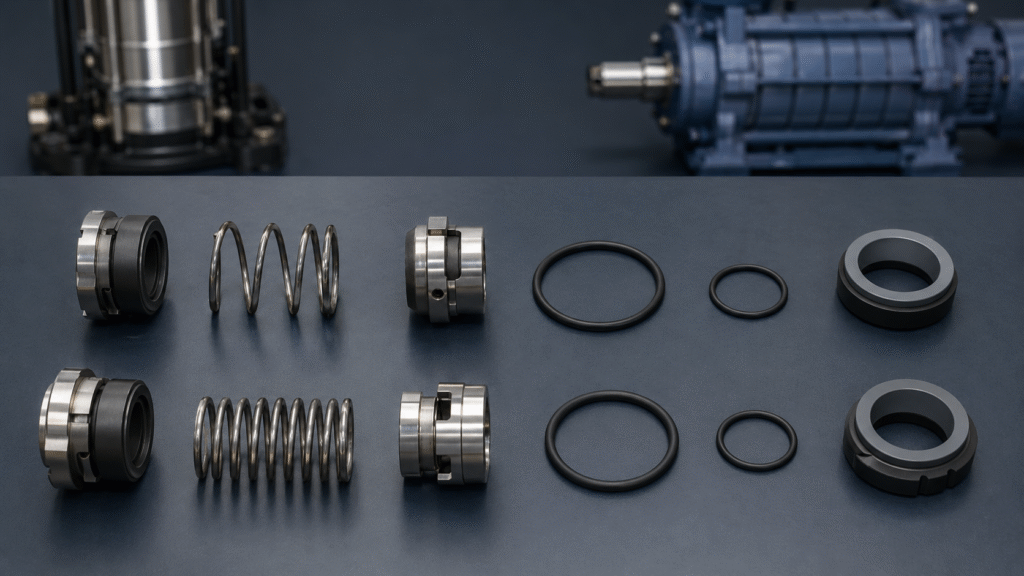
Although both families may pump clean water and mildly corrosive liquids, their seals are not automatically interchangeable.
In addition, replacement suppliers may use CDLA-style references for some CDLF seals and NDA, NDB, or CHL references for some CHL seals. These names can help catalog identification. Nevertheless, they do not replace physical and application checks.
Understand the CNP CDLF Pump Family
The official CNP CDL/CDLF pump page describes CDLF as a vertical, non-self-priming multistage centrifugal pump. A standard motor drives the pump through a coupling. The inlet and outlet are normally positioned at the pump base.
This vertical construction determines how the seal fits around the shaft and inside the pump head. It also affects the stationary seat, rotating assembly, seal chamber, and service procedure.
The official family covers a wide operating range. However, this does not mean every CDLF size uses the same mechanical seal. Different hydraulic sizes, motor powers, shafts, and production versions may require different seal dimensions.
When comparing replacements, review our CDLF vertical multistage pump mechanical seal. Available CDLA-style replacement sizes may include several shaft diameters. Therefore, confirm which version matches the actual pump before ordering.
Understand the CNP CHL Pump Family
The official CNP CHL/CHLF(T) product page describes this range as horizontal, non-self-priming multistage centrifugal pumps. The design uses a long-shaft motor, an axial inlet, and a radial outlet.
This compact layout creates a different seal installation environment from a vertical CDLF pump. The rotating assembly, stationary seat, spring design, and seal housing must match the horizontal pump construction.
CHL, CHLF, and CHLF(T) references may also represent different hydraulic or connection configurations. Moreover, production revisions can affect the installed seal.
Our CHL and CHLF replacement mechanical seal provides a product reference for selected pumps in this family. Nevertheless, the complete pump model, old seal, and dimensions must support the final selection.
Why the Pump Model Is Not Enough
A complete pump model is an important starting point. However, it may not identify every mechanical seal detail.
One pump family can include:
- Different nominal flow sizes
- Different numbers of stages
- Different motor powers
- Single-phase or three-phase motors
- Regional voltage and frequency versions
- Different shaft or sleeve diameters
- Old and new production designs
- Different seal materials
- Special versions for temperature or chemical service
- Previous repairs or modified components
The numbers in a pump model often describe hydraulic capacity and stage configuration. They should not be treated automatically as the mechanical seal shaft diameter.
For example, a number in a CDLF or CHL model may look similar to a common seal size. That similarity does not prove compatibility. Always compare the actual seal bore and shaft dimensions.
Information to Read from the Pump Nameplate
Photograph the complete nameplate before dismantling the pump. The photograph should be sharp enough to read every number and suffix.
Record the following information:
- Pump manufacturer
- Complete pump series and model
- Product number
- Serial number
- Motor power
- Voltage
- Frequency
- Pump speed
- Manufacturing date or production code
- Any existing spare-part number
- Previous mechanical seal reference
Do not shorten the pump model. A missing letter, suffix, or stage number may point to a different pump version.
In addition, photograph the complete pump. The image should show whether the unit is vertical or horizontal and how the motor connects to the hydraulic assembly.
Inspect the Old Mechanical Seal
Keep every old component until the replacement has been confirmed. Even a worn or broken part may provide useful identification information.
A complete mechanical seal normally includes a rotating component and a stationary component. Depending on the design, it may also include a spring, metal retainer, O-rings, rubber cups, washers, and drive features.
Take photographs of:
- The seal before removal
- The complete seal after removal
- The front and back of the rotating component
- The front and back of the stationary seat
- The spring and metal retainer
- O-rings and rubber cups
- Drive pins, slots, tabs, or set screws
- Material or part-number markings
- The shaft or sleeve
- The empty seal chamber
- The position of each component during removal
Keep the CDLF and CHL components in separate groups. Moreover, do not mix parts from different pumps in one photograph.
Measure the Critical Seal Dimensions
Two seals can look almost identical but use different working lengths, stationary seats, or face dimensions. Therefore, measurement is necessary even when the pump model is available.
Record these dimensions:
- Shaft or shaft-sleeve diameter
- Rotating seal inside diameter
- Maximum rotating assembly outside diameter
- Rotating face inside diameter
- Rotating face outside diameter
- Rotating assembly free length
- Installed working length, when known
- Stationary seat outside diameter
- Stationary seat inside diameter
- Stationary seat thickness
- Rubber cup outside diameter
- Seal chamber or gland bore
- Distance to any shaft shoulder or retaining feature
Our step-by-step mechanical seal measurement guide explains how to collect the main dimensions. Measure each rigid component several times and state whether the readings use millimetres or inches.
Do not rely on swollen rubber, broken edges, or a compressed spring as the only reference. Instead, measure stable metal and hard-face surfaces whenever possible.
Choose Seal Face and Elastomer Materials
A dimensionally correct seal can still fail if its materials do not suit the liquid. Consequently, CNP CDLF and CHL pump mechanical seal selection must include the complete operating conditions.
A mechanical shaft seal selection handbook identifies temperature, pressure, speed, shaft dimensions, and pumped liquid as important selection factors. These factors should be reviewed together.
Common face combinations include:
- Carbon and ceramic for clean water and moderate operating conditions
- Carbon and silicon carbide for clean water and more demanding duties
- Silicon carbide and silicon carbide for abrasive particles, chemicals, or applications requiring hard faces
- Tungsten carbide combinations when strength and impact resistance are important
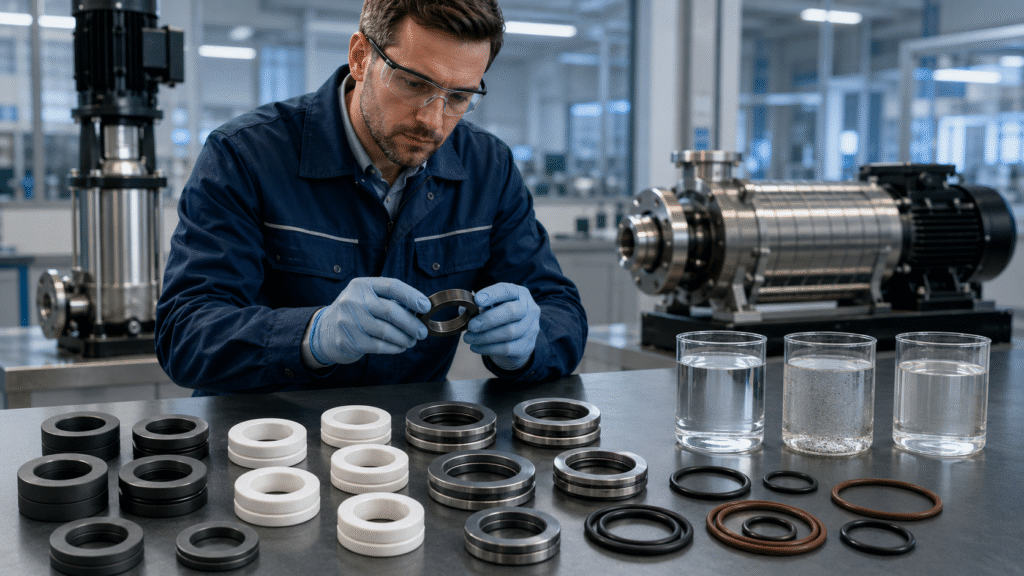
These are general guidelines rather than automatic specifications. A hard-face combination still needs adequate lubrication. In addition, tungsten carbide chemical resistance can depend on its binder grade.
The elastomer must also match the liquid:
- EPDM commonly suits water, hot water, and some mild chemicals, but it normally does not suit petroleum oils
- NBR can suit water and many oils within its temperature and chemical limits
- FKM offers good heat and oil resistance, but it is not compatible with every chemical
- PTFE may support more demanding chemical applications when the seal design allows it
Use our mechanical seal material selection guide to compare face and elastomer options in more detail. When chemicals are present, provide the exact liquid name, concentration, temperature, and cleaning process.
Select a Seal for a CNP CDLF Pump
Use the following process for a CDLF vertical multistage pump:
- Confirm that the complete nameplate begins with the correct CDLF family reference.
- Record the hydraulic size, stage configuration, motor power, serial number, and production code.
- Photograph the coupling, pump head, seal chamber, and old seal position.
- Measure the shaft or sleeve diameter.
- Measure the rotating assembly and stationary seat.
- Compare the free length and installed working length.
- Confirm the old spring, retainer, O-rings, and seat design.
- Check the pumped liquid, temperature, pressure, and operating schedule.
- Select suitable face and elastomer materials.
- Compare every detail with the replacement drawing or sample.
Do not select a CDLF seal from the nominal pump flow number alone. Furthermore, do not assume that two CDLF pumps with similar external dimensions use the same shaft seal.
Select a Seal for a CNP CHL Pump
Use a similar process for a CHL horizontal multistage pump:
- Confirm whether the nameplate shows CHL, CHLF, CHLF(T), or another related reference.
- Record the complete model, motor power, voltage, serial number, and production date.
- Photograph the horizontal hydraulic assembly and its connection to the motor.
- Photograph the old seal before separating its components.
- Measure the motor shaft or seal mounting diameter.
- Measure the stationary seat and its rubber or O-ring mounting arrangement.
- Record the rotating assembly length and spring design.
- Check for a shaft shoulder, drive feature, or installation-direction requirement.
- Confirm the liquid and operating conditions.
- Compare the complete assembly with the proposed replacement.
Do not assume that every seal advertised for CHL pumps fits every CHL, CHLF, or CHLF(T) version. A catalog reference must agree with the actual dimensions and construction.
CDLF and CHL Seal Selection Checklist
Before approving an order, confirm all the following details:
- Correct CNP pump family
- Complete pump model and suffix
- Serial number or production code
- Vertical or horizontal orientation
- Correct shaft or sleeve diameter
- Correct stationary seat diameter and thickness
- Correct rotating assembly length
- Correct installed working length
- Matching spring and drive design
- Matching installation direction
- Compatible seal-face materials
- Compatible elastomer
- Suitable metal components
- Correct temperature and pressure range
- Suitable conditions for the pumped liquid
- Confirmation from photographs, dimensions, or a sample
If one important detail conflicts with the others, stop the selection process. Investigate the difference before ordering.
Common CNP Mechanical Seal Selection Mistakes
Several mistakes can result in leakage or prevent installation:
- Treating CDLF and CHL seals as interchangeable
- Ordering from the pump family name alone
- Measuring only the shaft diameter
- Confusing pump model numbers with seal sizes
- Ignoring the stationary seat
- Mixing free length with working length
- Omitting the pump-model suffix
- Ignoring an old or new production revision
- Guessing face materials from color alone
- Selecting an elastomer without checking the liquid
- Reusing a damaged stationary seat
- Mixing parts from several pumps
- Installing the rotating assembly backwards
- Starting the pump before filling and venting it
In addition, a seal should not compensate for a worn shaft, damaged sleeve, loose bearing, or excessive vibration. Repair the underlying pump problem before installing the replacement.
Installation Checks Before Startup
Clean the shaft, sleeve, seal chamber, and O-ring grooves before installation. Remove deposits carefully without scratching the mounting surfaces.
Keep the lapped seal faces clean. A fingerprint, fiber, or small particle can disturb the lubricating film between the faces.
Use only a lubricant that is compatible with the elastomer and pumped liquid. Apply it to the required mounting surfaces rather than coating the lapped faces with grease.
Next, install the stationary seat evenly. Do not apply uneven pressure to ceramic or silicon carbide components because brittle faces may crack.
After assembly, check the coupling, bearings, shaft movement, and seal position. Prime and vent the pump according to the correct service procedure. Never allow a mechanical seal designed for liquid service to run dry.
Finally, monitor the pump during startup. Check for leakage, noise, vibration, abnormal temperature, and unstable motor current.
Frequently Asked Questions
Can the Same Mechanical Seal Fit Both CDLF and CHL Pumps?
Normally, you should not assume this. The two pump families use different orientations and shaft arrangements. The seal chamber, seat, working length, and drive design may also differ.
Is the Pump Model Enough to Order a Replacement?
Sometimes a complete model and serial number can identify the seal. However, photographs and dimensions provide important confirmation, especially for older or repaired pumps.
What Is the Most Important Seal Dimension?
The shaft or sleeve diameter is the first dimension to check. Nevertheless, the stationary seat, rotating assembly length, and installed working length are also critical.
Which Face Material Is Best for Clean Water?
Carbon against ceramic or silicon carbide often suits clean water. However, pressure, temperature, speed, water quality, and duty cycle must support the final choice.
Should I Replace the Stationary Seat with the Rotating Component?
Yes, replacing the seal as a matched set is normally safer. A used seat may contain wear tracks, scratches, or distortion that can damage the new rotating face.
What Information Should I Send to a Seal Supplier?
Send the complete pump nameplate, photographs of every seal component, all critical dimensions, the pumped liquid, temperature, pressure, and required quantity. Include an old sample when identification remains uncertain.
Final Selection Advice
CNP CDLF and CHL pump mechanical seal selection requires more than a pump family name or one shaft measurement. First, distinguish the vertical CDLF construction from the horizontal CHL construction. Then confirm the full model, production version, old seal design, stationary seat, dimensions, and materials.
Most selection errors occur when buyers rely on one clue and ignore conflicting information. A complete nameplate, organized photographs, accurate dimensions, and clear operating data make replacement identification faster and more reliable.