EBARA submersible pump seal failure often begins with contaminated seal-chamber oil, abrasive solids, dry operation, excessive vibration, unsuitable materials, or installation errors. However, the damaged seal may be the final result of another pump problem.
Many EBARA submersible pumps use two mechanical sealing stages with an oil-filled chamber between them. The exact design, materials, oil type, and maintenance procedure depend on the pump model. Therefore, technicians should always check the correct manual before dismantling the pump.
You can review our EBARA pump mechanical seal range when comparing replacement designs. Nevertheless, never select a seal by brand name or appearance alone.
This guide explains the most common failure causes, warning signs, inspection methods, and preventive actions.
Quick Answer: What Causes EBARA Submersible Pump Seal Failure?
The most common causes include:
- Water-contaminated or deteriorated seal-chamber oil
- Incorrect oil type, quantity, or filling procedure
- Sand, grit, fibers, and other abrasive solids
- Dry operation or an excessively low liquid level
- High liquid temperature or poor motor cooling
- Worn bearings, shaft runout, or excessive vibration
- Incorrect seal-face or elastomer materials
- Dirty, cracked, or incorrectly installed seal components
- An incorrect replacement seal or installation direction
- Clogged impellers and unstable pump operation
- Excessive starts and repeated thermal cyclingEBARA DMLEU maintenance manual
- Delayed oil and seal inspections
First, identify whether the problem began at the pump-side seal, motor-side seal, or another static sealing point. Then inspect the complete pump instead of replacing the visible damaged component immediately.
How the Double Mechanical Seal System Works
A submersible pump must prevent wastewater from reaching the motor. For this reason, many EBARA models use a double or tandem mechanical seal arrangement.
The EBARA DWU/DWXU technical information describes a double mechanical seal operating inside an oil chamber. It also shows different face-material combinations on the motor and impeller sides.
In a typical arrangement:
- The lower or pump-side seal faces the pumped liquid
- The upper or motor-side seal protects the motor
- The oil chamber lubricates and cools the seal system
- The lower seal experiences more direct contact with solids
- The upper seal provides another barrier before liquid can reach the motor
However, not every EBARA submersible pump uses the same arrangement. Larger sewage pumps may use cartridge-mounted double seals. Smaller drainage pumps may use a different compact assembly.
Therefore, confirm the complete pump model, serial number, shaft size, and sectional drawing before selecting parts.
1. Contaminated Seal-Chamber Oil
Water-contaminated oil is one of the clearest warning signs of lower-seal leakage.
When wastewater crosses the lower seal faces, it mixes with the oil in the chamber. The oil may then become cloudy, milky, white, darker than normal, or filled with suspended particles.
The EBARA DMLEU maintenance manual states that white oil indicates that water has mixed with the oil. It also identifies this condition as a sign that the mechanical seal requires replacement.
However, contaminated oil is not always the original cause. It may be the result of abrasive wear, damaged faces, incorrect installation, vibration, or unsuitable materials.
What to check
- Oil color and clarity
- Water droplets in the drained oil
- Metal or mineral particles
- Unusual odor
- Incorrect oil level
- Evidence of overfilling
- Condition of the oil plug and sealing washer
- Leakage around chamber O-rings or gaskets
Collect the oil in a clean, transparent container. Allow it to stand and check whether water, solids, and oil separate into layers.
Do not refill the chamber and restart the pump without finding the source of the contamination.
2. Insufficient, Incorrect, or Deteriorated Oil
The oil chamber supports lubrication and heat transfer. Therefore, the correct oil condition is essential.
Too little oil can reduce lubrication and cooling around the seal faces. In contrast, incorrect filling or overfilling may interfere with the chamber’s intended operation.
The wrong oil may also affect elastomers or provide unsuitable lubrication. Moreover, oil can deteriorate because of heat, water entry, suspended solids, or excessive service time.
Common oil-related mistakes
- Using an unapproved oil
- Mixing different oil types
- Filling the wrong quantity
- Reusing contaminated oil
- Ignoring the specified filling position
- Reusing a damaged oil-plug seal
- Failing to vent the chamber during filling
- Assuming one oil specification suits every EBARA model
Follow the oil type, quantity, and filling method listed for the exact pump model. Do not copy specifications from a similar-looking pump.
3. Abrasive Solids at the Lower Seal
The lower seal operates closest to the impeller and pumped liquid. As a result, it may encounter sand, grit, rust, mineral particles, sludge, and other abrasive materials.
Hard particles can enter the seal area and score the faces. Fine solids may also collect around springs, holders, and other moving components. Consequently, the seal may lose its ability to follow normal shaft movement.
Fibers, hair, and stringy material create a different problem. They can wrap around the shaft or seal area, restrict movement, and trap additional debris.
Typical signs of abrasive damage
- Circular grooves in the seal faces
- Scratched silicon carbide or ceramic surfaces
- Broken or chipped face edges
- Solids inside the oil chamber
- Heavy deposits around the lower seal
- Restricted spring movement
- Rapid wear after a short operating period
Cleaning the seal area helps, but it does not correct an unsuitable material combination. Check the solids concentration, particle size, and actual pumped liquid before selecting replacement faces.
4.How Dry Operation Causes Submersible Pump Seal Failure
Submersible pumps depend on the surrounding liquid and their internal design to control operating temperature. Therefore, prolonged operation below the permitted liquid level can create serious problems.
Dry operation may increase temperature around the pump and motor. It can also cause unstable flow, air entry, vibration, and poor hydraulic performance.
Even when an oil chamber lubricates the seal, the complete pump still needs to operate within the manufacturer’s immersion and temperature limits.
Common causes of dry or low-level operation
- Incorrect level-control settings
- A damaged or obstructed float switch
- Failed level sensors
- Excessive pump capacity for the inflow
- A blocked inlet
- Vortex formation
- Incorrect installation depth
- Manual operation that bypasses automatic controls
Check the minimum operating level in the correct pump manual. In addition, test every level-control device before returning the pump to service.
5. Excessive Temperature
High temperature can reduce oil viscosity, harden elastomers, distort seal components, and damage the lubricating film between the faces.
The pumped liquid may exceed the pump’s temperature limit. However, overheating can also result from dry operation, clogged passages, frequent starts, motor overload, or excessive seal-face loading.
Heat-related warning signs
- Hardened or cracked O-rings
- Soft, swollen, or deformed rubber
- Darkened oil
- Heat discoloration on metal parts
- Blistered carbon faces
- Radial face cracks
- Repeated thermal-protector operation
- Unusually high motor current
Record the real liquid temperature instead of relying only on the original system specification. Process conditions may have changed since the pump was installed.
6. Worn Bearings, Shaft Runout, and Vibration
A mechanical seal requires stable face contact. Worn bearings or excessive shaft movement can force the faces to move faster than the seal can follow.
As a result, the faces may open temporarily, wear unevenly, or strike one another. The same movement can damage O-rings and other secondary sealing components.
Possible vibration sources include:
- Worn motor bearings
- A bent or damaged shaft
- An unbalanced impeller
- Solids attached to the impeller
- A partially clogged pump
- Loose mounting components
- Incorrect guide-rail seating
- Operation far from the intended duty point
- Cavitation or air entry
- Reverse rotation
Do not install another mechanical seal until you have checked the bearings, shaft, impeller, and pump mounting. A new seal cannot compensate for unstable rotating equipment.
7. Incorrect Face or Elastomer Materials
A replacement seal may fit perfectly but still fail if its materials cannot handle the liquid.
Seal faces must suit the solids, temperature, lubrication, and chemical conditions. Meanwhile, O-rings and other elastomers must resist the complete liquid composition.
For example, wastewater may contain oils, cleaning chemicals, solvents, acids, alkalis, or industrial contaminants. These substances may attack elastomers that work well in ordinary water.
Information needed for material selection
- Complete liquid name
- Chemical concentration
- Normal and maximum temperature
- pH range
- Type and concentration of solids
- Particle size
- Presence of oil or solvent
- Cleaning and disinfection chemicals
- Operating hours and start frequency
Do not identify elastomers by color alone. NBR, EPDM, FKM, and other compounds may look similar, especially after use.
Likewise, do not assume that every dark seal face is silicon carbide. Carbon, coated materials, and some carbide grades may have similar appearances.
8.How Installation Errors Cause Submersible Pump Seal Failure
A new seal can fail immediately when technicians damage or contaminate it during installation.
Common mistakes include touching the lapped faces, installing a stationary seat unevenly, cutting an O-ring on a sharp edge, or striking a brittle face with a metal tool.
The wrong installation direction, spring position, or seal working length can also produce leakage and rapid wear.
Our mechanical seal leaking after installation guide explains how contamination, damaged O-rings, incorrect spring compression, and shaft problems can cause a new seal to leak.
Installation points to inspect
- Cleanliness of both lapped faces
- Chips, cracks, and scratches
- Correct upper and lower seal positions
- Spring and drive-component direction
- Correct stationary-seat profile
- O-ring size and groove position
- Correct working length
- Condition of the shaft and sleeve
- Oil-plug gasket and chamber O-rings
- Correct tightening sequence
- Correct oil filling and venting
Use clean tools and a clean work area. In addition, protect the seal faces from impact throughout the repair.
9. Selecting the Wrong Replacement Seal
Two EBARA pump seals may appear similar while using different shaft sizes, working lengths, seats, materials, or installation arrangements.
Therefore, a supplier reference such as 560D, 560DE, 560DF, or DSC does not confirm compatibility by itself.
Before ordering, use our mechanical seal measurement guide to record the rotating assembly, stationary seat, shaft, free length, and installation dimensions.
For larger sewage pumps, the EBARA DSC cartridge double mechanical seal provides an example of a preassembled double-seal design. However, the pump model, shaft size, and installation dimensions must all match.
For other selected submersible applications, the 560DF replacement mechanical seal provides another design reference. It should not be treated as a universal EBARA seal.
Information to confirm
- Complete pump model
- Every model suffix
- Pump serial or product number
- Motor power
- Manufacturing or production code
- Shaft or sleeve diameter
- Rotating seal dimensions
- Stationary seat dimensions
- Free and working lengths
- Upper and lower seal positions
- Face materials
- Elastomer materials
- Pumped liquid
- Old seal markings
- Clear photographs of every component
Keep the old seal until the replacement has been installed and tested successfully.
10. Clogged Impeller and Unstable Pump Operation
A clogged or damaged impeller can increase vibration, reduce flow, and change motor current. Consequently, the seal experiences additional movement and heat.
Low water levels may also cause vortexing and air entry. Meanwhile, a blocked discharge can move the pump away from its intended operating point.
Check for:
- Fibers wrapped around the impeller
- Solids trapped in the volute
- A partially closed valve
- A blocked discharge pipe
- Reverse rotation
- Excessive discharge head
- Air entering the pump
- Damaged impeller edges
- Unstable current or flow
Removing the blockage may prevent another seal failure. However, replace any faces or elastomers that already show damage.
11. Frequent Starts and Repeated Thermal Cycling
Every start changes shaft speed, face conditions, hydraulic load, and temperature. Excessive starts can therefore accelerate wear throughout the pump.
Frequent starts may result from a narrow level-control range, incorrect float positions, a small wet well, or unstable inflow.
In addition, rapid cycling may prevent the pump from reaching stable operating conditions. It can also increase motor temperature and bearing load.
Check the permitted number of starts for the exact pump model. Then correct the control system if the pump starts and stops too often.
12.How Delayed Maintenance Causes Submersible Pump Seal Failure
Submersible seal failure can remain hidden because the pump operates underwater. External leakage may not be visible.
Therefore, maintenance teams should monitor oil condition, insulation resistance, motor current, vibration, noise, flow, and operating history.
The EBARA DSZ3 technical data describes an oil-filled tandem seal arrangement and a leakage detector above the seal area. This design shows why early detection matters before liquid reaches the motor.
Do not ignore:
- Cloudy or white oil
- Falling insulation resistance
- Leakage-detector alarms
- Increasing vibration
- Abnormal noise
- Unstable motor current
- Reduced flow
- Repeated thermal trips
- Shorter intervals between seal replacements
An early inspection may limit damage to the lower seal. A delayed repair may allow contamination to reach the upper seal, bearings, or motor.
Failure Signs and Their Possible Causes
| Observed Sign | Possible Cause |
|---|---|
| Cloudy or milky oil | Water entering through the lower seal |
| Grit in the oil chamber | Abrasive solids crossing the lower seal |
| Grooved lower faces | Sand, grit, or hard particles |
| Cracked seal faces | Impact, heat, uneven installation, or excessive vibration |
| Hardened elastomers | High temperature, aging, or chemical attack |
| Swollen elastomers | Incompatible oil or pumped liquid |
| Uneven wear track | Shaft runout, bearing wear, or incorrect installation |
| Repeated seal leakage | Root pump problem was not corrected |
| Low insulation resistance | Moisture may be approaching or entering the motor |
| High vibration and noise | Bearing, impeller, shaft, or hydraulic problem |
| Immediate leakage after repair | Installation error, damaged parts, or incorrect seal |
| Leakage-detector alarm | Liquid may have entered the monitored chamber |
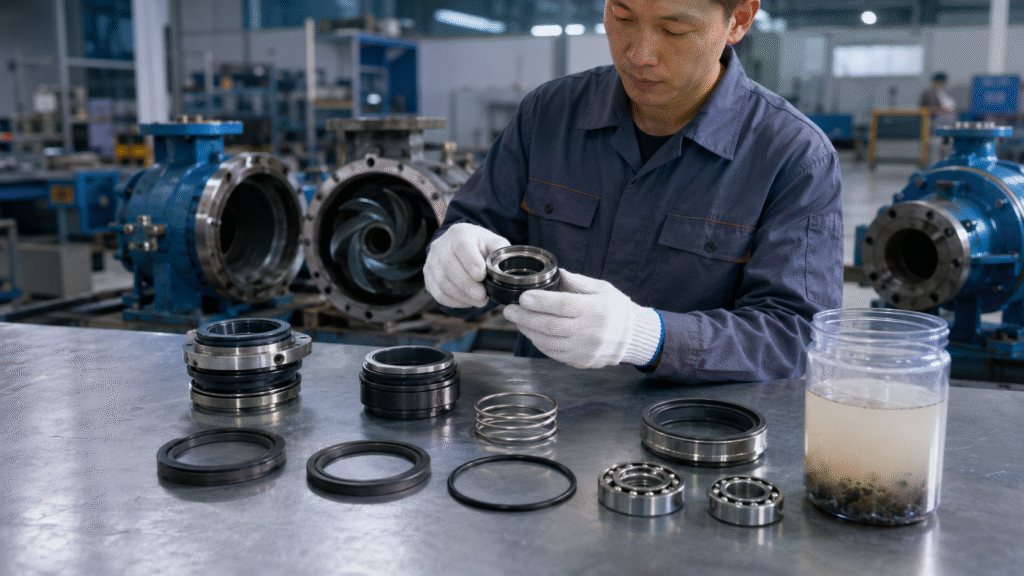
These signs narrow the investigation. However, they do not replace complete disassembly and inspection.
How to Diagnose the Failure Step by Step
First, isolate the electrical supply and follow the correct lockout procedure. Clean and decontaminate the pump before service.
Next, complete these checks:
- Record the pump model, serial number, motor power, and operating history.
- Photograph the pump and every seal component before cleaning them.
- Drain the chamber oil into a clean transparent container.
- Record the oil color, volume, odor, and contamination.
- Keep the upper and lower seal components in separate groups.
- Inspect both seal faces under bright, even lighting.
- Check springs, holders, O-rings, seats, and drive features.
- Check bearings, shaft movement, and impeller condition.
- Look for fibers, sand, grit, and deposits around the lower seal.
- Compare the old materials with the actual pumped liquid.
- Confirm the replacement dimensions and installation direction.
- Refill the chamber only with the specified oil and quantity.
- Complete the required electrical tests before reinstalling the pump.
Do not clean away useful wear patterns before photographing them. These patterns can help identify abrasion, heat, misalignment, or installation damage.
Should You Replace Only the Lower Seal?
The lower seal often experiences the harshest conditions. However, contamination in the oil chamber can also affect the upper seal.
Therefore, inspect the complete double-seal assembly whenever water or solids enter the chamber.
Replace damaged faces, elastomers, springs, seats, and other specified components according to the service procedure. Do not combine visibly worn faces with new parts unless the manufacturer allows it.
For a cartridge-mounted assembly, follow the complete cartridge replacement and setting procedure. Avoid dismantling a factory-set cartridge unless the design permits service.
How to Prevent Repeat Seal Failure
A preventive maintenance plan should address the pump, seal, oil chamber, and operating system together.
During operation
- Maintain the permitted liquid level
- Prevent prolonged dry operation
- Monitor motor current and flow
- Investigate vibration and abnormal noise
- Remove clogging before it becomes severe
- Limit starts to the permitted frequency
- Respond quickly to leakage alarms
- Record temperature and operating changes
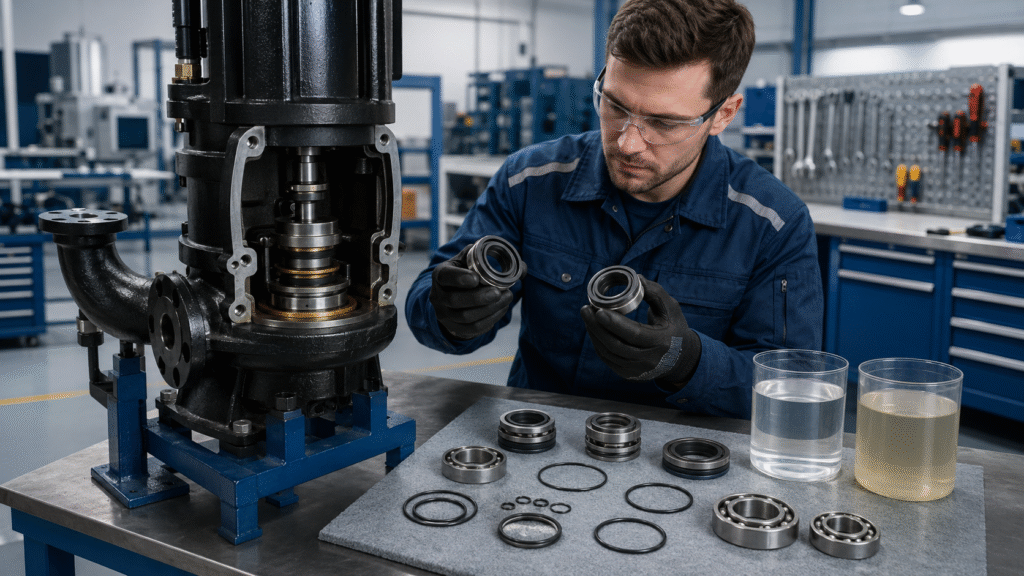
During maintenance
- Check the oil at the specified interval
- Replace the oil with the approved type
- Use the correct oil volume
- Inspect both sealing stages
- Check bearings and shaft movement
- Clean the impeller and seal area
- Replace damaged O-rings and gaskets
- Keep lapped faces clean
- Confirm material compatibility
- Follow the correct assembly direction
Before ordering a replacement
- Confirm the complete pump model
- Photograph the nameplate
- Keep every old seal component
- Measure the rotating and stationary parts
- Identify the upper and lower positions
- Describe the pumped liquid
- Provide temperature and solids information
- Explain how the previous seal failed
These steps help the supplier determine whether the problem involves selection, installation, operation, or the condition of the pump.
Frequently Asked Questions
Is Cloudy Oil Normal in an EBARA Submersible Pump?
No. Cloudy, milky, or white oil may indicate that water has entered the seal chamber. Stop the pump and inspect the mechanical seal according to the correct service procedure.
Does Every EBARA Submersible Pump Use the Same Seal?
No. Seal construction, shaft size, working length, materials, and oil requirements vary by pump series and production version.
Can Dry Running Damage the Seal?
Yes. Prolonged dry or low-level operation can increase temperature and create unstable hydraulic conditions. Always follow the minimum liquid-level requirements for the exact pump.
Which Seal Usually Fails First?
The lower or pump-side seal often faces the greatest exposure to solids and pumped liquid. However, the actual failure pattern depends on the pump design and operating conditions.
Can I Change the Oil Without Replacing the Seal?
Only when inspection confirms that the oil is due for routine replacement and shows no signs of water or solids. If the oil is white, milky, or contaminated, investigate the seal before restarting the pump.
Which Face Material Is Best for Sewage?
Hard face combinations can provide good wear resistance in abrasive service. Nevertheless, solids, impact risk, temperature, chemicals, lubrication, and the original pump design must guide the final choice.
Why Does a New EBARA Pump Seal Fail Quickly?
Possible reasons include dirty faces, a damaged O-ring, incorrect assembly, unsuitable materials, wrong oil, shaft movement, dry operation, or an incorrect replacement design.
Final EBARA Submersible Pump Seal Failure Checklist
Before returning the pump to service, confirm that:
- The root cause has been identified
- The impeller and flow passages are clean
- The bearings and shaft are in good condition
- Both sealing stages have been inspected
- The seal dimensions match the pump
- The upper and lower parts are correctly positioned
- The face and elastomer materials suit the liquid
- All O-rings and gaskets are undamaged
- The seal chamber contains the correct oil
- The oil quantity follows the pump manual
- The chamber plugs are sealed correctly
- The pump operates above the minimum liquid level
- The level-control system works correctly
- Current, vibration, noise, and flow are stable
- Required electrical tests have been completed
EBARA submersible pump seal failure should never be treated as an isolated component problem. Contaminated oil, abrasive solids, vibration, heat, incorrect materials, and installation errors can all produce similar damage.
Therefore, examine the complete pump and operating system before installing another seal. A correct diagnosis prevents repeated leakage, protects the motor, and extends the service life of the replacement.