Mechanical seal material selection should begin with the actual fluid and operating conditions, not with a preferred carbon, ceramic, silicon carbide, or tungsten carbide grade. The correct choice must consider primary faces, secondary seals, springs, sleeves, retainers, glands, and other wetted components exposed to process or support fluid.
A useful decision path is APPLICATION CONDITIONS → MATERIAL REQUIREMENTS → MATERIAL CHOICE. First define the process. Next identify chemical, thermal, abrasive, lubrication, and mechanical risks. Finally, choose compatible face, elastomer, and metal materials and confirm them against the seal design and manufacturer data.
Start With the Fluid, Not the Seal Material
Do not begin mechanical seal material selection with broad labels such as “water,” “chemical,” or “oil.” Record the exact fluid, concentration, pH where relevant, dissolved chemicals, contaminants, solids, viscosity, cleaning chemicals, and flush fluid. For example, glycol mixtures, chlorinated water, hot condensate, wastewater, and pure water can require different materials.
Build a Complete Operating-Condition Profile
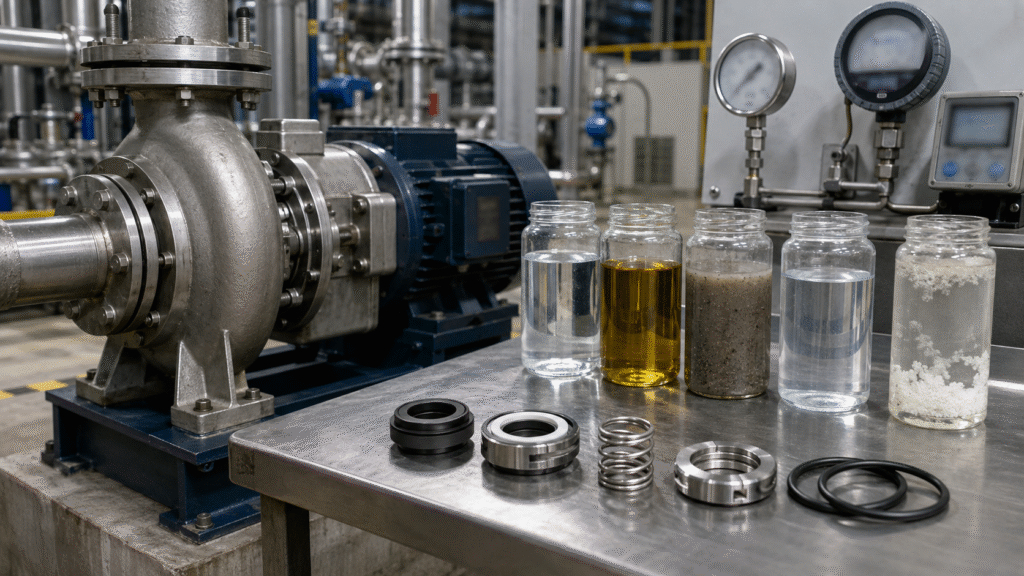
In addition, material compatibility depends on more than chemistry. Temperature, pressure, speed, solids, viscosity, and duty cycle can change wear, swelling, corrosion, face loading, and heat generation. Therefore, collect the complete operating profile before comparing materials or approving a replacement seal specification.
| Condition | What to Record | Why It Matters |
|---|---|---|
| Fluid | Exact composition | Sets base compatibility |
| Concentration | Normal and maximum | Changes compatibility |
| Temperature | Normal, maximum, transients | Changes chemistry and material properties |
| Pressure | Chamber and transients | Affects load and extrusion |
| Speed | RPM | Changes sliding heat |
| Solids | Hardness and size | Affects abrasion |
| Viscosity | Behavior | Influences fluid-film lubrication |
| Cleaning media | Chemical and cycle | May alter compatibility |
| Flush media | Composition | May contact seal components |
| Duty cycle | Operating pattern | Affects cycling |
Step 1: Check Chemical Compatibility of the Whole Seal
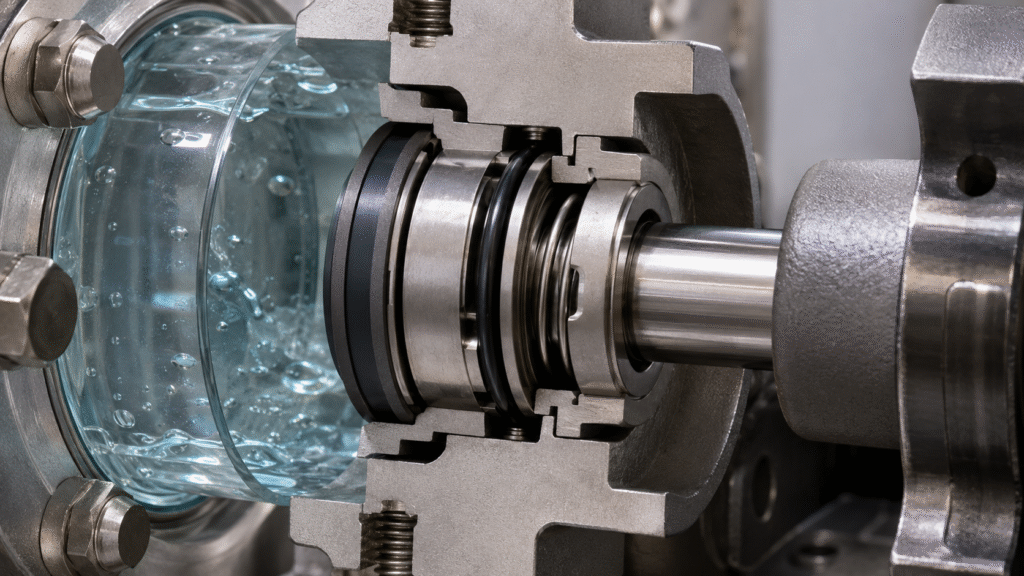
For mechanical seal material selection, chemical compatibility must cover the entire wetted assembly. A silicon carbide face can resist many aggressive fluids, yet the seal can still fail if an O-ring swells, a spring corrodes, or a sleeve suffers attack. Therefore, do not describe a seal as “corrosion resistant” from the face material alone.
Seal Faces
First, check both face materials and their exact grades. Carbon performance can change with impregnant, while reaction-bonded and sintered SiC can behave differently in certain chemicals. Tungsten carbide also requires binder verification. The mechanical seal materials guide explains these face-material differences in detail.
Elastomers
Next, NBR, EPDM, FKM, FFKM, and PTFE-based secondary seals each cover different chemical and temperature conditions. However, the family name is only a starting point because compound formulation matters. Use the mechanical seal elastomers guide for deeper comparison after the fluid and temperature profile is known.
Metal Components
Finally, springs, retainers, drive parts, sleeves, glands, and other wetted metals also need chemical review. Do not assume that one stainless-steel grade is automatically suitable for every water or chemical service. Likewise, a higher alloy should be justified by both corrosion conditions and mechanical requirements.
Step 2: Evaluate Temperature and Fluid Phase
In addition, temperature can change both chemical compatibility and seal operation. Record normal and maximum process temperature, startup and shutdown conditions, cleaning cycles, hot flushes, and temporary spikes. A material that looks compatible at room temperature may behave differently at elevated temperature or after repeated thermal cycling.
Also, temperature changes viscosity and vapor pressure. Therefore, a hot or volatile liquid can reduce lubrication even when the materials resist the chemistry. Next, check whether the fluid remains stable at the actual seal-chamber condition. Do not use one universal temperature limit for NBR, EPDM, FKM, FFKM, carbon, or other materials. The real limit depends on compound or grade, fluid, exposure time, pressure, seal design, and manufacturer specification.
Step 3: Evaluate Solids, Abrasion and Crystallization
For example, solids change the material decision because they can scratch faces, accumulate around springs, or disturb the lubricating film. Record solids concentration, particle hardness, particle size, crystallization tendency, and whether the flush itself carries contamination. Fine abrasive particles create different risks from large, impact-producing solids.
Hard faces such as SiC, TC, or selected hard/hard pairings may be considered when abrasion becomes important. However, “slurry equals tungsten carbide” and “dirty water equals SiC/SiC” are not reliable rules. Chemistry, lubrication, pump design, seal arrangement, and support system still affect the final choice. The wastewater and slurry materials guide covers these applications in more detail. Define the solids problem before upgrading hardness.
Step 4: Consider Lubricity, Pressure and Speed
However, fluid lubricity often receives less attention than corrosion, yet it directly affects face behavior. Some oils provide useful lubrication, while low-viscosity liquids, volatile fluids, sticky products, and liquids near vaporization can create unstable films. Therefore, the hardest face combination is not automatically the best pair.
In addition, pressure and speed influence friction, heat, mechanical stress, and elastomer extrusion risk. Higher closing load or sliding velocity can make thermal behavior more important. However, pressure and speed do not belong to materials alone. The balanced vs unbalanced mechanical seals guide explains hydraulic face loading separately.
Select the Seal Face Pairing
Therefore, choose the two faces as a working pair rather than as isolated materials. Friction, wear, heat transfer, and lubrication depend on both surfaces. Therefore, the table below gives practical starting points for real pump duties rather than universal material specifications.
| Application Condition | Pairing Direction to Evaluate | Main Checks Before Approval |
|---|---|---|
| Clean water | Carbon/ceramic or carbon/SiC may be considered | Temperature, speed, water chemistry, cost |
| Abrasive wastewater | More wear-resistant hard-face arrangement may be needed | Solids, lubrication, impact, chemistry |
| Corrosive chemical | Carbon/SiC or SiC-based combinations may be considered | SiC grade, carbon impregnant, full wetted compatibility |
| Mechanically severe duty | TC-based pairing may be considered | Binder chemistry, impact, rotating mass, lubrication |
| Hot water | Carbon/SiC or another suitable pairing may be evaluated | Vapor margin, heat removal, elastomer, cycling |
| Lubricating oil | Carbon with a compatible hard face may be suitable | Oil chemistry, viscosity, temperature, volatility |
Select the Secondary Seal Material
Use a simple sequence for secondary seals: fluid compatibility → temperature → pressure and extrusion risk → cleaning chemicals → application severity and cost. NBR may suit general service, EPDM many water-based duties, and FKM many oil or chemical applications. FFKM may be justified in severe service, but it is not automatically best. PTFE-based elements can help with aggressive chemicals where the seal design supports them. However, PTFE behaves differently from an elastomer and cannot simply replace an O-ring without checking groove geometry, loading, and movement.
Check Springs and Other Wetted Metals
In addition, metal selection should include more than the spring. Review the sleeve, gland, retainer, drive pins, collars, fasteners exposed to the fluid, and any metal bellows or support parts. Corrosion can weaken a spring, roughen a sleeve, seize a movable component, or contaminate the face interface. Therefore, select stainless steels or higher alloys only after checking chemical exposure and mechanical duty. “316 is always enough” and “a higher alloy is always better” are both unreliable shortcuts.
Mechanical Seal Material Selection by Application
Clean Water Pumps
For example, clean water often allows economical material combinations, but first confirm temperature, treatment chemicals, chlorine, glycol, suspended solids, and speed. Carbon/ceramic or carbon/SiC may be considered when the complete duty supports them. Treated or hot water should not automatically inherit the same material set as ambient clean water.
Hot Water and Boiler Feed Pumps
Hot-water service increases concern about vaporization, thermal cycling, elastomer condition, and heat removal. Face materials must work with the actual lubrication regime, while secondary seals must survive process, startup, shutdown, cleaning, and repeated thermal-cycle conditions throughout actual pump operating conditions.
Wastewater and Slurry Pumps
Meanwhile, wastewater composition varies widely. Review solids hardness, concentration, fibers, chemicals, and abrasive grit before considering hard/hard faces. In addition, check crystallization and deposit behavior because a harder face does not prevent solids from restricting springs or moving secondary seals.
Acids and Corrosive Chemicals
Likewise, exact chemical name, concentration, temperature, and cleaning media are essential. SiC may be considered in many corrosive applications, but grade matters. Carbon impregnant, elastomers, springs, sleeves, and glands must also remain compatible. The guide to mechanical seals for acids and corrosive fluids covers this decision in greater detail.
Oils and Hydrocarbons
However, oil service may provide useful lubrication, yet low-viscosity or volatile hydrocarbons behave differently. Check additives, solvent content, temperature, vapor pressure, elastomer compatibility, and the risk of flashing before confirming the final face pair or secondary-seal compound for the actual pump duty.
Food and Beverage Pumps
In addition, material selection must include product compatibility plus cleaning and sanitation cycles. Record detergents, acids, caustics, steam exposure, temperature, and required food-contact or hygiene approvals. A material can be chemically suitable yet still fail a project requirement if the exact compound lacks the needed approval.
Common Mechanical Seal Material Selection Mistakes
For example, common mistakes include choosing only by hardness, selecting from a broad fluid name, ignoring concentration, and checking normal temperature but not cleaning cycles. Buyers also forget elastomers, assume face corrosion resistance protects the whole seal, or upgrade materials without checking geometry and face pairing. Another mistake is copying the failed seal material automatically. Process chemistry, temperature, solids, cleaning chemicals, or pump conditions may have changed. Dry running or vibration will not be solved by simply buying a harder face.
What If the Existing Seal Keeps Failing?
First, examine what changed before repeating the old material specification. Review process chemistry, concentration, temperature, solids, cleaning media, dry-running events, pump condition, support-system performance, and whether the previous replacement was correct. Failure evidence may reveal a problem that material upgrades cannot solve. A material change makes sense when failure evidence points to wear, corrosion, swelling, thermal behavior, or another material-related weakness. Otherwise, an upgrade may increase cost while leaving the root cause untouched.
How to Confirm a Material Change
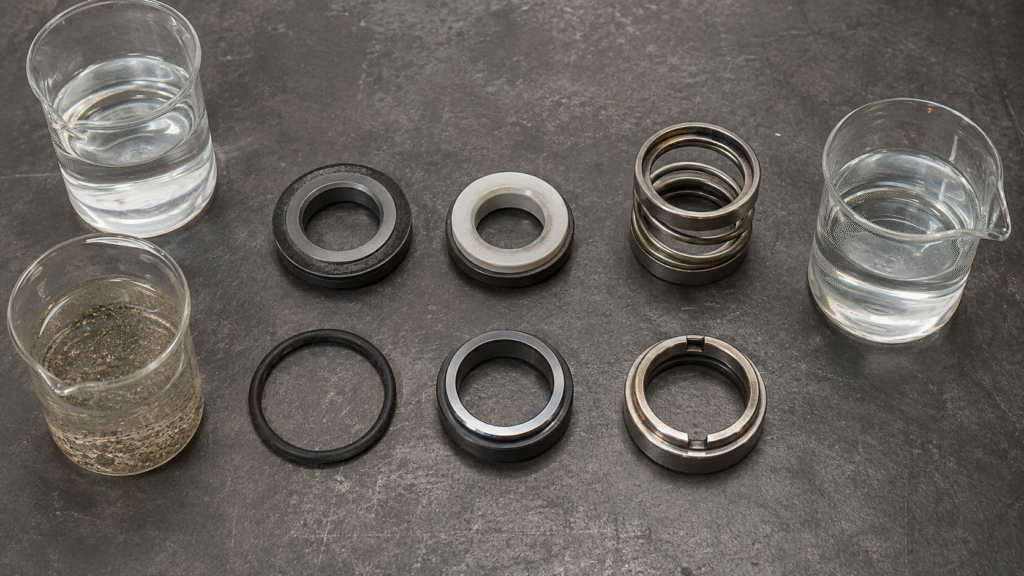
When changing ceramic to SiC, carbon to a hard face, NBR to FKM, FKM to FFKM, or stainless steel to a higher alloy, confirm more than the material name. Review geometry compatibility, mating-face behavior, thermal characteristics, chemical exposure, elastomer groove design, and manufacturer recommendations. Finally, compare the benefit with cost and operating risk. Mechanical seal material selection should solve a defined application problem, not simply move toward a harder or more expensive material.
A Practical Material Selection Checklist
Before approving materials, confirm:
- Process fluid, concentration, and pH
- Temperature, cleaning, and transients
- Seal-chamber pressure and shaft speed
- Solids, hardness, size, and crystallization
- Lubricity, viscosity, and vaporization risk
- Face materials and exact grades
- Secondary-seal compatibility
- Wetted metals
- Geometry and seal-design compatibility
- Previous failure evidence
- Manufacturer confirmation when critical
Mechanical Seal Material Selection FAQ
Is Silicon Carbide the Best Mechanical Seal Face Material?
No. SiC can provide strong wear, thermal, and chemical performance, but its suitability depends on grade, mating face, lubrication, solids, and mechanical conditions. Carbon, ceramic, or TC-based combinations may be more economical or mechanically appropriate in specific services, so compare the complete duty.
Is FFKM Always Better Than FKM?
No. FFKM can offer broader capability in severe chemical or temperature conditions, but the exact compound still matters. FKM or another elastomer may fully meet the duty at lower cost. Check fluid, cleaning media, pressure, temperature, and required approvals before paying for the upgrade.
Should I Upgrade to Harder Faces After a Seal Failure?
Only when evidence shows abrasive wear or another material limitation that harder faces can address. Dry running, runout, cavitation, wrong installation, or poor support conditions require different corrections. A harder replacement should solve a verified wear mechanism rather than hide another pump problem.
Can I Select Materials From the Fluid Name Alone?
No. Concentration, temperature, contaminants, solids, cleaning chemicals, pressure, and lubrication can change the answer. Mechanical seal material selection should always use the full operating profile, including temporary cleaning, sanitation, or flush fluids that may contact the seal during normal operation.
Strong mechanical seal material selection begins with the application, not a material ranking. Define every fluid and operating condition, check faces, secondary seals, and metals together, then confirm grade-level compatibility and seal geometry. That process avoids unnecessary upgrades while giving the replacement materials a clear engineering reason for being selected.