Seawater pump seals must handle chloride corrosion, suspended solids, biological growth, and changing operating conditions. Therefore, selecting a seal requires more than choosing a stainless-steel spring and a hard face. Every wetted component must suit the water quality, temperature, pressure, pump design, and maintenance pattern. A weak O-ring, spring, sleeve, or seat holder can shorten the life of an otherwise suitable seal.
Seawater also changes between locations and seasons. Coastal intake water may contain sand, shells, algae, silt, or treatment chemicals. In addition, stagnant water inside a stopped pump can create different corrosion conditions from flowing water. A reliable selection process should consider both normal operation and the periods before startup, after shutdown, and during cleaning.
Why Seawater Creates Difficult Seal Conditions
Chloride ions make seawater especially aggressive toward many common metals. Although stainless steel forms a protective passive film, local damage can start at scratches, deposits, threads, and narrow gaps. As a result, corrosion may remain hidden until a spring breaks, a sleeve becomes rough, or an O-ring groove loses its sealing surface.
Pitting corrosion creates small but deep cavities on exposed metal. Crevice corrosion develops beneath gaskets, deposits, washers, and tightly fitted components. Therefore, seal designs with trapped seawater require careful review. Stagnant liquid can also concentrate salts as water evaporates, especially near warm equipment or splash zones.
Galvanic Corrosion and Marine Deposits
Galvanic corrosion can occur when dissimilar metals share electrical contact in seawater. The less noble metal may corrode faster, while the more noble material receives protection. Consequently, mixing a corrosion-resistant alloy with an unsuitable spring, fastener, or sleeve may create a new failure path.
Marine growth and mineral deposits add another risk. They can restrict movement, block flushing passages, and trap low-oxygen water against metal surfaces. In addition, hard particles may enter the face gap and score the running surfaces. Seawater pump seals must therefore resist chemical attack and tolerate realistic contamination.
Select Seal Faces for Wear and Corrosion Resistance
For many seawater pump seals, silicon carbide is a common first choice. It offers high hardness, strong wear resistance, good heat transfer, and broad corrosion resistance. Therefore, it can perform well when the water contains fine sand or other abrasive particles. However, the exact silicon carbide grade still matters, especially when binders or secondary phases are present.
Carbon against silicon carbide often provides smooth running in relatively clean seawater. The carbon face helps reduce friction, while the silicon carbide face provides hardness and corrosion resistance. Nevertheless, carbon grades use different resins, metals, or other impregnants. The supplier should confirm that the selected grade suits seawater, temperature, pressure, and any treatment chemicals.
When to Use Silicon Carbide Against Silicon Carbide
Silicon carbide against silicon carbide may suit abrasive seawater, intake pumps, and services with suspended solids. Because both faces are hard, the pair can resist scoring better than many soft-versus-hard combinations. However, hard-face pairs need a stable lubricating film. Dry running, vapor formation, or poor venting can create rapid heat generation.
The 3M silicon carbide seal rings reference describes silicon carbide as resistant to wear, chemicals, corrosion, and thermal loads. Even so, material properties cannot correct a poor seal chamber or unstable operation. Therefore, check face loading, cooling, shaft speed, and startup procedures before choosing a hard-face pair.
Limits of Tungsten Carbide and Ceramic Faces
Tungsten carbide provides high strength and good resistance to impact. However, its corrosion behavior depends partly on the binder system. Some grades may be less suitable for chloride-rich or chemically treated seawater. Consequently, buyers should request the complete grade rather than accepting “tungsten carbide” as a sufficient material description.
Ceramic faces can work in clean, moderate water service. Yet they may chip under shock or suffer during sudden temperature changes. In addition, ceramic is usually less attractive when sand, shell fragments, or severe vibration are present. A mechanical seal materials guide can help compare face options before the final supplier review.
Choose Secondary Seals for the Full Water Chemistry
Elastomers seal around faces, sleeves, seats, and gland joints. Therefore, they must resist seawater and every added chemical. Chlorination, dechlorination, biocide dosing, oil contamination, and cleaning agents can change compatibility. Seawater pump seals should never use an elastomer selected only from the word “water.”
EPDM often performs well in water-based service and may suit many seawater applications. However, it generally has poor compatibility with petroleum oils and many hydrocarbons. FKM can resist oils and many chemicals, yet it is not automatically superior in hot water or every treatment solution. NBR may suit some moderate services, although ozone, heat, and chemical exposure require review.
Check O-Ring Movement and Compression
A chemically compatible O-ring can still fail through poor installation or excessive compression. Salt crystals, corrosion products, and deposits may restrict the axial movement of pusher seals. As a result, the faces may not follow wear, vibration, or shaft movement correctly.
PTFE-based secondary seals offer broad chemical resistance but provide less elastic recovery than rubber. Therefore, their groove design, loading, and surface finish need careful control. For critical duty, ask the supplier to confirm the exact compound, not only the polymer family.
Review Every Wetted Metal Component
Seawater pump seals require metal review across springs, pins, retainers, sleeves, glands, fasteners, and seat holders. Standard 316 stainless steel sees wide marine use, but it is not corrosion-proof in seawater. British Stainless Steel Association guidance highlights its vulnerability to pitting and crevice corrosion, especially when seawater becomes stagnant or warm.
For more severe conditions, engineers may consider duplex stainless steel, super duplex stainless steel, titanium, or nickel-based alloys. However, no alloy should be selected from reputation alone. Temperature, oxygen level, flow velocity, crevice geometry, fabrication quality, and electrical contact with other metals all influence performance.
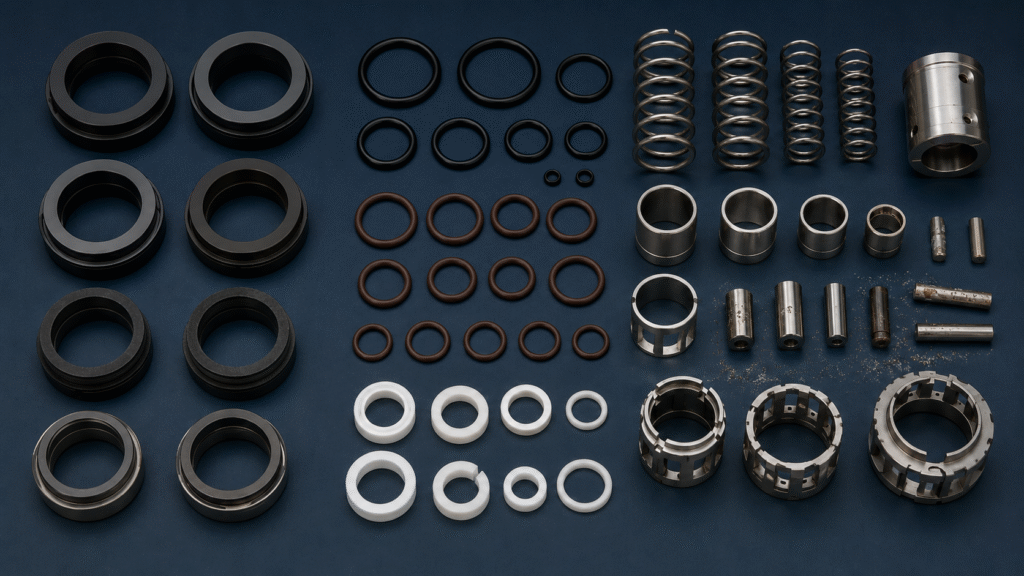
Keep Springs Away From Raw Seawater
A seal may use corrosion-resistant faces but still fail because small springs remain exposed. Springs have thin cross-sections and highly stressed surfaces, so localized attack can become serious quickly. Therefore, stationary multiple-spring designs require close material, stress, and exposure review during selection.
External seals, protected spring arrangements, or non-pusher bellows designs can reduce direct exposure in some pumps. In submersible equipment, an oil-chamber seal design may separate the sealing system from raw seawater and provide lubrication. Nevertheless, the lower seal, oil condition, and chamber integrity still require scheduled inspection.
Match the Seal Arrangement to the Pump
A single seal may suit a clean, continuously flooded seawater pump with stable conditions. However, the arrangement must control leakage, heat, and solids. Horizontal centrifugal pumps, vertical seawater pumps, cooling-water pumps, and submersible pumps can expose seals to very different pressures and chamber conditions.
Double seals may provide stronger containment or a cleaner environment around the faces. A pressurized barrier system can keep process water away from the inner sealing interface. In addition, a tandem arrangement may provide secondary containment. The correct choice depends on leakage risk, pump design, available utilities, and operating procedures.
Submersible Pumps Need Special Attention
Many submersible seawater pump seals use upper and lower positions with an oil chamber between them. The lower seal faces the pumped seawater, solids, and pressure changes. Meanwhile, the upper seal helps protect the motor from oil leakage or water entry. Therefore, each position can require different materials and design details.
When comparing Flygt pump seal options, confirm the exact pump model and whether the part is an upper or lower seal. Similar-looking assemblies may have different dimensions, face materials, and working positions. In addition, inspect the oil for water contamination, discoloration, or suspended debris during maintenance.
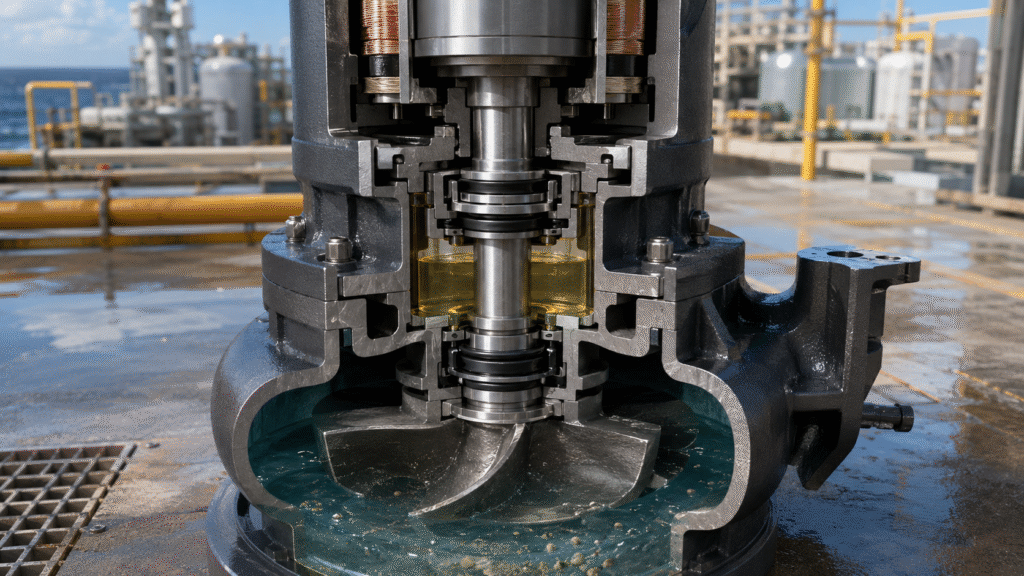
Control Solids, Heat, and Dry Running
Seawater intakes can carry sand, silt, shells, fibers, and marine organisms. These contaminants may score faces or block springs. Therefore, record solids concentration, particle size, and seasonal changes before selecting materials. A suitable strainer or separator may protect the pump, although it must not restrict required flow.
Heat usually indicates more than a material problem. Excessive face loading, shaft runout, poor circulation, vapor formation, or misalignment can raise temperature. As a result, elastomers harden, carbon faces blister, and salts form deposits. Harder faces alone will not solve those operating faults.
Dry running remains a major risk because the seal faces depend on a thin lubricating film. Poor priming, air pockets, blocked intakes, or low tank levels can remove that film. Consequently, startup procedures, level controls, venting, and operator training are essential parts of seal reliability.
Confirm Pump Data Before Ordering
Correct materials cannot compensate for incorrect dimensions. First, record the pump manufacturer, complete model, serial number, shaft size, and operating speed. Next, confirm the seal chamber pressure, temperature, rotation, working length, stationary seat dimensions, and available flush connections before ordering.
Use clear photographs and dimensions to identify the correct mechanical seal. However, appearance alone cannot confirm the spring arrangement, balance diameter, seat profile, or material grade. Therefore, provide the removed rotating assembly, stationary seat, O-rings, and any visible markings when requesting a quotation.
Buyers can review the pump mechanical seal range to understand available designs. Even so, the final choice should match the exact pump and service. Seawater pump seals may need different faces, elastomers, and metal parts from seals used in freshwater versions of the same pump family.
Installation and Maintenance Reduce Corrosion Risk
Before installation, clean the chamber and remove old salt, rust, and gasket material. Inspect the shaft sleeve for pitting, grooves, or roughness beneath the O-ring path. In addition, confirm that drainage and venting passages remain open. Trapped seawater can create hidden crevices after shutdown.
Installers should keep seal faces clean and avoid touching them with dirty hands. Use only a lubricant approved for the selected elastomer and process. Therefore, do not apply general grease without checking compatibility. Uneven stationary-seat installation can crack a brittle face or create leakage around the seat.
After startup, check leakage, vibration, pressure, and temperature around seawater pump seals. During planned maintenance, inspect faces, springs, sleeves, O-rings, and oil chambers. Finally, document the damage pattern instead of replacing parts without analysis. Repeated pitting, broken springs, scored faces, or swollen elastomers usually reveal a specific selection or operating problem.
Practical Seawater Seal Selection Checklist
Start with the water source, chloride exposure, temperature range, solids, biological content, and treatment chemicals. Then record pump type, speed, pressure, seal arrangement, and dry-running risk. These details define the actual duty more accurately than the general term “seawater” alone.
Next, specify each critical material. Confirm face grades, carbon impregnation, elastomer compound, spring alloy, sleeve alloy, gland material, and fasteners. Also review galvanic contact between components. A single unsuitable metal part can become the first failure point during operation or shutdown.
Finally, verify dimensions, installation instructions, flushing, venting, and maintenance access. Seawater pump seals perform best when material selection and operating control support each other. Careful application data, compatible components, and regular inspection provide a stronger solution than relying on one “marine-grade” label.