Mechanical seal materials determine how the sealing faces handle friction, wear, heat, chemicals, and mechanical stress. Carbon, ceramic, silicon carbide, and tungsten carbide can all work well, but they solve different problems. Therefore, the right face material depends on the pumped liquid, lubrication, solids, temperature changes, shaft condition, and the material running against it.
This guide compares the four main mechanical seal face materials from an application perspective. It explains their practical strengths, limitations, grades, and common pairings without turning material choice into a complete seal-selection process.
What Properties Matter in Mechanical Seal Materials?
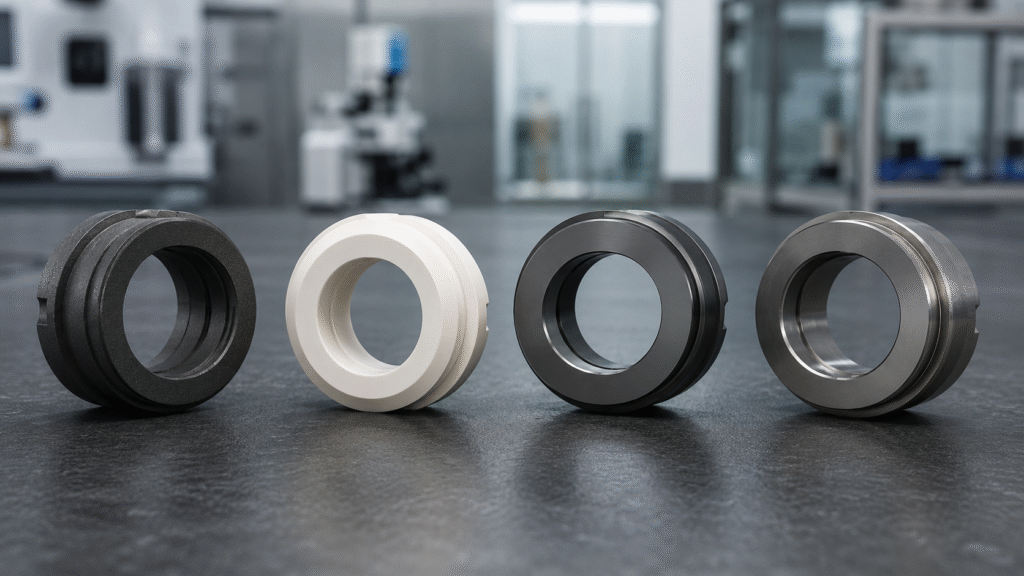
A seal face must remain flat while sliding against its mating face across a very thin lubricating film. Therefore, hardness alone cannot predict performance. Engineers also need friction behavior, thermal stability, corrosion resistance, toughness, and compatibility between the two faces.
Wear Resistance
Abrasive particles can scratch or erode a face, while repeated contact gradually changes the wear track. Hard materials generally resist abrasion better. However, a very hard but brittle ring may still chip under impact, poor installation, or severe shaft movement.
Friction and Lubrication
Face pairing affects friction as much as the individual material. Carbon often runs against a harder ceramic or carbide because this hard/soft arrangement can provide controlled sliding behavior. Nevertheless, every conventional wet-running seal still needs a stable lubricating film.
Chemical Resistance
Process liquid can attack a face directly or attack a secondary phase within the material. Therefore, the exact grade matters. Concentration, temperature, contaminants, cleaning chemicals, and shutdown conditions can also change corrosion behavior.
Thermal Conductivity and Thermal Shock
Seal faces generate heat through sliding contact and fluid shear. Materials that transfer heat efficiently can help control face temperature. However, thermal shock also matters because sudden temperature changes create stress across the ring.
Mechanical Toughness
Toughness describes resistance to cracking and impact rather than scratching. This distinction becomes important in pumps with coarse solids, vibration, shock, or difficult handling. Consequently, the hardest material is not automatically the toughest one.
Carbon-Graphite Seal Faces
Among common mechanical seal materials, carbon-graphite is often used as the softer member of a face pair. Its structure can provide favorable sliding behavior against ceramic, silicon carbide, or tungsten carbide. In addition, different carbon grades use different base structures and impregnants, so “carbon” is not a complete engineering specification.
Advantages of Carbon Faces
Carbon can offer low-friction potential and forgiving running behavior when lubrication is adequate. It also wears preferentially against a harder mating face, which can protect the more expensive hard ring in suitable applications. Manufacturer carbon material data also shows that impregnation changes application-specific properties.
Limitations of Carbon Faces
Abrasive solids can groove or rapidly wear carbon because it is softer than the common hard-face materials. Chemical compatibility also depends on the carbon grade and impregnant. Therefore, do not assume every resin-impregnated, metal-impregnated, or specialty carbon behaves the same.
Typical Carbon Pairings
Carbon against ceramic remains common in clean-water and general pump service. Carbon against silicon carbide is widely used when better wear, thermal, or chemical performance is needed. Carbon can also run against tungsten carbide where the application benefits from a tougher hard face.
Ceramic Mechanical Seal Faces
In general pump terminology, ceramic commonly means an aluminum oxide, or alumina, seal face. It is a hard, economical mating material with useful chemical stability in many clean-water duties. Ceramic manufacturers offer multiple alumina formulations, so one purity percentage should never be treated as a universal requirement.
Ceramic works especially well as a hard stationary face against carbon in stable, relatively clean service. However, alumina is brittle, and its thermal-shock tolerance is usually less forgiving than silicon carbide. Sudden temperature changes, impact during installation, or severe vibration can therefore increase damage risk.
Silicon Carbide Mechanical Seal Faces
Silicon carbide, or SiC, combines very high hardness with strong abrasion resistance, broad chemical resistance in many grades, and good heat-transfer capability. As a result, it is widely used in industrial water, wastewater, chemical, and abrasive pump services. Silicon carbide material data also shows why grade and manufacturing route matter.
Reaction-Bonded vs Sintered SiC
Reaction-bonded silicon carbide normally contains a free-silicon phase. This construction can provide excellent wear and thermal properties for many duties. However, the free silicon can reduce compatibility with certain aggressive chemicals.
Sintered silicon carbide contains little or no free silicon and often provides broader corrosion resistance. Nevertheless, both remain ceramic materials and can chip or crack under severe impact. Special SiC grades also exist, but their performance depends on the complete face design and operating environment.
No silicon carbide grade should be assumed safe for unrestricted dry running. A hard face still depends on suitable lubrication and heat removal unless the complete seal design specifically supports another operating mode.
Tungsten Carbide Mechanical Seal Faces
Tungsten carbide, often shortened to TC or WC, combines high hardness with greater mechanical toughness than many ceramic face materials. Therefore, it can be useful where abrasion occurs together with shock, vibration, coarse solids, or high mechanical loading.
Unlike monolithic ceramics, tungsten carbide contains carbide particles held by a metallic binder. Consequently, binder chemistry strongly affects corrosion behavior. Cemented carbide corrosion data shows why the binder cannot be ignored when wet corrosion is possible.
Why Binder Material Matters
Cobalt-bonded tungsten carbide can provide strong toughness and wear performance, but cobalt may be vulnerable in some corrosive liquids. Nickel-bonded grades often improve corrosion resistance in selected wet environments. However, neither description is universal because grade formulation, fluid chemistry, concentration, and temperature still matter.
Therefore, never specify only “TC” for demanding chemical service. Confirm whether the proposed face uses cobalt, nickel, or another binder system and verify compatibility with the real process fluid.
Carbon vs Ceramic vs SiC vs Tungsten Carbide
The table below gives a practical comparison rather than fixed operating limits. Actual performance depends on grade, face geometry, mating material, lubrication, seal design, and operating conditions.
| Property | Carbon-Graphite | Alumina Ceramic | Silicon Carbide | Tungsten Carbide |
|---|---|---|---|---|
| Relative hardness | Low to moderate | High | Very high | Very high |
| Wear resistance | Good in clean service; weaker with abrasives | Good in clean service | Excellent for many abrasive duties | Excellent, especially with mechanical severity |
| Chemical resistance | Grade and impregnant dependent | Good in many compatible fluids | Broad in many grades; grade matters | Strongly binder dependent |
| Thermal conductivity | Useful, grade dependent | Lower than SiC in general | High | Good, grade dependent |
| Mechanical toughness | Relatively forgiving as a soft face | Brittle | Hard but brittle | Higher toughness than ceramic faces |
| Relative cost | Low to moderate | Often economical | Moderate to high | Often high |
| Typical starting applications | Clean water, oils, general service | Clean water, light-duty pumps | Chemicals, wastewater, abrasives | Abrasive, shock-loaded, mechanically severe service |
This comparison shows why mechanical seal materials should be selected as a pair rather than as isolated rings. For example, a softer carbon face can change the friction and wear behavior of the same hard mating material.
How Mechanical Seal Face Pairings Work
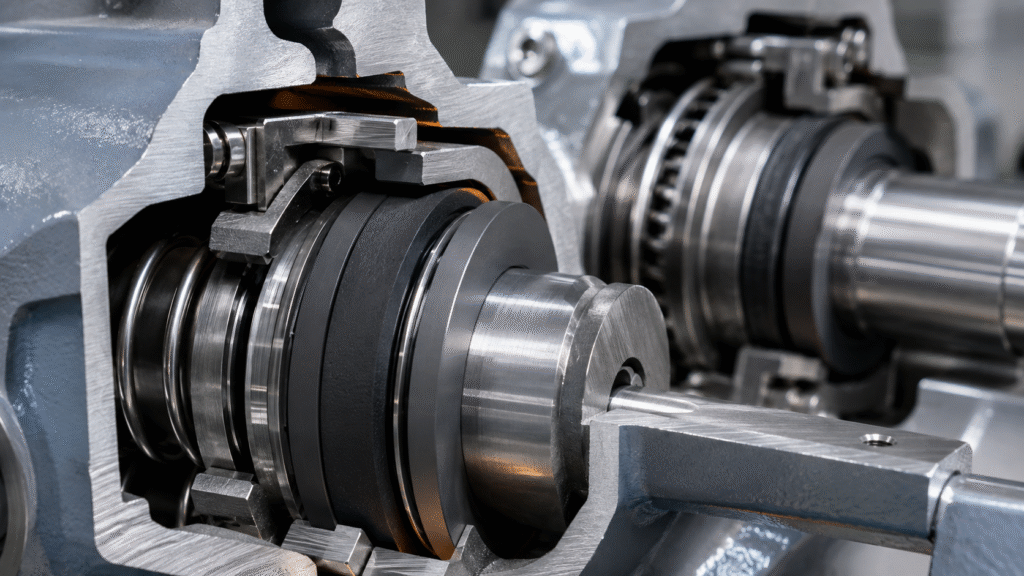
Face pairing determines how two surfaces share friction, wear, heat, and contamination. Therefore, changing one ring can change the complete tribological system. Never replace an original pairing only because another material sounds harder or more expensive.
Hard / Soft Pairings
Carbon versus ceramic and carbon versus silicon carbide are common hard/soft combinations. Carbon can provide favorable sliding behavior, while the harder mating face supplies wear resistance and dimensional stability. In addition, these pairings can be more forgiving than hard/hard faces in clean, well-lubricated service.
Hard / Hard Pairings
SiC versus SiC can suit wastewater, fine abrasives, crystals, and solids-containing liquids because neither face is a soft carbon wear surface. TC versus TC, or approved SiC/TC combinations, may suit mechanically severe service. However, hard/hard faces still require lubrication and suitable cooling.
For a deeper carbide comparison, use the silicon carbide vs tungsten carbide mechanical seals guide. It covers grade, toughness, corrosion, rotating mass, and application differences in greater detail.
Which Mechanical Seal Materials Fit Different Pump Applications?
Application examples provide useful starting points, but they are not automatic specifications. General mechanical seal selection must still consider pressure, speed, seal geometry, fluid behavior, and pump condition.
Clean Water Pumps
Carbon against ceramic is an economical starting point for many clean, stable water duties. Carbon against SiC may add wear resistance and stronger thermal performance. However, hot water, poor lubrication, solids, or frequent temperature changes can alter the preferred pairing.
Wastewater and Slurry Pumps
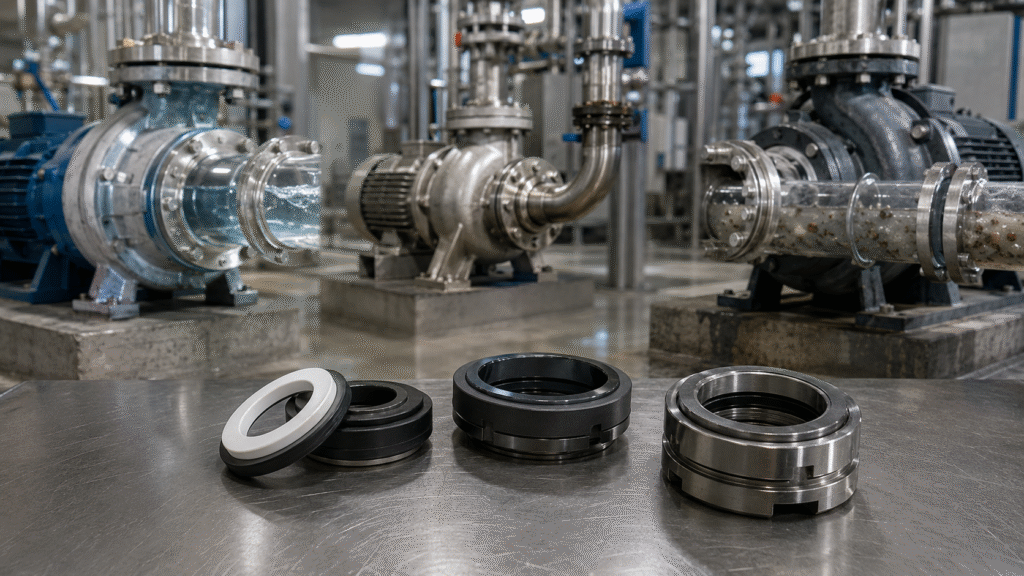
Fine abrasive solids often favor SiC versus SiC. Meanwhile, tungsten-carbide-based pairings may deserve consideration when coarse particles, impact, or vibration add mechanical severity. The wastewater and slurry materials guide explains these conditions without forcing one hard-face combination onto every dirty-water pump.
Chemical Pumps
Chemical service requires grade-level compatibility. Sintered SiC is often a strong starting point for aggressive fluids, while carbon may still work against SiC in clean, well-lubricating chemicals. For acids and corrosive fluids, also check elastomers, springs, retainers, and every wetted component.
Hot Water and Boiler Feed Pumps
Heat transfer, vapor margin, thermal cycling, and face loading become important in hot-water service. SiC can offer useful thermal properties, while carbon/SiC is common in many industrial duties. Nevertheless, materials alone cannot correct flashing or unstable seal-chamber conditions.
Oil and Hydrocarbon Pumps
Carbon paired with SiC or TC can work in many lubricating oil services. However, light hydrocarbons may have low viscosity or high volatility, which changes film behavior. Therefore, chemistry, temperature, vapor pressure, and seal arrangement still require review.
Do Not Forget Elastomers and Other Seal Materials
Face materials are only one part of the material system. NBR, EPDM, FKM, FFKM, and PTFE-based secondary seals must match the fluid and temperature. Springs, sleeves, drive parts, and glands also need suitable corrosion and mechanical properties.
Use the mechanical seal elastomers guide for secondary-seal selection. Keeping that topic separate prevents the mechanical seal materials overview from becoming an elastomer compatibility chart.
Common Mechanical Seal Materials Selection Mistakes
One common error is choosing only by hardness. Another is assuming SiC is automatically superior in every pump. Buyers may also ignore tungsten carbide binder chemistry, copy an old material pair after the process changes, or upgrade faces while leaving incompatible elastomers and metal parts unchanged.
Dry-running risk creates another mistake. SiC/SiC and TC-based hard faces still generate damaging heat when the lubricating film disappears. The mechanical seal dry running guide explains why hardness does not replace lubrication.
Mechanical Seal Materials FAQ
Is Silicon Carbide Always Better Than Ceramic?
No. SiC generally provides stronger abrasion resistance and thermal performance, but ceramic can remain an economical, reliable hard face in suitable clean-water service. The pump duty determines whether the additional capability is useful.
Is Tungsten Carbide More Corrosion Resistant Than Silicon Carbide?
Not automatically. Tungsten carbide corrosion behavior depends strongly on its binder system. Silicon carbide also varies by grade, particularly between reaction-bonded and sintered materials. Therefore, compare exact grades against the actual fluid.
Can SiC Run Against SiC?
Yes, many seals use SiC against SiC for abrasive, dirty, or corrosive service. However, the faces still need appropriate lubrication, cooling, flatness, and loading. Hardness alone does not create dry-running capability.
Which Material Is Best for Clean Water?
Carbon/ceramic and carbon/SiC are both common starting combinations. The better option depends on temperature, speed, water chemistry, solids, cost, and the seal design. Therefore, no single pairing should be specified for every clean-water pump.
Mechanical seal materials work as an interacting face pair, not as isolated material names. Carbon offers useful sliding behavior, ceramic provides an economical hard face, SiC combines hardness with strong thermal and chemical performance, and TC adds valuable toughness. Finally, confirm the exact grade, mating face, fluid, lubrication, and operating environment before approving a material change.