Selecting mechanical seals for acids requires more than matching the seal size to the pump shaft. Corrosive liquids can attack seal faces, O-rings, bellows, springs, sleeves, and metal glands. Therefore, every wetted component must be checked before the seal is approved.
A seal that performs well in clean water may fail quickly in hydrochloric acid, sulfuric acid, sodium hydroxide, solvents, or mixed chemical solutions. In addition, temperature, concentration, pressure, solids, and vapor pressure can change the way a material behaves. This guide explains how to select suitable face materials, secondary seals, metal parts, and seal arrangements for demanding chemical pump service.
Why Mechanical Seals for Acids Need Special Attention
A mechanical seal contains several materials that remain in direct or indirect contact with the process fluid. These materials normally include a rotating face, a stationary face, an O-ring or wedge, springs, drive parts, a sleeve, and a gland.
However, the chemical does not need to damage every component to cause leakage. For example, one swollen O-ring can stop the face from moving freely. Similarly, a corroded spring can reduce face loading and allow the seal to open.
Corrosive fluids may also create operating problems that are not purely chemical. Some liquids crystallize when they contact air, while others have poor lubricity or high vapor pressure. As a result, material compatibility alone cannot guarantee reliable operation.
Start with the Exact Process Fluid
Before selecting a seal, identify the exact chemical instead of using a general description such as “acid,” “chemical liquid,” or “corrosive water.”
First, confirm the chemical name and concentration. Next, record the normal and maximum temperature. Finally, provide the pressure, speed, viscosity, solids content, and any dry-running risk.
The following information is especially important:
- Chemical name and full composition
- Normal and maximum concentration
- Normal and maximum temperature
- Seal chamber pressure
- Pump speed
- Fluid viscosity
- Suspended solids or crystals
- Vapor pressure
- Dry-running risk
- Required leakage and safety limits
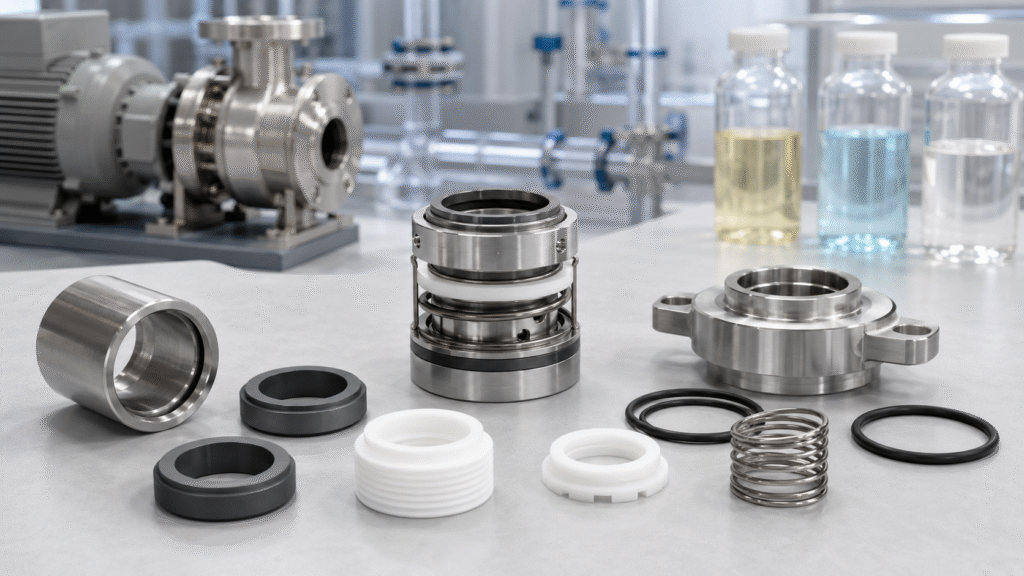
Concentration can completely change the corrosion behavior of a fluid. Moreover, higher temperature often accelerates chemical attack. Consequently, a material that works in a dilute acid at room temperature may fail in the same acid at a higher concentration.
A chemical compatibility chart can help with initial screening. For example, the Trelleborg Material Compatibility tool allows engineers to compare several sealing materials. Nevertheless, the final decision should still be based on the complete operating conditions.
How to Choose Seal Faces for Mechanical Seals for Acids
Seal faces must resist chemical attack, wear, heat, and distortion. Therefore, face selection should never be based on hardness alone. Common options include carbon graphite, ceramic, silicon carbide, and tungsten carbide.
Sintered Silicon Carbide for Corrosive Fluids
Sintered silicon carbide is often a strong starting point for corrosive service. It offers excellent hardness, broad chemical resistance, good thermal conductivity, and strong wear resistance.
For clean fluids with acceptable lubrication, carbon against silicon carbide is often suitable. However, silicon carbide against silicon carbide may be better for abrasive, crystallizing, or particle-containing liquids.
Not all silicon carbide grades are identical. Reaction-bonded silicon carbide contains a free-silicon phase, whereas sintered silicon carbide has a different composition. Therefore, demanding applications should specify the exact grade rather than only “SiC.”
For a wider comparison of common face materials, refer to our mechanical seal materials guide.
Carbon Graphite Seal Faces
Carbon graphite provides low friction and good running characteristics. As a result, carbon against silicon carbide is widely used in chemical pumps.
However, the carbon grade and impregnation material must be compatible with the process fluid. Strong oxidizers, aggressive solvents, or rapid pressure changes can damage some carbon grades. In addition, absorbed liquid may expand and cause blistering.
Before selecting carbon, confirm the carbon grade, impregnation material, operating temperature, pressure cycle, and solids content. When compatibility remains uncertain, a specialized carbon grade or two hard faces may be safer.
Ceramic Seal Faces
Alumina ceramic offers good corrosion resistance at a relatively low cost. Therefore, it can suit light-duty chemical pumps with moderate pressure and speed.
However, ceramic is more brittle than silicon carbide and has lower thermal conductivity. Consequently, it may be less suitable for severe thermal shock, high-speed operation, or abrasive service.
Tungsten Carbide Seal Faces
Tungsten carbide provides high strength and good impact resistance. For that reason, it is often selected for heavy-duty pumps, slurry service, and mechanically demanding applications.
Nevertheless, chemical resistance depends on the binder material. Some grades may perform poorly in strong acids. Therefore, tungsten carbide should not automatically replace silicon carbide in corrosive service.
Choose Compatible O-Rings, Wedges, and Bellows
Secondary seals are common failure points in mechanical seals for acids. An unsuitable O-ring may swell, soften, crack, shrink, or lose elasticity after exposure. Therefore, the compound must be checked against the exact chemical and temperature.
PTFE Secondary Seals
PTFE offers broad chemical resistance and is widely used for aggressive acids, solvents, and mixed chemicals. It can be used as a wedge, V-ring, bellows, encapsulated seal, gasket, or protective barrier.
However, PTFE is not an elastomer. It has limited elasticity and may creep under sustained load. Therefore, the seal design must provide correct support and compression.
PTFE bellows seals are especially useful when the process fluid should not contact a conventional elastomer. In addition, an external PTFE bellows design can reduce the number of exposed metal components.
FFKM O-Rings
FFKM combines broad chemical resistance with elastomeric sealing behavior. Therefore, it is often considered for severe chemical exposure, high temperatures, or applications where standard elastomers fail.
However, FFKM is more expensive than common O-ring materials. Different FFKM compounds also have different resistance limits. The DuPont Kalrez seal design guidance explains why chemical stability, temperature, swelling, mechanical properties, and gland design must be considered together.
FKM O-Rings
FKM resists many oils, fuels, acids, and hydrocarbons. In addition, it performs well at elevated temperatures.
Nevertheless, FKM is not resistant to every corrosive fluid. Strong bases, amines, ketones, and some organic acids may attack certain compounds. Therefore, always confirm the exact FKM grade.
EPDM O-Rings
EPDM can be suitable for hot water, steam, many dilute acids, alkalis, and polar fluids. However, it normally performs poorly with petroleum oils, fuels, and many hydrocarbon-based liquids.
For water-based chemical solutions, EPDM may be a practical option. Even so, concentration and maximum temperature must be verified.
NBR O-Rings
NBR is common in water, oil, and general industrial service. However, it is usually not the first choice for strong acids, oxidizing chemicals, or severe corrosive duty.
Choosing NBR only because it is inexpensive may cause rapid swelling, hardening, or leakage. Therefore, it should be used only after a proper compatibility check.
Check Every Wetted Metal Component
Mechanical seals for acids can still fail even when the faces and O-rings are compatible. Springs, drive pins, sleeves, glands, and fasteners may corrode first.
Possible metal options include:
- 304 stainless steel
- 316 or 316L stainless steel
- Alloy 20
- Nickel-based corrosion-resistant alloys
- Titanium
- Other application-specific alloys
Stainless steel is not resistant to every acid. For example, hydrochloric acid and chloride-rich fluids can cause rapid attack or localized pitting in standard stainless-steel grades. Therefore, do not select a metal only because it is described as “stainless” or “corrosion resistant.”
For severe service, consider a design with springs outside the process fluid. In addition, non-metallic wetted components may reduce corrosion and prevent spring blockage.
Select the Correct Seal Arrangement for Corrosive Fluids
Material selection cannot correct an unsuitable seal arrangement. Therefore, the fluid hazard, lubrication, crystallization tendency, and emission limits should determine whether the pump needs a single seal, external seal, cartridge seal, or double seal.
Single Internal Mechanical Seal
A single internal seal is compact and economical. It may work when the fluid is clean, all wetted materials are compatible, lubrication is adequate, and limited leakage does not create a serious hazard.
However, an internal design exposes more components to the process fluid. Consequently, it may be unsuitable for highly aggressive or crystallizing chemicals.
External Mechanical Seal
An external seal keeps important working components outside the process fluid. Therefore, it can be useful for strongly corrosive liquids.
PTFE bellows and non-metallic wetted components are common in this arrangement. However, pressure capability and installation dimensions must be checked carefully.
Cartridge Mechanical Seal
A cartridge seal is supplied as a preassembled unit. As a result, it reduces installation errors and controls the setting dimension more accurately.
Cartridge designs may include corrosion-resistant alloys, PTFE secondary seals, special face materials, and flush connections. Therefore, they are useful when reliability and repeatable installation are important.
Double Mechanical Seal
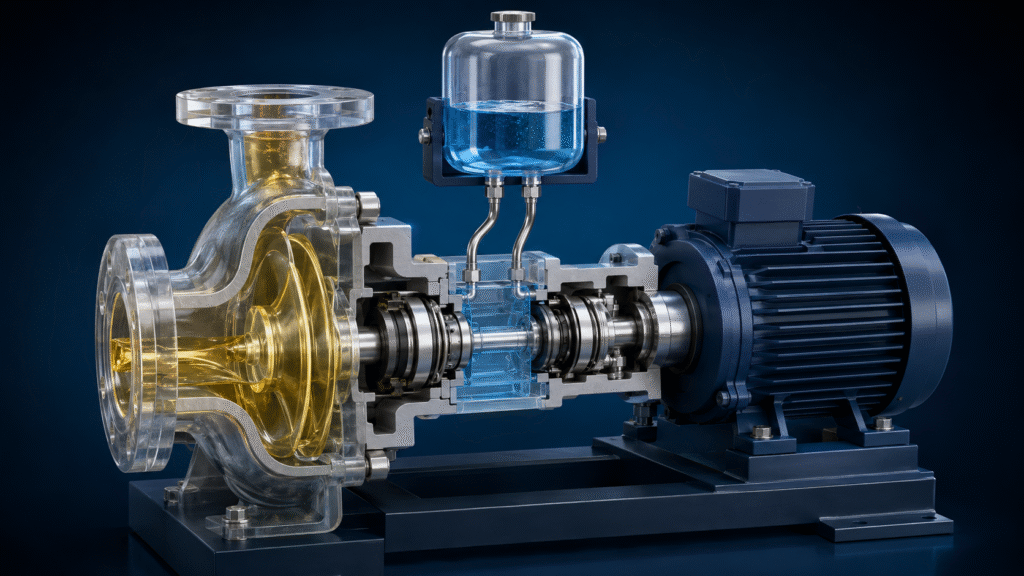
A double seal may be required for hazardous, toxic, poorly lubricating, volatile, or crystallizing fluids. A compatible buffer or barrier liquid separates the process fluid from the atmosphere and lubricates the seal faces.
However, the support system must maintain the correct pressure, temperature, circulation, and fluid quality. The John Crane chemical industry sealing guidance provides additional examples of sealing systems for corrosive and hazardous processes.
Consider Crystallization and Suspended Solids
Some acids, salts, and chemical mixtures leave crystals or deposits when the liquid evaporates at the seal faces. Consequently, springs may become blocked, O-rings may lose movement, and faces may remain open.
For crystallizing fluids, place springs outside the product whenever possible. In addition, use an appropriate flush or quench and avoid narrow spaces where deposits can accumulate.
When suspended solids are present, two hard faces may resist wear better than a soft carbon face. However, face materials alone cannot solve every solids problem. The seal chamber, flushing method, and operating procedure must also control particle accumulation.
Check Lubrication, Vapor Pressure, and Dry Running
Mechanical seal faces need a stable fluid film. However, volatile chemicals can vaporize between the faces because of pressure reduction or frictional heat.
Once the fluid film disappears, the seal may experience dry contact, rapid temperature rise, carbon blistering, face cracking, or thermal distortion. Therefore, compare the seal chamber pressure with the fluid vapor pressure at the actual operating temperature.
Also check whether the pump loses suction, traps air, or starts without liquid. For poor-lubricating or volatile fluids, a double seal with a suitable barrier system may provide better reliability.
Typical Mechanical Seals for Acids and Corrosive Applications
The following combinations are general starting points rather than final specifications.
| Process condition | Possible starting configuration | Important checks |
|---|---|---|
| Clean, dilute acid | Carbon versus sintered SiC with compatible EPDM, FKM, or PTFE | Concentration, temperature, and carbon impregnation |
| Strong or concentrated acid | Sintered SiC faces with PTFE or application-specific FFKM | Metal alloy, oxidizing behavior, and dry-running risk |
| Hydrochloric acid or chloride-rich fluid | Non-metallic wetted parts, PTFE bellows, or a verified alloy | Do not assume 316 stainless steel is suitable |
| Abrasive corrosive slurry | Sintered SiC versus sintered SiC | Solids concentration, flushing, and heat generation |
| Corrosive solvent | Carbon versus SiC or SiC versus SiC with PTFE or compatible FFKM | Volatility, elastomer compatibility, and carbon grade |
| Crystallizing chemical | External or cartridge design with springs outside the product | Flush, quench, temperature control, and deposits |
| Toxic or hazardous chemical | Double cartridge seal with a compatible barrier system | Emission limits, barrier pressure, and support plan |
These combinations provide a useful starting point. Nevertheless, final approval should always be based on the exact fluid composition and operating data.
Information to Send to a Mechanical Seal Supplier
A supplier cannot confirm mechanical seals for acids by shaft diameter alone. Therefore, send complete pump and process information whenever possible.
Include:
- Pump manufacturer and model
- Pump nameplate photograph
- Shaft or sleeve diameter
- Seal chamber dimensions
- Clear photographs of every old seal component
- Existing face and O-ring materials
- Chemical name and concentration
- Normal and maximum temperature
- Normal and maximum pressure
- Pump speed
- Solids or crystals in the fluid
- Previous failure symptoms
- Required seal arrangement
- Required material certificates
When the old seal model is unknown, follow our guide on how to identify a mechanical seal from photos, dimensions, and pump data. In addition, review our CNP chemical pump mechanical seals for compatible replacement options.
Common Mechanical Seal Selection Mistakes
Choosing Only by Pump Model
The same pump model may use different materials for water, acids, solvents, or high-temperature liquids. Therefore, the pump model confirms dimensions but not chemical compatibility.
Assuming All FKM Is Chemically Resistant
FKM covers a family of compounds. As a result, a standard grade may fail where a special FKM, FEPM, PTFE, or FFKM is required.
Ignoring Metal Springs
A seal may have PTFE secondary parts and silicon carbide faces but still fail because the spring corrodes. Therefore, exposed metal components must be included in the review.
Treating All Silicon Carbide as the Same
Sintered and reaction-bonded silicon carbide have different compositions. Consequently, the correct grade matters in strong acids and caustic solutions.
Ignoring Carbon Impregnation
The process fluid may attack the resin or metal inside a carbon face. Therefore, carbon compatibility should include the impregnation material.
Selecting Materials Without Temperature Data
Chemical compatibility often becomes more demanding as temperature rises. For that reason, always provide the maximum operating and cleaning temperature.
Reusing the Previous Material After Repeated Failure
An old seal is not automatically the correct specification. If leakage continues, inspect the failed components and reconsider the materials, seal arrangement, installation, and operating procedure.
Final Selection Checklist
Before ordering mechanical seals for acids and corrosive fluids, confirm the following:
- The exact fluid and concentration are known.
- Maximum temperature and pressure are available.
- The seal face grades are specified.
- The carbon impregnation is compatible.
- The secondary seal compound is confirmed.
- Every wetted metal component is compatible.
- The seal arrangement matches the hazard level.
- Solids, crystallization, and dry running have been evaluated.
- The pump and seal dimensions have been verified.
- Installation and support-system requirements are understood.
There is no universal seal material for every corrosive fluid. Therefore, reliable selection requires a complete review of the process liquid, operating conditions, seal design, and every wetted component.
To confirm a replacement or customized configuration, contact our mechanical seal team with the pump model, old seal photographs, dimensions, chemical concentration, temperature, pressure, and operating speed.