Single vs double mechanical seals should be compared through leakage risk, fluid behavior, pump design, and maintenance capability. A single seal uses one sealing interface, while a double arrangement uses two. Therefore, the correct choice depends on what the pumped liquid can safely contact, how well it lubricates the faces, and what happens if the inboard seal begins to leak.
Many clean-water pumps operate reliably with one seal and a suitable flush. However, volatile, toxic, abrasive, crystallizing, or poorly lubricating fluids may require additional containment. In addition, a double seal needs support equipment and regular monitoring. Buyers should therefore compare the complete sealing system rather than counting seal faces alone.
How Single vs Double Mechanical Seals Work
A single mechanical seal has one rotating face and one stationary face. The process liquid usually forms the lubricating film between them. Consequently, a controlled microscopic leakage path exists across the faces. For clean, stable, and nonhazardous fluids, that simple arrangement can provide reliable service with modest installation and maintenance requirements.
A double mechanical seal contains two sealing interfaces, normally called the inboard and outboard seals. The space between them holds a clean liquid or gas. Therefore, the second seal can contain leakage, protect the atmosphere, or isolate the inboard faces from the process. The exact function depends on pressure and piping arrangement.
Double Does Not Always Mean Pressurized
An unpressurized dual arrangement keeps the intermediate fluid below seal chamber pressure. Process fluid can leak across the inboard faces into this buffer zone. However, the outboard seal limits its release to the atmosphere. This arrangement provides secondary containment, although it does not completely isolate the process.
A pressurized dual arrangement keeps barrier fluid above the seal chamber pressure. As a result, clean barrier fluid moves across the inboard faces toward the pump. Process liquid should not cross those faces toward the atmosphere during normal operation. Therefore, this arrangement offers stronger containment for hazardous or poorly lubricating fluids.
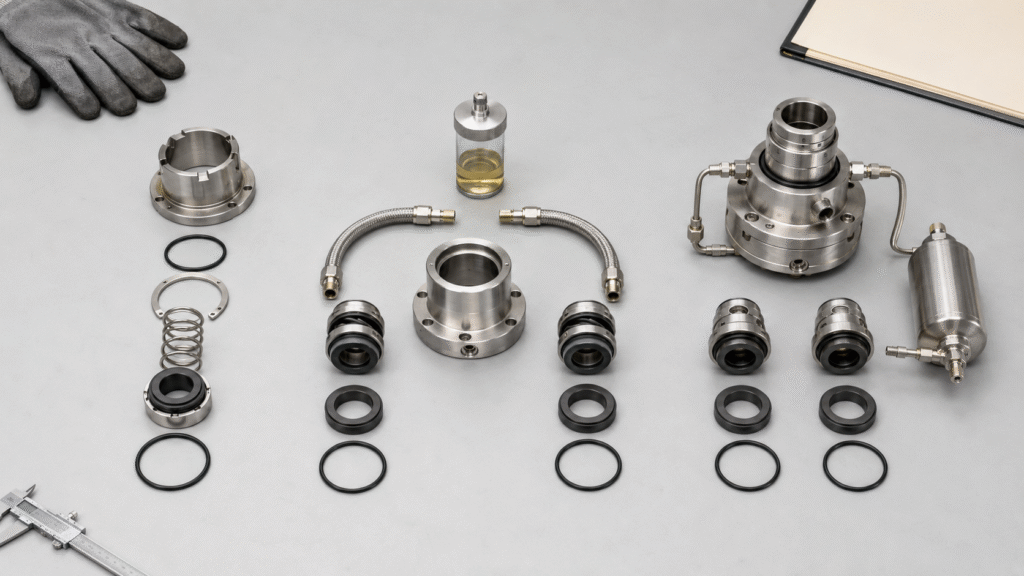
Advantages of a Single Mechanical Seal
Single seals use fewer parts and require less axial space. In addition, they normally need simpler piping and fewer instruments. Installation, startup, and troubleshooting can therefore remain straightforward. These benefits make a single arrangement practical for many water pumps, general industrial pumps, and stable fluids that provide adequate face lubrication.
Purchase and repair costs are often lower because one set of faces needs attention. Furthermore, maintenance teams may already stock common component seals and seats. A broad pump mechanical seal range can support many standard pump families. However, dimensional fit and material compatibility still require verification before ordering.
Where Single Seals Work Best
Single seals often suit clean water, cooling water, mild oils, and other nonhazardous liquids. The process should remain stable at the seal chamber and provide a useful lubricating film. Therefore, low vapor margin, frequent dry running, heavy solids, or rapid crystallization can make a simple arrangement less reliable.
The surrounding area must also tolerate the expected leakage level. For example, a small amount of clean water may create little process risk. However, the same leakage rate becomes unacceptable with a toxic solvent or strong odor. The single vs double mechanical seals decision must therefore include safety and environmental consequences.
Limitations and Risks of a Single Seal
A single seal provides only one primary sealing interface. If it fails, process liquid can reach the atmosphere or surrounding equipment. Therefore, sites handling dangerous fluids may need a secondary containment method. Even when the liquid is harmless, uncontrolled leakage can damage bearings, foundations, electrical equipment, or nearby products.
The process liquid also contacts and lubricates the faces directly. Consequently, poor lubricity, flashing, solids, or chemical deposits can shorten seal life. A harder face combination may improve wear resistance, but it cannot correct vapor formation or dry running. In addition, an external flush can help only when its source and flow remain reliable.
When a Single Seal Becomes a False Economy
A lower purchase price does not guarantee lower operating cost. Repeated leakage, cleanup, lost product, and production interruptions can exceed the initial saving. Therefore, review the previous failure pattern before installing the same arrangement again. A mechanical seal leaking after installation may also indicate poor setting, damaged faces, incorrect materials, or pump problems.
However, upgrading to two seals without fixing vibration, runout, or suction problems will not ensure reliability. Both arrangements need a stable pump and correct operating conditions. The correct response is a complete failure analysis, followed by a seal arrangement that addresses the actual risk.
Benefits of Double Mechanical Seals
Double seals create an intermediate zone between the process and atmosphere. Therefore, they can provide secondary containment or complete process isolation, depending on pressure. The clean intermediate fluid may also cool and lubricate one or both face pairs. This feature helps when the process liquid has poor lubricity or damages exposed seal faces.
In addition, the outboard seal provides a second controlled boundary. Monitoring pressure, level, temperature, or flow can reveal changes before process leakage becomes uncontrolled. Consequently, plants can plan maintenance from support-system condition rather than waiting for visible leakage. This benefit strongly affects single vs double mechanical seals selection when failure consequences are serious.
Better Control of Difficult Fluids
Pressurized dual seals can keep crystallizing, polymerizing, abrasive, or corrosive products away from the inboard face interface. However, barrier fluid must remain compatible with the process. Any inward leakage should not damage product quality, create a reaction, or disrupt downstream treatment.
Unpressurized dual seals can collect leakage from volatile or moderately hazardous fluids. The buffer system then directs vapor or liquid toward safe recovery. Therefore, these arrangements can reduce atmospheric release without allowing barrier fluid into the product. Yet they still require careful evaluation because some process leakage can eventually pass the outboard seal.
Costs and Responsibilities of a Double Seal
A double system costs more because it includes another face pair, additional hardware, and support equipment. Depending on the design, it may also require a reservoir, cooler, pressure source, circulation device, instruments, and alarms. Therefore, buyers should include these items when comparing single vs double mechanical seals.
Maintenance also becomes more demanding. Technicians must check fluid level, pressure, temperature, contamination, and circulation. In addition, they must use the correct support fluid and keep the system vented. John Crane buffer and barrier fluid guidance explains that fluid compatibility, lubricity, heat transfer, stability, and safe handling all matter.
Support-System Failure Can Damage Both Seals
A blocked line, empty reservoir, incorrect pressure, or trapped air can remove lubrication and cooling. As a result, both face pairs may overheat even when the mechanical seal itself is correctly built. Operators should verify the support system before starting the pump and after any maintenance work.
Barrier pressure also needs controlled margin above seal chamber pressure. Too little margin may allow process fluid into the barrier zone. However, excessive pressure can increase leakage into the pump and raise face loading. Therefore, use the seal and support-system instructions rather than applying one pressure rule to every pump.
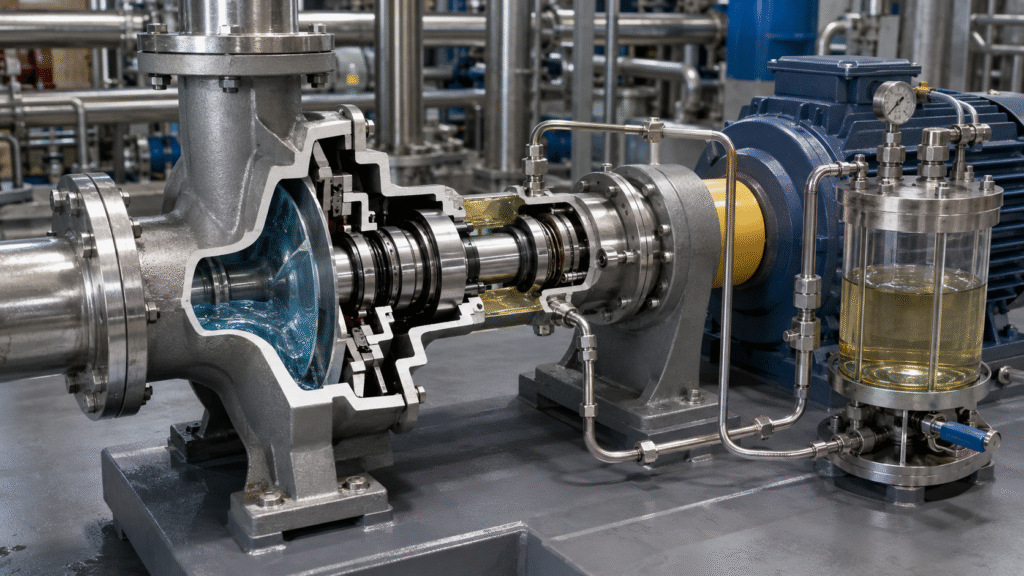
Tandem, Back-to-Back, and Face-to-Face Designs
The term “double seal” describes several physical orientations. Tandem seals place both sets in the same general direction and often use an unpressurized buffer fluid. Back-to-back seals face away from each other, while face-to-face designs oppose the rotating faces differently. Consequently, each arrangement responds differently to pressure reversal, axial space, and circulation.
Do not select an orientation only from a catalog picture. First, confirm normal and transient seal chamber pressure. Next, review rotation, solids, heat removal, and available ports. Finally, check how each seal behaves if the barrier or buffer system loses pressure.
API 682 seal arrangements classify one-seal, dual-unpressurized, and dual-pressurized systems by function. However, many general industrial pumps do not follow every API 682 hardware requirement. The classification remains useful, but suppliers must still match the design to the actual pump, service, and site standard.
Materials Still Matter in Both Arrangements
When comparing single vs double mechanical seals, two face pairs do not compensate for incompatible materials. Faces, elastomers, springs, sleeves, and glands must suit every liquid they contact. Therefore, use a mechanical seal material selection guide to compare chemical resistance, wear, heat transfer, and elastomer behavior before approving either arrangement.
For a pressurized double seal, the inboard components may contact both barrier fluid and small amounts of process fluid. Meanwhile, the outboard faces normally run on the clean barrier fluid. Consequently, the material review must cover process liquid, support fluid, cleaning chemicals, and temperature across the complete operating cycle.
Cartridge Construction Can Simplify Dual-Seal Installation
Many double seals use cartridge construction because the gland, sleeve, faces, and setting devices arrive as one assembly. This approach can reduce field-setting errors and simplify piping connections. Buyers can review a cartridge mechanical seal range when a pump has adequate chamber space and a suitable mounting interface.
However, a cartridge does not make every double seal interchangeable. Confirm shaft size, gland register, bolt pattern, port direction, axial clearance, and coupling access. In addition, verify whether the design needs a pressurized barrier or unpressurized buffer system before connecting the piping.
How to Choose the Correct Arrangement
First, describe the complete fluid, including concentration, solids, vapor pressure, toxicity, and cleaning chemicals. Next, record temperature, seal chamber pressure, speed, startup frequency, and dry-running risk. These facts define whether the process can safely lubricate a single seal or needs isolation.
Then consider leakage consequences. Ask whether process fluid may reach the atmosphere, whether contamination may enter the product, and whether cleanup is acceptable. Therefore, high hazard or strict purity requirements often justify a double arrangement. Clean and nonhazardous service may remain suitable for one seal.
Finally, evaluate maintenance resources and utilities. A double system needs trained technicians, compatible support fluid, instruments, and inspection routines. If the site cannot maintain those items, reliability may suffer. The single vs double mechanical seals choice must fit the real operating organization, not only the engineering specification.
Information to Send the Supplier
Provide the pump manufacturer, model, shaft size, chamber dimensions, and current seal arrangement. In addition, include process conditions, available piping connections, support-fluid options, and previous failure details. Clear photographs can help a supplier identify the correct mechanical seal and distinguish component, cartridge, single, and dual configurations.
Ask the supplier to confirm face materials, elastomers, metal parts, seal orientation, support plan, and required pressure. Finally, request an installation drawing and startup procedure. This information reduces uncertainty and helps the maintenance team prepare the pump before the new seal arrives.
Final Single vs Double Mechanical Seals Decision
Choose a single seal when the fluid lubricates the faces, leakage presents low risk, and the pump operates under stable conditions. It offers simpler installation, fewer support components, and lower initial cost. However, the process must tolerate the controlled leakage path inherent in face sealing.
Choose a double seal when containment, isolation, or clean face lubrication outweighs added complexity. It may suit hazardous, volatile, abrasive, crystallizing, or poorly lubricating fluids. Therefore, the best single vs double mechanical seals decision balances process risk, support-system capability, pump compatibility, materials, and lifecycle cost.