A mechanical seal support system controls the environment around a seal when the process or pump cannot provide stable conditions by itself. The mechanical seal still controls leakage between the rotating shaft and stationary housing. Meanwhile, the support system manages lubrication, heat, fluid phase, cleanliness, circulation, and pressure around the faces.
Not every pump needs complex equipment. Many clean, cool, stable liquids can support a suitable single seal. However, hot, dirty, crystallizing, volatile, poorly lubricating, or hazardous services may need additional control. Therefore, the right approach starts with the seal-chamber environment, not with adding more piping.
What Is a Mechanical Seal Support System?
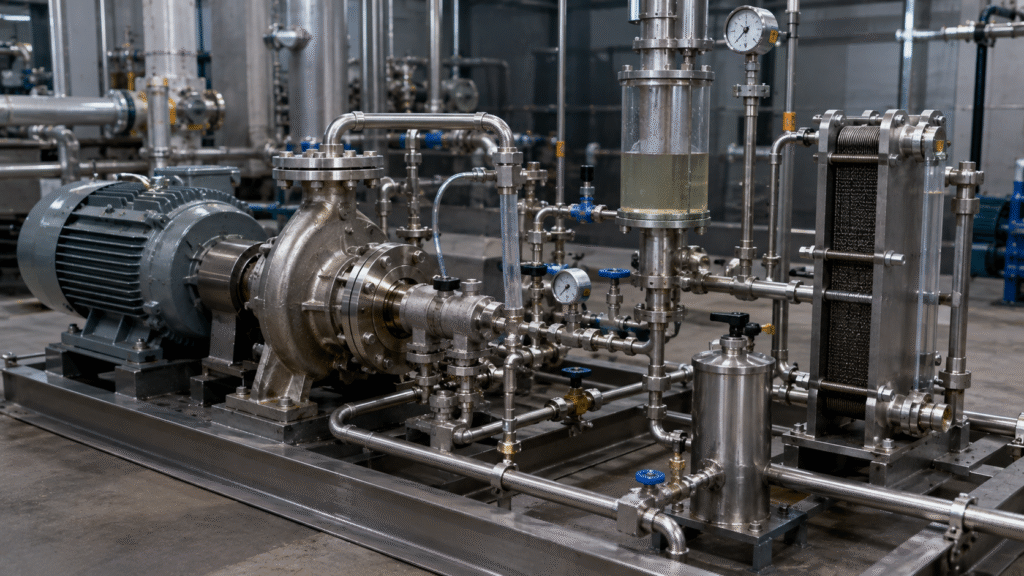
A mechanical seal support system is the piping, fluid circuit, reservoir, cooler, separator, quench, or related equipment that supports the seal environment. It does not replace the mechanical seal. Instead, it helps create conditions in which the primary faces and secondary seals can operate reliably.
Depending on the application, standardized seal support system configurations may circulate process liquid, introduce a compatible external flush, remove heat, manage solids, or provide buffer or barrier fluid. In addition, some systems monitor pressure, temperature, level, or flow. Therefore, complexity depends on the pump, seal arrangement, risk, and operating conditions.
What Conditions Must a Mechanical Seal Control?
Mechanical seals work best when the face interface receives stable lubrication and avoids damaging heat, vapor, or contamination. Therefore, support-system design should focus on conditions inside and around the seal chamber rather than only on pump discharge conditions or general process temperature.
Lubrication
Wet-running seal faces depend on a thin liquid film. The surrounding fluid must provide suitable lubrication at seal-chamber pressure and temperature. If circulation is poor or vapor enters the interface, friction can rise quickly. A support system may help maintain a usable liquid environment, but it cannot make every process fluid suitable.
Temperature
Face friction, process heat, and fluid shear can raise local temperature. As a result, viscosity, elastomer behavior, vapor pressure, deposits, and face distortion can change. Cooling may involve controlled circulation, a heat exchanger, or chamber or jacket cooling where the equipment supports it. Cooling and flushing are related tools, but they are not identical concepts.
Fluid Phase and Vaporization
A liquid that approaches vaporization near the seal can lose the stable film needed for wet-running operation. Therefore, engineers should consider seal-chamber pressure, actual liquid temperature, vapor pressure, and circulation together. Improving vapor margin may require cooling, pressure control, better circulation, or a different seal arrangement.
Cleanliness
Solids, crystals, coke, or process deposits can enter the face interface or restrict springs and moving secondary seals. Consequently, cleanliness can be as important as temperature. Depending on the service, the solution may involve recirculation, external clean flush, filtration, separation, chamber design, or another sealing arrangement.
When Does a Mechanical Seal Need a Support System?
A simple seal chamber can be enough when the liquid is clean, cool, stable, and able to lubricate the faces. The pump and seal geometry must also provide suitable circulation and venting. In this situation, extra reservoirs, coolers, or external flush lines may add maintenance without solving a real problem.
A mechanical seal support system becomes more important when conditions threaten the face environment. Examples include hot liquid, low vapor margin, abrasive solids, crystallizing products, poor lubricity, high containment requirements, or dual-seal operation. However, each condition can require a different response. Dirty fluid does not automatically require external water, and hot fluid does not automatically require a cooler.
Process-Side Flush and Recirculation
Process-side circulation uses the pumped liquid itself to influence the seal chamber. The liquid may move from a higher-pressure region toward the chamber, or circulate locally through a controlled loop. The goal is to remove heat, support venting, or maintain a more stable fluid condition.
Using Process Fluid
Using process fluid avoids introducing a foreign liquid into the product. Therefore, it can be attractive when the fluid is clean, chemically stable, and suitable for face lubrication. However, hot process fluid may carry unwanted heat, while dirty fluid may bring solids directly toward the seal.
The API 682 seal flush plans guide explains how Plan 11, Plan 21, and Plan 23 use different process-side circulation and cooling concepts. This article keeps those plans separate because piping-plan selection depends on pump pressure, chamber geometry, heat load, and process conditions.
Using an External Clean Flush
An external flush introduces a compatible clean liquid from another source. It can help isolate the seal faces from dirty, abrasive, crystallizing, or poorly lubricating process fluid. In addition, it may improve local cleanliness and heat removal when the external fluid is correctly selected.
However, added liquid may dilute or contaminate the process, affect downstream treatment, react with the product, or change system balance. Therefore, engineers must review chemistry, pressure, contamination limits, and fluid availability before using an external source.
Mechanical Seal Cooling Systems
Cooling aims to control temperature at or around the seal. A cooler may remove heat from a circulating fluid, while a jacket or cooled chamber can reduce local temperature where the pump design allows it. In other systems, circulation alone can carry enough heat away without a separate exchanger.
Therefore, the choice depends on the real heat source. If hot process liquid continuously enters the chamber, cooling duty differs from a local loop that mainly removes seal-generated heat. Therefore, the mechanical seal support system should control the chamber condition rather than simply adding cooling hardware.
Quench Systems on the Atmospheric Side
A quench acts on the atmospheric side of the mechanical seal, not the process-side face environment. Depending on the application, a compatible quench fluid or gas may help prevent icing, wash deposits, reduce crystallization, or control conditions around the outboard area.
Therefore, quench should not be confused with a process-side flush. The two act on different locations and solve different problems. Some applications use neither, while others may use both. The seal drawing and approved mechanical seal piping plans should identify the intended quench connection and operating method.
Buffer Fluid vs Barrier Fluid
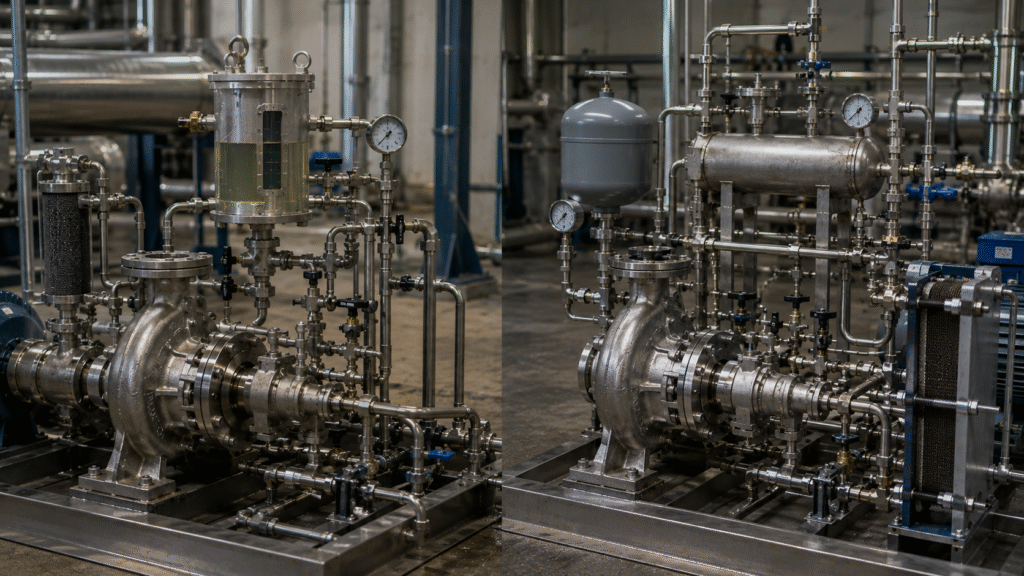
Buffer and barrier fluids mainly support certain dual mechanical seal arrangements. The important distinction is pressure strategy, leakage direction, and the job of the intermediate fluid during normal operation, not simply whether a reservoir or external vessel appears beside the pump.
| Feature | Buffer Fluid | Barrier Fluid |
|---|---|---|
| Relative pressure concept | Normally below seal-chamber pressure | Normally above seal-chamber pressure |
| Typical dual-seal role | Supports an unpressurized intermediate zone | Supports a pressurized intermediate zone |
| Containment concept | Accepts controlled inboard leakage into the buffer zone | Tends to keep process fluid out of the barrier zone |
| Main objective | Outboard lubrication, cooling, containment and leakage management | Clean lubrication, process isolation and containment support |
| Monitoring | May include level, temperature, pressure or circulation | Commonly requires pressure plus level, temperature or circulation monitoring |
A buffer system can collect process leakage while supporting the outboard seal. By contrast, a barrier system uses a clean fluid at a higher pressure than the process-side seal chamber. The required differential must come from the seal manufacturer and system design rather than a universal value.
If you are deciding whether a single or dual arrangement is necessary, use the single vs double mechanical seals guide. For physical orientation, the tandem, back-to-back and face-to-face double seal guide explains why geometry and pressure strategy should not be treated as the same thing.
Support Systems for Dirty or Crystallizing Fluids
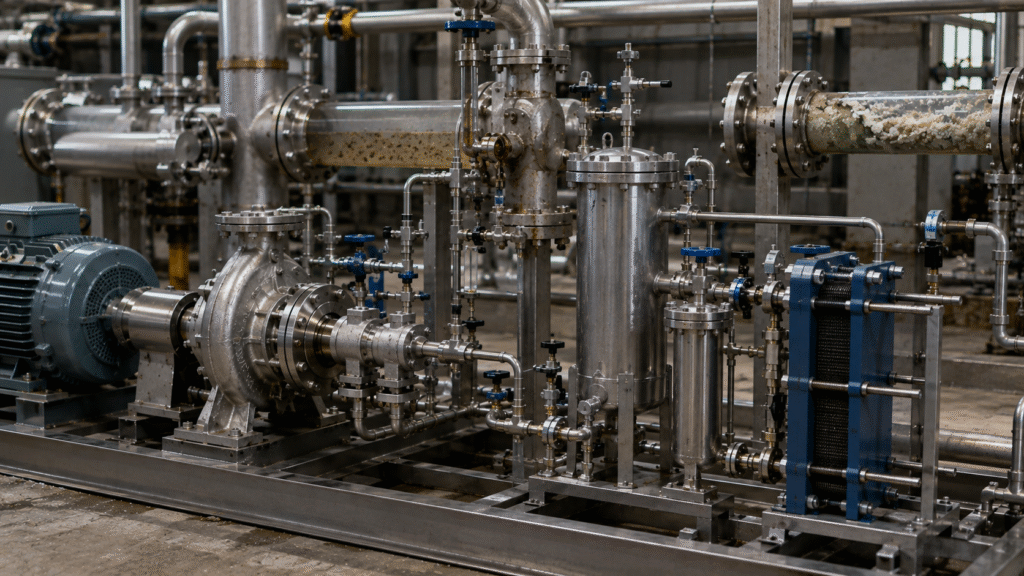
Dirty service requires more than simply increasing flush flow. Suspended solids can score faces, plug restrictions, settle in the chamber, or restrict moving components. Likewise, crystallizing products can form deposits when temperature, concentration, evaporation, or stagnant zones change near the seal chamber.
A compatible external flush may help in some applications. However, other services may need a separator, filter, improved circulation, different chamber geometry, or another seal arrangement. Therefore, solids control should begin with particle behavior and process chemistry rather than one standard piping response.
How Support Systems Work with Single and Double Mechanical Seals
Many single seals use process fluid directly, sometimes with simple recirculation or cooling. Others need an external flush or atmospheric-side quench. Therefore, the support method should match the actual lubrication, temperature, cleanliness, or atmospheric-side problem during operation without adding unnecessary equipment.
Dual seals add an intermediate zone between the process and atmosphere. That zone may contain buffer or barrier fluid, depending on the pressure arrangement. Consequently, support-system condition becomes part of seal operation. Loss of fluid, pressure, circulation, or cooling can affect both sealing interfaces.
What Should Be Monitored?
Monitoring depends on system complexity. For example, useful variables include pressure, temperature, fluid level, circulation or flow, cooler condition, contamination, valve position, and signs of blocked lines. A simple single seal may need only routine operating checks, while an engineered dual system can need continuous instrumentation.
Operators should also watch trends rather than isolated readings. A falling reservoir level, rising temperature, changing pressure, dirty support liquid, or reduced circulation may indicate developing trouble. However, alarm values and instrument requirements must follow the approved system design rather than generic limits.
Common Mechanical Seal Support System Problems
A mechanical seal support system can fail even when the seal itself was installed correctly. Common problems include blocked flush lines, closed valves, trapped air, incorrect piping, fouled coolers, contaminated buffer or barrier fluid, low reservoir level, and loss of circulation.
Incorrect commissioning creates another risk. If the pump starts before required circulation, cooling, or barrier conditions are established, the faces may lose lubrication or overheat. The mechanical seal failure guide explains why support-system problems can appear later as face damage, leakage, deposits, or repeated seal failures.
How to Choose the Right Support Approach
First, determine whether the process fluid can lubricate and cool the seal directly. Next, check temperature, vapor margin, solids, crystallization, chemical compatibility, containment requirements, and seal arrangement. Then identify the simplest practical support method that controls the actual problem without creating unnecessary contamination or maintenance.
Finally, review contamination limits, utilities, monitoring, startup sequence, and maintenance capability. A mechanical seal support system should be practical for the site to operate and maintain. Adding a cooler, reservoir, or external flush without understanding its purpose can create new failure modes instead of improving the seal environment.
Mechanical Seal Support System FAQ
Does Every Mechanical Seal Need a Flush?
No. Some seals operate successfully with process fluid already present in the chamber and need no separate flush line. Whether additional circulation is useful depends on fluid cleanliness, temperature, vapor margin, chamber design, seal geometry, startup conditions, and the manufacturer’s operating requirements.
Is Cooling the Same as Flushing?
No. Flushing changes or circulates fluid around the seal, while cooling specifically removes or controls heat. A flush can also provide cooling, but cooling may instead occur, for example, through a heat exchanger, jacket, cooled chamber, or controlled local circulation loop.
What Is the Difference Between Buffer and Barrier Fluid?
Buffer fluid normally operates below process-side seal-chamber pressure in an unpressurized dual arrangement. Barrier fluid normally operates above process-side pressure in a pressurized dual arrangement. The actual pressure strategy, monitoring method, and required differential must follow the specific seal and support-system design.
Can External Flush Be Used for Slurry?
Sometimes, but not automatically. A clean compatible flush may protect the faces from solids, yet it can also dilute the product, change chemistry, or create downstream process problems. Solids separation, filtration, chamber changes, or another seal arrangement may therefore be more suitable.
What Happens if Seal-Support Flow Stops?
Loss of circulation can reduce lubrication, cooling, vapor margin, or solids control. As a result, the seal may overheat, run partially dry, or accumulate deposits. The article on what happens when a mechanical seal runs dry explains the face-damage mechanism in more detail.
A mechanical seal support system should solve a defined operating problem. Simple services may need only a suitable seal chamber, while difficult fluids can require circulation, cooling, quench, buffer, barrier, or solids-control equipment. Therefore, start with the seal environment, choose only needed functions, and maintain the support equipment with the seal.