Mechanical seal selection starts with the pump, fluid, and operating conditions—not with the seal’s appearance. A correct replacement must fit the equipment, tolerate the process liquid, and operate within the real pressure, temperature, and speed range. Therefore, buyers and maintenance teams should collect complete application data before comparing materials or seal designs.
This mechanical seal selection guide follows a practical sequence for pump applications. It focuses on the questions that matter during purchasing, repair, and replacement work. In addition, it shows why dimensions such as the stationary seat and working length can be just as important as shaft diameter.
What Information Do You Need Before Mechanical Seal Selection?
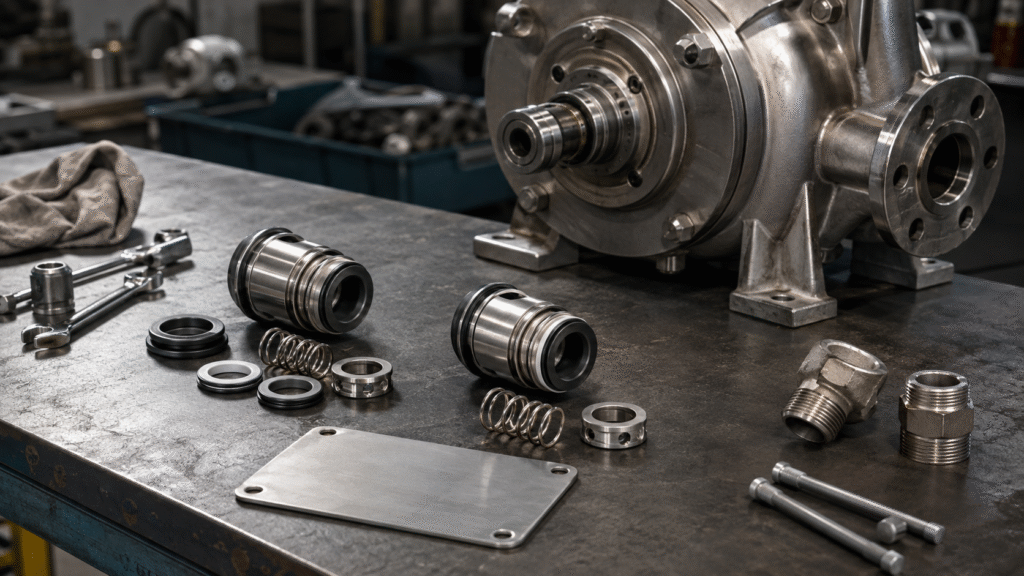
Before contacting a supplier, record the pump manufacturer, complete model, serial or product number, and shaft or sleeve diameter. Next, collect clear photographs of the rotating seal and stationary seat. Keep the old parts together because small drive features, seat profiles, springs, and elastomer shapes can help distinguish similar designs.
Operating data matters just as much. Record the pumped fluid, concentration when relevant, normal and maximum temperature, seal-chamber pressure, RPM, solids content, viscosity, and dry-running risk. Also note any flush, quench, cooling, buffer, or barrier system. This information gives the supplier a reliable basis for mechanical seal selection.
Step 1: Identify the Pump and Existing Mechanical Seal
Start with the pump nameplate whenever possible. A complete pump model can narrow the replacement options quickly, especially for branded multistage, wastewater, and process pumps. However, model information alone may not identify every production variant. Therefore, compare the old seal, stationary seat, dimensions, and installation position before ordering.
If the old seal is unknown, use a structured process to identify the correct mechanical seal. Confirm shaft diameter, rotating assembly dimensions, seat outside diameter, seat thickness, free length, and installed working length. Appearance is only supporting evidence because many seals share similar springs, retainers, and face shapes.
Step 2: Evaluate the Pumped Fluid
The pumped liquid determines lubrication, chemical compatibility, wear risk, and seal arrangement. Therefore, mechanical seal selection should describe the fluid precisely. “Water,” “chemical,” or “oil” is often too broad when concentration, contamination, temperature, or additives change material behavior.
Clean Water
Clean water normally supports simple single-seal arrangements when pressure, speed, and temperature remain suitable. Carbon against ceramic or silicon carbide is common in many pumps. However, hot water, treated water, glycol mixtures, or poor suction conditions can change lubrication and vapor margin.
Abrasive and Solids-Containing Fluids
Sand, slurry, wastewater solids, crystals, and suspended particles can enter the face interface or restrict moving parts. As a result, harder face combinations such as silicon carbide against silicon carbide may become appropriate. Tungsten carbide can also suit mechanically severe service. The complete choice still depends on particle size, concentration, chemistry, and flush conditions.
Corrosive Chemicals
For acids, alkalis, solvents, and mixed chemicals, check every wetted component. Face materials, elastomers, springs, sleeves, and metal retainers may react differently. In addition, concentration and temperature can change compatibility dramatically. A detailed chemical compatibility check should support the final material decision rather than a generic “chemical resistant” label.
Oils and Hydrocarbons
Oils often provide better lubricity than water, but viscosity and temperature still matter. Light hydrocarbons may be volatile and can form a weak lubricating film near vapor conditions. Elastomer compatibility also requires attention. For example, a material suitable for mineral oil may not suit every fuel, solvent, or synthetic oil.
Viscous or Crystallizing Fluids
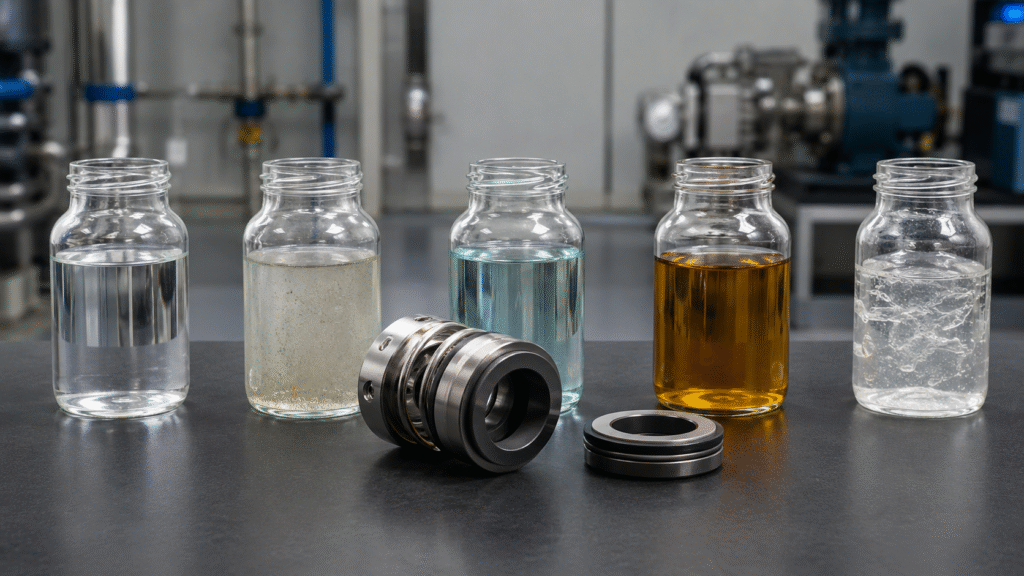
Highly viscous products can restrict circulation and heat removal around the faces. Crystallizing liquids may form deposits when pressure, temperature, or concentration changes. Therefore, consider spring location, flushing, seal chamber design, and whether the faces remain continuously lubricated. A double arrangement may help in some services, but it is not an automatic solution.
Step 3: Check Pressure and Temperature
Pressure and temperature affect face loading, fluid film stability, elastomers, and dimensional behavior. Consequently, they must be reviewed together rather than as separate catalog numbers.
Pressure
Use seal-chamber pressure when available, not simply pump discharge pressure. The actual chamber condition depends on pump design and operating point. Higher pressure can increase hydraulic closing force, especially in an unbalanced design. However, no single pressure limit applies to every mechanical seal because geometry, size, materials, speed, and fluid behavior all influence the operating envelope.
Temperature
Temperature changes viscosity, vapor pressure, elastomer properties, carbon grades, and metal expansion. In addition, hotter service can reduce the safety margin against flashing at the faces. Record both normal and maximum process temperatures. Also consider cleaning cycles, steam exposure, startup conditions, and cooling arrangements where they apply.
Step 4: Check Shaft Speed and Pump Condition
Shaft speed increases sliding velocity and heat generation at the sealing interface. Nevertheless, high speed alone does not automatically mean a balanced seal is required. Face diameter, materials, pressure, lubrication, cooling, and dynamic stability also affect the result. Therefore, use the complete seal design limits rather than one simplified speed rule.
Pump condition can invalidate an otherwise correct mechanical seal selection. Excessive shaft runout, misalignment, worn bearings, vibration, cavitation, or pipe strain can disturb face contact repeatedly. Before fitting another replacement, review shaft runout and misalignment if the pump has repeated leakage or uneven face wear.
Step 5: Select Mechanical Seal Face Materials
Face materials must manage friction, wear, heat, and chemical exposure. A mechanical seal materials guide can provide deeper comparisons, but general selection usually starts with carbon, ceramic, silicon carbide, and tungsten carbide.
Carbon
Carbon graphite offers low friction and useful running behavior against a harder mating face. It is common in clean water, oils, and many process liquids. However, carbon grade and impregnation matter. Strong oxidizers, aggressive chemicals, solids, or unsuitable thermal conditions may require another grade or a hard-face combination.
Ceramic
Alumina ceramic provides good corrosion resistance and economical performance in many light-duty pumps. It often pairs with carbon. However, ceramic is relatively brittle and conducts heat less effectively than silicon carbide. Therefore, severe thermal shock, abrasive service, or demanding speeds may justify a different hard face.
Silicon Carbide
Silicon carbide combines high hardness, strong wear resistance, good thermal conductivity, and broad chemical resistance. It is widely considered for chemical pumps, wastewater, abrasive liquids, and demanding water service. Nevertheless, different silicon carbide grades are not identical. Confirm the actual material grade when chemical resistance is critical.
Tungsten Carbide
Tungsten carbide provides high strength and good resistance to mechanical wear and impact. It can suit slurry, wastewater, and heavy-duty pump applications. However, binder chemistry affects corrosion resistance. Therefore, tungsten carbide should not automatically replace silicon carbide in aggressive chemical service.
Step 6: Select the Correct Elastomer
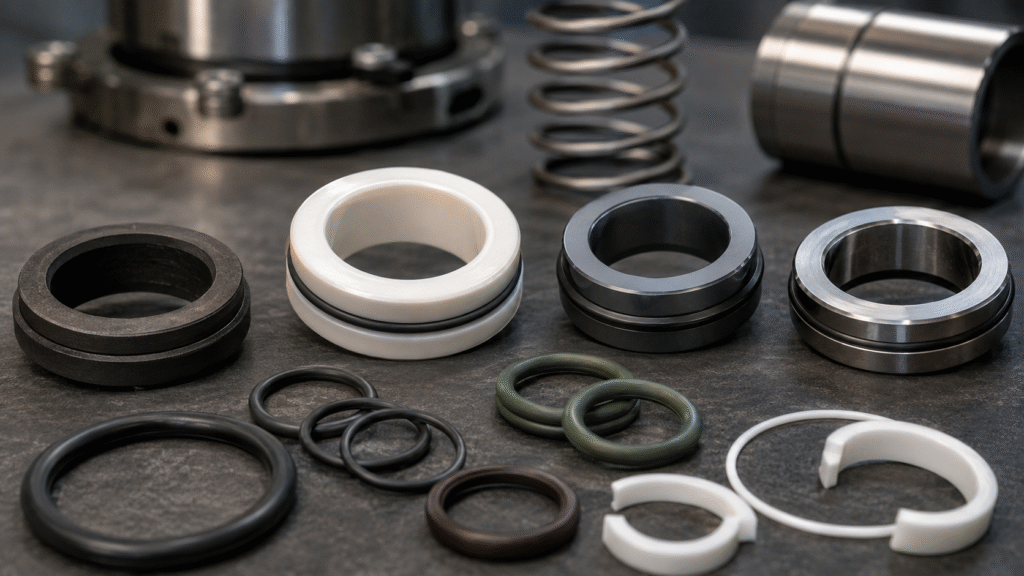
Secondary seals may use NBR, EPDM, FKM, FFKM, or PTFE-based elements, mechanical seal elastomers,depending on the design. NBR often suits oils and general industrial service. EPDM is frequently considered for water-based fluids and selected chemicals, while petroleum oils are usually a poor match. FKM suits many oils, fuels, and chemicals, but not every solvent or base.
FFKM offers broader chemical and temperature capability in demanding applications, although the exact compound still matters. PTFE provides very broad chemical resistance but is not an elastomer and has different sealing behavior. Therefore, the design must support it correctly. Never identify an O-ring compound by color alone because color is not a reliable material code.
Step 7: Single or Double Mechanical Seal?
A single seal is often suitable when the fluid lubricates the faces adequately, process leakage presents limited risk, and the pump operates under stable conditions. It usually needs fewer support components and less maintenance. However, a single arrangement is not automatically correct just because the liquid is nonhazardous.
The single vs double mechanical seals decision should also consider toxicity, volatility, lubricity, crystallization, solids, containment requirements, and available auxiliary systems. A double seal can provide secondary containment or clean face lubrication. Yet its success depends on the correct buffer or barrier system, compatible support fluid, pressure control, monitoring, and maintenance.
Step 8: Balanced or Unbalanced Mechanical Seal?
Balanced seals reduce the effective hydraulic closing area and can lower face loading under pressure. Unbalanced seals often use simpler geometry and can work reliably in suitable general-purpose duties. However, mechanical seal selection should never use one universal pressure boundary to separate the two designs.
The balanced vs unbalanced mechanical seals decision depends on balance ratio, seal geometry, shaft diameter, face materials, fluid properties, speed, lubrication, and operating temperature. Pressure direction and transient conditions also matter. API Standard 682 provides an important framework for shaft sealing systems in demanding process industries, but final suitability still depends on the actual seal and service.
Step 9: Component or Cartridge Mechanical Seal?
Component seals can be economical, compact, and widely available. However, installers must position the rotating and stationary parts correctly. Working length and spring compression are especially important because they determine the installed face loading. A component seal that fits the shaft can still be wrong if its axial setting differs.
A cartridge seal arrives as a preassembled unit with the main sealing components held in their intended relationship. Therefore, it can reduce field-setting and positioning errors. Cartridge construction does not remove the need to confirm shaft size, gland geometry, chamber space, port arrangement, pump condition, and operating requirements.
Why the Stationary Seat and Working Length Matter
The stationary seat forms the mating surface for the rotating face and also establishes part of the installed geometry. Its outside diameter, inside diameter, thickness, profile, mounting style, and elastomer arrangement can all affect fit. Consequently, two rotating assemblies with the same shaft size may require completely different stationary seats.
Working length is equally important for component seals. Too little compression may provide insufficient closing force, while excessive compression can increase face loading and heat. Therefore, never select only by shaft diameter or relaxed seal length. Confirm the installed axial dimension and spring compression required by the specific design.
Common Mechanical Seal Selection Mistakes
The most common mistake is selecting by shaft diameter alone. Another is choosing a seal because it looks similar to the old part. Buyers also make errors by ignoring the stationary seat, estimating working length, or copying the old face materials without checking whether the fluid or duty has changed.
Mechanical condition is another frequent blind spot. A new seal cannot repair worn bearings, excessive runout, poor alignment, cavitation, or severe vibration. In addition, harder face materials do not automatically solve a pump problem. Correct selection requires both a suitable seal and a stable machine.
Information to Send Before Ordering a Replacement Mechanical Seal
For reliable mechanical seal selection, send the supplier enough information to verify both fit and service conditions. Include:
- Pump manufacturer
- Complete pump model
- Serial or product number
- Shaft or sleeve diameter
- Clear rotating seal photos
- Clear stationary seat photos
- Rotating seal dimensions
- Stationary seat dimensions
- Installed working length, if known
- Pumped fluid and concentration
- Normal and maximum temperature
- Seal-chamber pressure
- RPM
- Existing or required face materials
- Existing or required elastomer
- Quantity required
When information is incomplete, send the old rotating assembly and stationary seat details together rather than guessing. A supplier can then compare the pump identity, dimensions, material needs, and seal design. For standard replacement work, reviewing a pump mechanical seal range can also help narrow the available constructions.
Good mechanical seal selection is a process of confirmation, not visual matching. First identify the pump and existing seal. Next define the fluid and operating conditions. Then verify materials, arrangement, hydraulic balance, stationary seat, and working length. Finally, confirm the pump itself is mechanically stable. This sequence gives purchasing and maintenance teams a stronger basis for ordering the correct replacement seal.