When a mechanical seal runs dry, the thin liquid film between its rotating and stationary faces disappears or becomes unstable. Friction then rises sharply, heat builds at the sealing interface, and damage can develop very quickly. Even if the pump still appears to operate, the seal may already be losing the surface condition needed for reliable service.
Dry running does not always mean the entire pump contains no liquid. A seal can experience partial or intermittent dry running while liquid remains elsewhere in the system. Trapped air, vaporization, poor seal-chamber circulation, or a failed flush can remove lubrication specifically from the seal faces.
Understanding this distinction helps maintenance teams find the real cause instead of simply installing another seal.
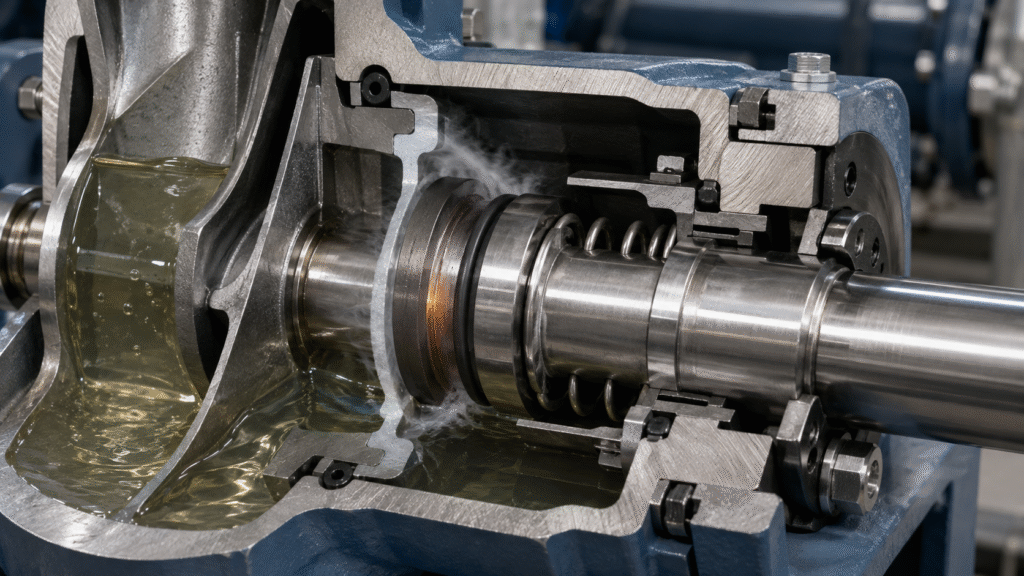
Why a Mechanical Seal Needs a Liquid Film
Most conventional liquid-lubricated pump seals operate with two extremely flat faces running very close together. One face rotates with the shaft, while the other remains stationary. A microscopic fluid film develops between them during normal operation.
This film performs two important jobs. First, it reduces direct contact and friction between the faces. Second, it carries heat away from the sealing interface. The AESSEAL explanation of how a mechanical seal works describes this separation as a key part of stable seal operation.
The EagleBurgmann lubrication film guidance also explains that the process medium or an external fluid provides lubrication and cooling. Film behavior depends on factors such as pressure, temperature, speed, medium, and face materials.
When the liquid film collapses, the seal moves toward direct face contact. Friction increases and generates additional heat. Higher temperature can then reduce lubrication further. Therefore, dry running can become a self-accelerating failure process.
This is different from purpose-designed dry gas seals or special dry-running seal technologies. Those products use different face geometry, materials, coatings, or gas-film principles. A standard liquid-lubricated pump seal should not be assumed to have the same dry-running capability.
What Causes a Mechanical Seal to Run Dry?
Dry running often begins with a pump-system problem rather than a defective mechanical seal. Therefore, the failed seal should be treated as evidence of the operating condition.
The Pump Was Not Properly Primed
A common cause occurs during commissioning or maintenance. The motor starts before the pump casing and seal chamber are completely filled and vented.
Air trapped around the seal faces prevents a stable liquid film from forming. This problem can occur even when technicians have partially filled the pump.
A good mechanical seal installation guide should therefore include priming, venting, and confirmation of seal-support flow before startup.
The Tank or Suction Source Runs Empty
A centrifugal pump may continue rotating after the supply tank reaches a low level. The pump can then draw air or gas instead of a continuous liquid stream.
This situation frequently affects transfer pumps, tank-drainage pumps, batch processes, and systems controlled manually. Intermittent air entry may create repeated short dry-running events before the pump finally loses suction completely.
Low-level switches and suitable control logic can help prevent this operating condition.
Flush or Seal-Support Flow Is Lost
Some mechanical seals depend on recirculation, an external flush, barrier fluid, or another support arrangement. If that flow stops, the seal environment can change rapidly.
Blocked piping, closed valves, contaminated strainers, incorrect valve sequencing, or support-system failure can remove cooling and lubrication from the faces.
Flowserve mechanical seal piping plans are designed to create suitable conditions around mechanical seals. However, the correct arrangement depends on the process, seal configuration, fluid properties, and equipment design.
Vaporization and Cavitation Disrupt the Film
A seal can experience dry-running damage even when the pump still contains liquid. If local pressure drops enough, part of the liquid near the seal may vaporize.
Likewise, cavitation, poor suction conditions, hot process fluids, or operation near the liquid’s vapor pressure can create unstable two-phase conditions. Gas or vapor does not provide the same lubricating behavior as the intended liquid film.
Therefore, investigating a dry-running failure should include suction conditions, process temperature, seal-chamber pressure, and abnormal pump noise.
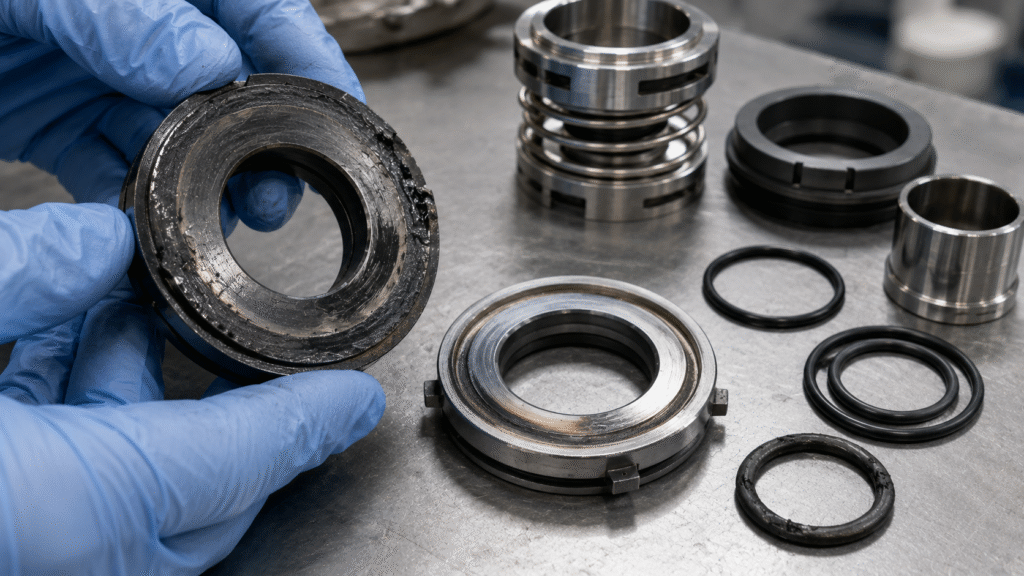
What Damage Happens When the Seal Faces Run Dry?
The first change is usually not an obvious broken component. Instead, the operating condition at the seal interface changes.
As lubrication decreases, direct face contact increases. Friction generates heat in a very small area. The faces may then distort, glaze, wear, crack, or lose the flat surface required for controlled sealing.
Carbon Faces Can Glaze, Wear or Overheat
Carbon is widely used because it provides useful friction and wear characteristics against harder mating faces. However, it still depends on the intended operating environment.
During severe dry running, the carbon surface can become polished or glazed. It may also show accelerated wear, edge damage, heat discoloration, or other signs of abnormal friction.
Some damage may look minor after disassembly. However, a change in face flatness or surface condition can be enough to cause leakage after the pump returns to normal operation.
For more detail on carbon, ceramic, silicon carbide, and tungsten carbide, review our mechanical seal materials comparison before choosing a replacement face combination.
Hard Faces Can Suffer Thermal Stress
Ceramic, silicon carbide, and tungsten carbide provide different combinations of hardness, wear resistance, thermal behavior, and toughness. However, a hard face is not automatically immune to dry running.
Rapid frictional heating creates thermal gradients across the sealing surface. Uneven expansion can distort the face. Severe thermal stress may also contribute to fine cracking or local surface damage.
The existing article on mechanical seal thermal damage explains these temperature-related mechanisms in more detail. Dry running is one important path that can create this thermal stress.
Elastomers and Secondary Seals Also Suffer
The damage does not stop at the primary faces. Heat generated at the interface can spread into nearby O-rings, bellows, gaskets, and other secondary sealing elements.
Elastomers may harden, lose elasticity, develop compression set, or deteriorate faster when temperatures exceed their intended conditions. Chemical exposure can make the situation worse.
Therefore, replacing only the damaged carbon face may not restore reliability. Inspect the complete mechanical seal, including O-rings, rubber bellows, drive components, springs, and the stationary-seat sealing element.
Why a Seal May Leak After the Pump Is Refilled
A common maintenance mistake is assuming that a seal survived because leakage stops after liquid returns.
Once dry running has altered the sealing faces, the original fluid film may not recover correctly. Face distortion, glazing, cracks, debris, or uneven wear can change the contact pattern.
As a result, leakage may begin immediately after the pump is restarted. In other cases, the seal runs for a short period before leakage gradually increases.
If you find a mechanical seal leaking after installation, check whether the pump was completely primed and vented before its first start. Also verify that flush or barrier systems were operating before shaft rotation.
Do not automatically tighten the gland or increase spring compression. Those actions cannot repair heat-damaged faces. Additional face loading may actually increase friction and make the problem worse.
How to Inspect a Seal After Suspected Dry Running
Start by recording the operating event before dismantling the pump. Determine whether the tank emptied, suction pressure dropped, a valve closed, the flush stopped, or the process temperature changed.
Next, inspect both sealing faces under clean lighting. Look for glazing, scoring, uneven wear, discoloration, deposits, edge damage, cracks, or unusual contact patterns. Keep the rotating and stationary faces together so their wear patterns can be compared.
Inspect all secondary seals as well. Look for hardened O-rings, flattened elastomers, blistering, cracking, or heat-related loss of flexibility. Check springs and drive components for deposits or abnormal movement.
Finally, inspect the pump. Bearing condition, shaft movement, cavitation, vibration, blocked passages, and suction problems may have contributed to the event. A new mechanical seal cannot correct an unstable pump system.
The objective is not simply to confirm that the seal failed. The objective is to identify why lubrication disappeared.
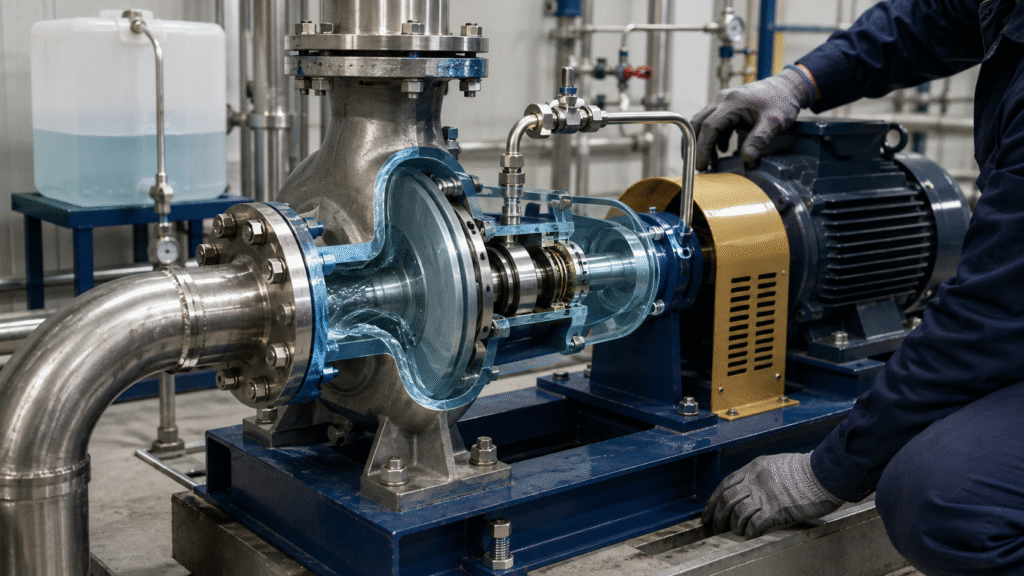
How to Prevent Mechanical Seal Dry Running
The most effective prevention starts before the motor turns. Operating procedures and system controls should make it difficult to start a conventional wet-running seal without liquid.
Prime and Vent the Pump Correctly
Fill the pump casing and seal chamber completely before startup. Vent trapped gas from high points where the equipment design requires it.
Do not assume that liquid at the suction connection means the seal chamber is fully flooded. Pump geometry can leave air pockets around the sealing area.
After maintenance, follow a defined commissioning checklist rather than relying on operator memory.
Confirm Flush and Barrier Systems Before Rotation
Where a seal uses an external flush, circulation loop, buffer system, or pressurized barrier system, establish the required condition before starting the pump.
Check valve positions, fluid level, pressure, temperature, and circulation according to the specific seal-support design.
If recurring blockages have caused previous failures, investigate the source of contamination instead of only cleaning the line after every shutdown.
Use Low-Level and Low-Flow Protection
Automatic protection can prevent human error from becoming seal damage. Tank level switches, suction-pressure protection, flow monitoring, and suitable pump interlocks may stop equipment before liquid supply is lost.
The correct instrumentation depends on the process. However, the control philosophy should address predictable dry-running scenarios.
Transfer systems that repeatedly empty tanks deserve particular attention.
Correct Suction and Vaporization Problems
If dry-running symptoms appear while liquid is still present, investigate the hydraulic conditions.
Check suction restrictions, clogged strainers, insufficient net positive suction conditions, excessive process temperature, entrained gas, and operation far from the intended pump range.
Also examine whether the liquid can flash inside the seal chamber. Improving the seal environment may be more effective than repeatedly upgrading the mechanical seal.
Choose a Seal for the Real Operating Risk
Some applications cannot completely eliminate brief loss of lubrication. Tank drainage, batch processing, high-vapor-pressure fluids, and certain process transitions may create predictable dry-running risk.
In these cases, tell the seal supplier about the operating sequence before selecting materials. Special face technologies, coatings, engineered seal arrangements, or dual sealing systems may provide better reliability.
However, material upgrades should not replace good operating practices. Even silicon carbide faces should not be treated as permission to dry-run a conventional wet mechanical seal.
Can a Mechanical Seal Survive a Short Dry Run?
There is no universal safe dry-running time for a conventional liquid-lubricated mechanical seal.
Survival depends on rotational speed, face diameter, face loading, material pair, seal design, fluid residue, temperature, pressure, and the amount of cooling that remains. A condition that causes little visible damage in one pump may destroy another seal.
Therefore, avoid rules such as “a few seconds is acceptable.” Unless the seal manufacturer specifically approves dry-running operation, start the pump only after the correct lubricating environment is established.
If an accidental event occurs, inspect the cause and operating data before deciding whether continued service is safe.
Frequently Asked Questions
Does Dry Running Always Destroy a Mechanical Seal?
Not every event creates immediate visible failure. However, conventional wet-running seals depend on a stable lubricating film. Even a short event may change face condition or accelerate wear. The safest approach is to eliminate dry running and investigate every significant loss-of-lubrication event.
Can Silicon Carbide Mechanical Seals Run Dry?
Silicon carbide offers excellent hardness, wear resistance, and useful thermal properties. However, a conventional SiC mechanical seal still depends on its intended lubrication conditions. Dry-running capability must come from the complete seal design, face technology, and operating approval, not the SiC material name alone.
Can a Blocked Flush Cause Dry Running?
Yes. If the seal depends on flush flow for lubrication, cooling, or maintaining a stable liquid around the faces, loss of that flow can create partial or severe dry-running conditions. Always identify why the flush stopped before restarting the pump.
Should I Replace a Seal After It Runs Dry?
It depends on the event and seal condition. If leakage, overheating, abnormal noise, or visible face damage appears, further inspection is necessary. For critical equipment, follow the pump and seal manufacturer’s inspection requirements rather than assuming the seal remains serviceable.
Conclusion
When a mechanical seal runs dry, the real problem is the loss of a stable lubricating and cooling film between the seal faces. Friction then increases, temperature rises, and damage can spread from the faces to nearby elastomers and other components.
Reliable prevention depends on proper priming, venting, seal-support flow, hydraulic conditions, operating controls, and correct seal selection. Most importantly, identify why the liquid film disappeared before installing another seal.