Mechanical seal thermal damage occurs when heat generation, heat removal, or temperature change pushes the sealing interface outside a stable operating condition. However, high process temperature is only one source. For example, face friction, poor lubrication, vaporization, excessive loading, blocked circulation, speed, and seal diameter can raise local temperature.
Therefore, the key question is not simply whether a pump is “hot.” Instead, technicians should identify the heat source and check whether the lubricating film remains stable. They should also inspect the faces, elastomers, and surrounding components for evidence. This approach separates mechanical seal thermal damage from general mechanical seal failure and avoids treating every dark or cracked part as proof of overheating.
What Is Mechanical Seal Thermal Damage?
Mechanical seal thermal damage describes heat-related changes that disturb face flatness, lubrication, secondary sealing, or component stability. For example, it can develop gradually or after rapid heating and cooling. Severity depends on fluid, materials, geometry, loading, circulation, and temperature-change rate. Possible results include distortion, hot spots, cracking, elastomer hardening, and unstable leakage. However, these signs are clues rather than proof because contamination, chemical attack, runout, or incorrect installation can look similar.
Where Does Heat Come From in a Mechanical Seal?
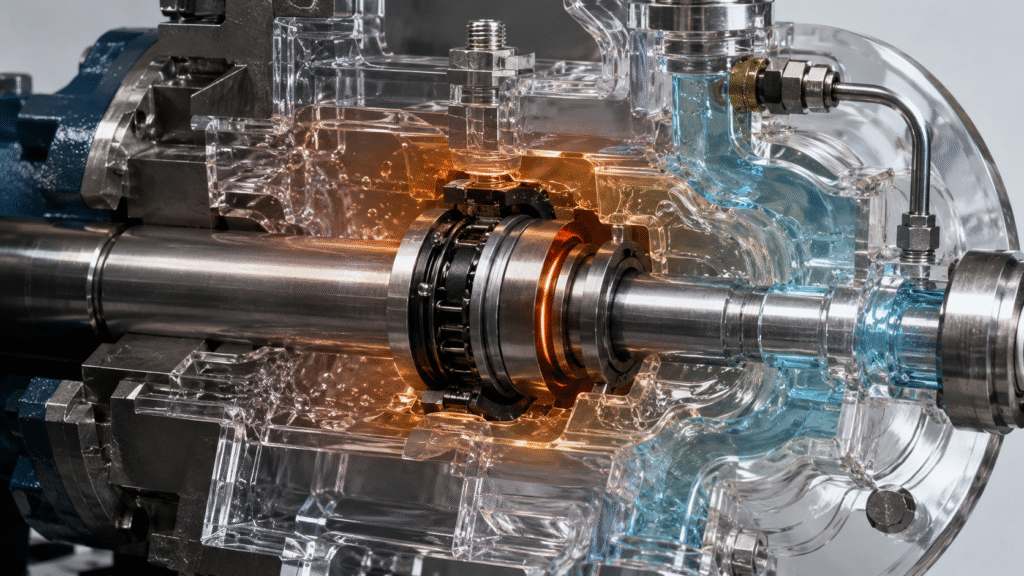
Heat at a mechanical seal can come from several sources at the same time. First, sliding contact and fluid shear generate heat directly at the face interface. Next, poor lubrication increases friction, while dry running removes much of the liquid cooling mechanism. In addition, high process temperature raises the starting temperature of the seal environment.
Excessive face loading can increase contact friction, while high shaft speed and larger seal diameter raise sliding velocity. Meanwhile, a blocked flush line, dirty cooler, or lost cooling water can reduce heat removal. Therefore, investigate overheating as a heat-balance problem rather than blaming process temperature alone.
How the Fluid Film Controls Friction and Temperature
First, a wet-running mechanical seal normally operates with a controlled liquid film between the faces. That film supports lubrication, limits severe surface contact, carries heat into the surrounding liquid, and helps control leakage. The lubrication film in mechanical seals is central to temperature control.
When vaporization, poor lubricity, dry running, or unstable pressure weakens the film, friction can increase and cooling becomes less effective. Face temperature may then rise further and destabilize the fluid again. This feedback can produce overheating, distortion, and leakage without any universal film-thickness threshold.
What Happens When Seal Faces Overheat?
Therefore, seal faces depend on high flatness and stable contact conditions. In addition, uneven temperature changes their geometry and can redistribute load across the sealing track. As a result, some areas may carry excessive contact while other areas open more than intended.
Thermal Distortion
For example, thermal distortion develops when temperature is not uniform across a seal face or its supporting structure. Different parts expand by different amounts, creating a thermal gradient. The face can then lose its intended flatness, which changes contact pressure and lubrication across the sealing band. A distorted running track may show uneven contact or localized wear. However, gland distortion, seat squareness, runout, or misalignment can create similar patterns. Therefore, appearance should lead to further checks rather than a one-photo diagnosis.
Hot Spots and Uneven Contact
Similarly, local high-contact regions generate more frictional heat. That heat can further change face shape and concentrate contact in the same area. Consequently, a hot spot can become self-reinforcing if lubrication and heat removal remain poor. Possible evidence includes glazing, polished zones, discoloration, abnormal carbon wear, or an uneven running track. However, these signs are not unique to heat, so contamination, loading errors, surface damage, and mechanical movement should also be checked.
Thermal Shock
Likewise, rapid heating or cooling can create thermal stress because materials and component regions expand or contract at different rates. Risk depends on temperature-change rate, geometry, thermal conductivity, constraint, and material brittleness. Ceramic faces can be sensitive to severe thermal shock, while silicon carbide and tungsten carbide have different thermal and mechanical characteristics. However, no hard-face material is automatically safe under every transient. Rapid or severe changes must be evaluated with the actual face pairing and seal design.
How Heat Damages Elastomers and Metal Components
In addition, heat-related damage affects secondary seals. O-rings can harden, lose elasticity, develop compression set, crack, or change shape after excessive exposure. Swelling may appear when heat accelerates chemical incompatibility. Chemical attack and heat aging can look similar. Therefore, assess elastomer heat-aging behavior with fluid chemistry, cleaning media, exposure time, and compound specification. Therefore, color cannot identify the elastomer or prove the cause.
Metal components can also be affected. Temperature may change clearances, alter thermal growth, or combine with chemical exposure to accelerate corrosion and loss of movement. Therefore, inspect springs, retainers, sleeves, bellows, glands, and nearby fits when heat-related failure is suspected.
Why Vaporization Can Destabilize a Mechanical Seal
Importantly, bulk process temperature does not need to reach atmospheric boiling before vapor-related problems appear at the faces. Local pressure, frictional heating, fluid composition, and seal-chamber conditions influence film stability. If part of the film vaporizes, lubrication and heat removal can deteriorate. The faces may contact more heavily and generate additional heat. Therefore, assess vapor margin using real seal-chamber pressure and temperature rather than one process temperature elsewhere in the system.
Common Causes of Mechanical Seal Overheating
Dry Running
For example, dry running is one of the most severe heat-generating conditions for wet-running mechanical seals. Without a stable liquid film, friction can rise rapidly and face cooling falls. Damage can include distortion, cracking, wear, and secondary-seal heat exposure. The guide on what happens when a mechanical seal runs dry explains this failure mechanism in detail.
Incorrect Face Loading
Likewise, too much face load can increase friction and heat. Possible causes include incorrect component-seal working length, excessive spring compression, installation errors, or hydraulic loading that does not suit the design. Less load is not automatically better either, because insufficient closing force can destabilize the interface and increase leakage.
Poor Flush or Cooling
In addition, a blocked line, closed valve, wrong flow direction, insufficient circulation, dirty cooler, lost cooling water, or incorrect commissioning can remove needed heat-control functions. The API 682 seal flush plans guide explains Plan 11, Plan 21, and Plan 23 separately. This article focuses only on the thermal consequence of lost or inadequate circulation.
High Process Temperature
Meanwhile, high process temperature reduces the margin for removing seal-generated heat. Moreover, it can change viscosity, vapor pressure, elastomer behavior, and chemical reaction rates. Therefore, material limits and support-system capability should be checked at the actual seal-chamber condition, not only against a general pump temperature.
Temperature Cycling
Finally, frequent hot and cold cycles can expose faces and secondary seals to repeated expansion and contraction. Startup, shutdown, batch changes, CIP or cleaning cycles, and alternating process temperatures may therefore contribute to thermal fatigue or elastomer aging. However, temperature cycling alone does not prove a failure cause. The rate of change, material combination, component geometry, lubrication state, and mechanical restraint all influence whether a given cycle becomes damaging.
How to Recognize Thermal Damage
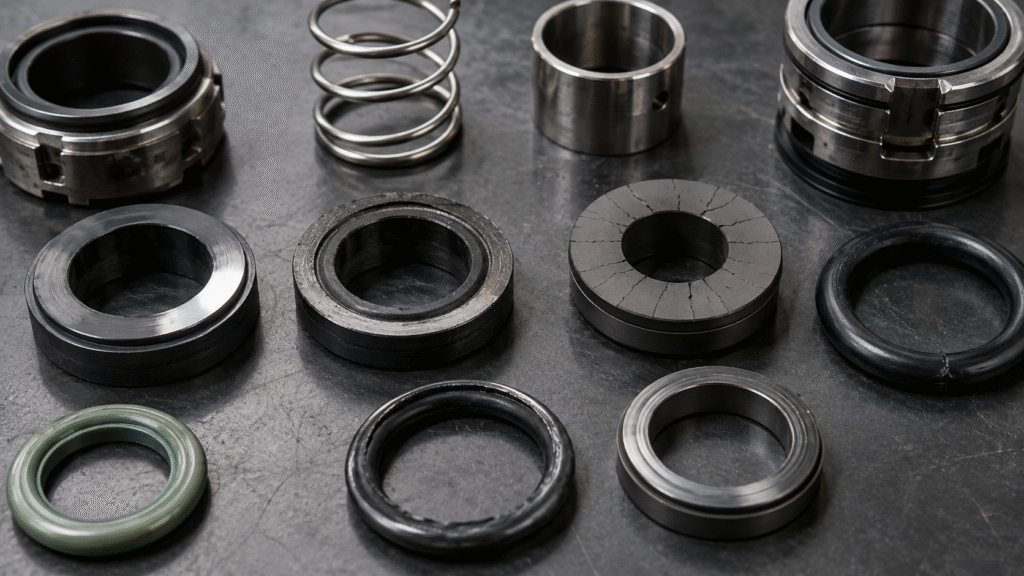
Therefore, inspection should combine physical evidence with operating history, process conditions, and surrounding component condition. The table below lists possible heat-related explanations together with other causes that deserve careful investigation before a technician assigns a reliable root cause with confidence.
| Observed Condition | Possible Heat-Related Explanation | Other Causes to Check |
|---|---|---|
| Glazed carbon face | Excess heat or weak fluid film | Contamination, face loading, surface condition |
| Fine or radial cracks | Thermal stress or rapid temperature change | Impact, installation damage, mechanical stress |
| Hardened O-ring | Prolonged temperature exposure | Chemical incompatibility, aging, wrong compound |
| Swollen elastomer | Heat-accelerated chemical interaction | Fluid incompatibility, cleaning chemical |
| Uneven wear track | Thermal distortion or local hot spot | Runout, misalignment, gland or seat distortion |
| Chipped hard face | Thermal stress may contribute | Impact, vibration, installation damage |
| Discoloration or deposits | Local heating or vaporization | Chemistry, contamination, crystallization |
| Rapid temperature rise with leakage | Film instability or excessive friction | Incorrect loading, dry running, support-system failure |
These observations are not one-to-one failure codes, and several mechanisms may produce similar surfaces. Therefore, use the mechanical seal failure guide when mechanical, hydraulic, chemical, and thermal causes overlap or when the evidence does not point clearly to one heat-related mechanism.
How to Prevent Mechanical Seal Thermal Damage
Therefore, preventing mechanical seal thermal damage should target the actual heat source and the missing heat-removal mechanism. A harder or more expensive material may help in a verified material limitation, but it cannot replace stable lubrication, correct loading, circulation, or appropriate operating control.
Maintain a stable liquid film. Keep the chamber filled and investigate vapor formation, low lubricity, or unstable pressure before damage repeats.
Check actual seal-chamber temperature. Review circulation, pressure, vapor margin, and heat input rather than relying only on process temperature elsewhere.
Prevent dry running. Prime and vent the pump, and establish support-system conditions before operation.
Control startup and shutdown. Avoid unnecessary rapid temperature changes and monitor temperature and leakage according to the pump, seal, and site procedure.
Maintain flush and cooling systems. Keep lines open, coolers clean, valves correctly positioned, and circulation paths properly commissioned.
Use compatible materials. Review face pairing, thermal conductivity, chemical compatibility, elastomer compound, and temperature together. The mechanical seal materials guide covers carbon, ceramic, SiC, and tungsten carbide.
Check face loading and installation. Confirm working length, spring compression, gland condition, and the required installation sequence.
Monitor pump operation. Vibration, cavitation, speed changes, or altered suction conditions can disturb the fluid film and heat balance.
When Changing Materials Will—and Will Not—Solve the Problem
For example, a material change can help when evidence shows the original face, elastomer, or metal cannot tolerate the verified environment. Another face pairing may improve thermal behavior, while another elastomer compound may better tolerate the actual temperature and fluid.
However, materials cannot correct an empty seal chamber, blocked flush, excessive face loading, unstable pressure, or poor pump condition. Do not change ceramic to SiC, carbon to a hard face, or FKM to FFKM only because it appears more advanced. The mechanical seal material selection guide explains how to verify a material change against fluid, temperature, solids, lubrication, and seal geometry.
Mechanical Seal Thermal Damage FAQ
Is High Process Temperature the Main Cause of Seal Overheating?
Not always. Friction, dry running, poor lubrication, vaporization, excessive loading, speed, seal diameter, and insufficient circulation can all create or trap heat. High process temperature reduces the available thermal margin, but it is only one part of the heat balance.
Does a Cracked Seal Face Prove Thermal Shock?
No. Thermal stress is one possible cause, especially after rapid temperature change, but impact, installation damage, vibration, mechanical stress, or material defects may produce similar evidence. Therefore, review the crack pattern together with operating history, face contact, surrounding components, and recent startup or shutdown conditions.
Is Silicon Carbide the Best Material for High Temperature?
Not automatically. Silicon carbide offers useful thermal conductivity and wear characteristics, but selection still depends on fluid lubricity, chemistry, mating face, solids, face loading, seal geometry, and operating conditions. Therefore, material choice must address the complete application and the actual thermal mechanism being corrected.
Can a Mechanical Seal Overheat Without Dry Running?
Yes. A seal can retain some liquid film yet still run too hot because of excessive face loading, poor circulation, vapor instability, high process temperature, high sliding speed, or restricted cooling. Therefore, overheating does not automatically prove a completely dry interface.
Should Temperature Be Monitored During Startup?
Yes, when temperature monitoring is appropriate for the pump and site procedure. Watch temperature together with leakage, vibration, pressure, and support-system condition. In addition, compare trends with normal operating behavior rather than relying on one universal observation period, because commissioning requirements differ between pumps and seal systems.
Mechanical seal thermal damage develops when heat generation, lubrication, material behavior, and heat removal fall out of balance. Therefore, diagnose the fluid film, face loading, temperature history, support system, and pump operation together. Prevent repeat mechanical seal thermal damage by correcting the thermal cause, not simply fitting a harder face.