Pump cavitation and vibration can destroy a mechanical seal even when the seal has the correct size, materials, and installation setting. The seal may begin leaking first, yet the real problem often starts elsewhere in the pump. Poor suction conditions, unstable hydraulic operation, worn bearings, misalignment, or an unbalanced impeller can force the sealing faces to operate under constantly changing conditions.
This distinction matters during troubleshooting. Replacing a damaged mechanical seal may stop the leak temporarily. However, if the pump continues to cavitate or vibrate, the new seal will experience the same loads and may fail again.
The most reliable repair therefore begins with the complete rotating and hydraulic system, not only the leaking component.
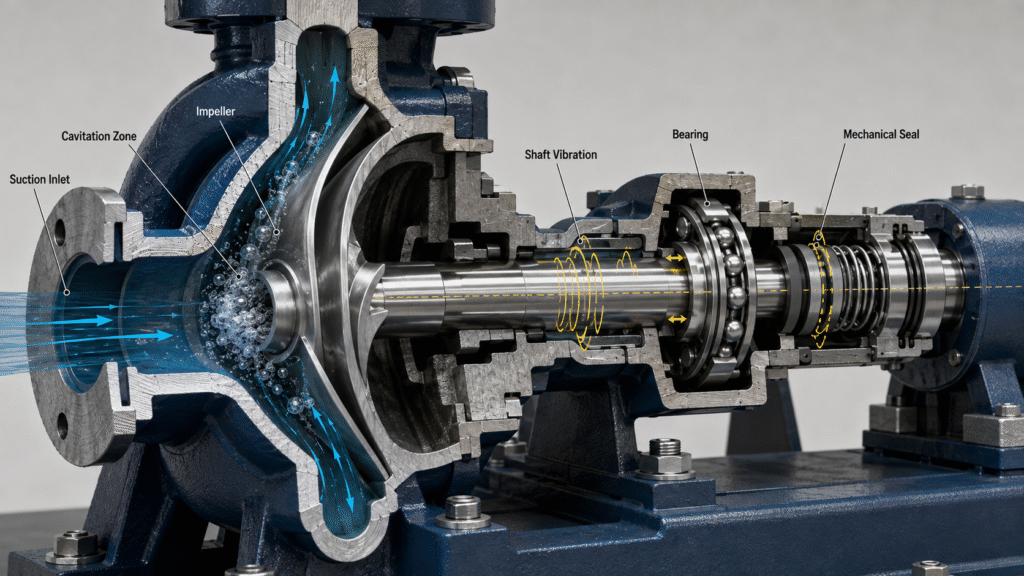
Pump Cavitation and Vibration Are Related but Not the Same
Cavitation is a hydraulic phenomenon. It begins when local liquid pressure falls low enough for vapor cavities to form. When those cavities move into a higher-pressure region, they collapse rapidly.
KSB cavitation guidance describes this process as the development and sudden collapse of vapor cavities in a fluid flow. In a centrifugal pump, the impeller inlet is a common area of concern because local pressure can fall sharply as liquid accelerates into the rotating passages.
Bubble collapse produces pressure disturbances, noise, and erosion. It can also create an unstable hydraulic load on the impeller. Consequently, the shaft, bearings, and seal can experience increased vibration.
Vibration, in contrast, describes mechanical motion. Cavitation can cause it, but so can imbalance, misalignment, worn bearings, bent shafts, pipe strain, looseness, resonance, and operation away from the intended duty point.
Therefore, not every vibrating pump is cavitating, and not every seal damaged by vibration has a suction-side problem.
Why NPSH Matters
Net positive suction head helps engineers evaluate the pump’s margin against cavitation. KSB NPSH guidance explains that available NPSH must provide enough suction margin for the selected pump and operating condition.
However, a simple NPSH check should not become the entire diagnosis. Liquid temperature, suction losses, tank level, flow rate, speed, inlet geometry, entrained gas, and the actual pump curve also influence hydraulic stability.
If conditions change after commissioning, a pump that once operated reliably may later develop cavitation.
How Cavitation Reaches the Mechanical Seal
The collapsing bubbles normally attack hydraulic components such as the impeller rather than the mechanical seal faces directly. Nevertheless, their effects can travel through the complete rotating assembly.
Pressure fluctuations create changing radial and axial hydraulic forces. The impeller transmits those forces to the shaft and bearings. The mechanical seal then has to follow the resulting shaft motion while maintaining a controlled fluid film between two very flat faces.
A small amount of designed axial movement is normal in many seal constructions. Excessive or rapid motion is different. The rotating and stationary faces may no longer maintain a stable contact pattern.
Pump cavitation and vibration can therefore turn a hydraulic problem into a sealing problem without any defect in the original mechanical seal.
Cavitation Can Also Disturb Seal-Chamber Conditions
Hydraulic instability can change more than shaft position. Pressure and flow around the seal chamber may fluctuate as the pump moves through unstable operating conditions.
If gas or vapor reaches the sealing interface, lubrication can become less stable. This condition is different from complete dry running, but repeated loss of a continuous liquid film can increase friction and local temperature.
Our guide to what happens when a mechanical seal runs dry explains what occurs when the lubricating film disappears more severely.
In addition, severe off-design operation can change recirculation patterns inside the pump. Therefore, technicians should investigate the pump operating point and suction system whenever seal damage appears together with unusual hydraulic noise.
How Excessive Vibration Damages Mechanical Seal Faces
A mechanical seal needs the rotating face, stationary face, shaft, gland, and secondary seals to remain mechanically stable. Excessive vibration keeps disturbing that relationship.
The seal’s flexible elements can compensate for limited shaft movement. However, they cannot correct an unstable rotor indefinitely.
Rapid radial movement can shift the contact pattern across the seal faces. Axial movement can make the movable face follow the shaft repeatedly. If movement exceeds the seal’s ability to track it, the faces may momentarily separate or load unevenly.
That behavior can produce leakage, accelerated wear, face chipping, and local hot spots.
Seal Faces May Show Uneven Wear or Edge Damage
A healthy sealing interface should develop a consistent running pattern for its design and application. Excessive shaft movement can concentrate load on only part of the face.
Carbon faces may show uneven polishing, chipping, or accelerated wear. Brittle hard faces can suffer edge damage when vibration or mechanical shock becomes severe.
Our mechanical seal materials comparison explains why ceramic, silicon carbide, tungsten carbide, and carbon respond differently to mechanical, thermal, and abrasive loads.
Material upgrades can improve tolerance in some applications. However, changing ceramic to a tougher face material will not repair a worn bearing or unstable shaft.
O-Rings, Bellows and Springs Also Experience Motion
The primary faces are not the only affected components. Pusher seals may contain secondary O-rings that move along a shaft or sleeve as the face adjusts axially.
Constant vibration can increase fretting, secondary-seal wear, deposit sensitivity, and movement at these interfaces. Rubber bellows may also experience repeated flexing. Springs and drive components must respond to the same unstable motion.
Therefore, a failed seal may show several damage mechanisms at the same time.
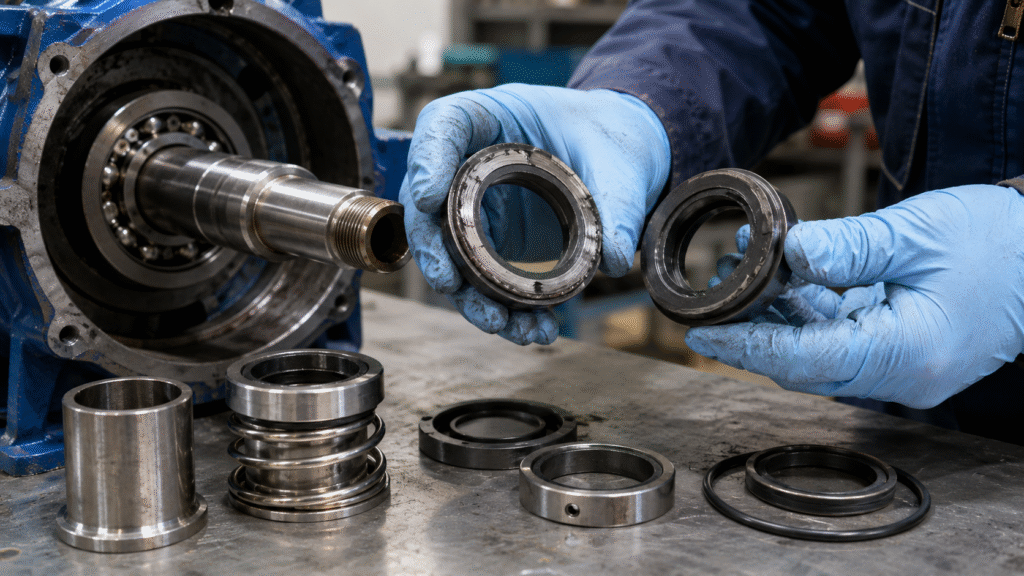
Cavitation Damage vs Other Vibration Problems
Maintenance teams should avoid diagnosing cavitation from seal leakage alone. Instead, combine operating symptoms, pump history, vibration behavior, hydraulic data, and the condition of dismantled components.
| Observation | Possible Cavitation Connection | Other Conditions to Check |
|---|---|---|
| Gravel-like or crackling pump noise | Strong indication of vapor-bubble activity | Entrained air, solids, loose components |
| Increased vibration with poor suction conditions | Cavitation may be contributing | Bearings, alignment, imbalance |
| Pitted impeller surfaces | Cavitation erosion may be present | Corrosion or abrasive erosion |
| Seal leakage only while running | Unstable hydraulic loads may affect the seal | Runout, misalignment, bearing wear |
| Uneven seal-face wear | Shaft movement may disturb face loading | Incorrect installation or gland distortion |
| Repeated seal failures after replacement | Root pump problem may remain | Wrong materials, dry running, poor flush |
| Low tank level or restricted suction | Reduced suction margin may trigger cavitation | Air leakage or blocked strainers |
KSB describes typical cavitation noise as similar to pebbles moving in a concrete mixer. However, sound alone cannot prove the cause. Combine it with suction pressure, flow, vibration, performance, and inspection evidence.
A Sulzer cavitation case study also shows the practical relationship between cavitation, elevated vibration, pump efficiency, and equipment reliability. The solution required changes to the pump operating environment rather than repeated component replacement.
Find the Source of Vibration Before Replacing the Seal
Pump cavitation and vibration often appear together, but troubleshooting should separate hydraulic causes from mechanical causes.
Start on the suction side when cavitation is suspected. Check tank level, suction pressure, liquid temperature, clogged strainers, partially closed valves, suction pipe restrictions, excessive lift, air ingress, and changes in process conditions.
Then compare the actual flow with the pump’s intended operating range. Operating too far from the best efficiency region can increase hydraulic forces and instability. Flowserve pump instructions warn against abnormal high or low flow because these conditions can contribute to cavitation, vibration, overheating, and reduced equipment life.
Next, inspect the mechanical system.
Check bearings, coupling alignment, shaft runout, shaft or sleeve condition, impeller balance, foundation, hold-down bolts, pipe strain, and evidence of looseness. Each problem can create vibration without cavitation.
If a mechanical seal leaking after installation appears only while the shaft rotates, the pump condition deserves particular attention. A seal that remains dry while stationary but leaks under rotation may be responding to runout, vibration, cavitation, or another dynamic condition.
Do Not Treat Every Vibration Problem with a Stronger Seal
A common repair strategy is to install harder faces, stronger springs, or a more expensive cartridge seal after repeated failures.
Sometimes an upgraded design is appropriate. However, the seal should not become a mechanical support for a defective pump.
John Crane condition monitoring guidance identifies imbalance, misalignment, cavitation, bearing wear, and shaft instability as rotating-equipment conditions that can accelerate seal-face wear and increase leakage risk.
This is important because several different root causes can create similar seal damage.
For example, a chipped face may suggest mechanical shock. Yet the shock could originate from cavitation, a damaged bearing, excessive runout, or poor installation. Likewise, uneven face wear may come from vibration, gland distortion, or incorrect working length.
Use a mechanical seal material selection guide only after you understand the operating problem. Select tougher materials when the real duty requires them, not as a substitute for root-cause repair.
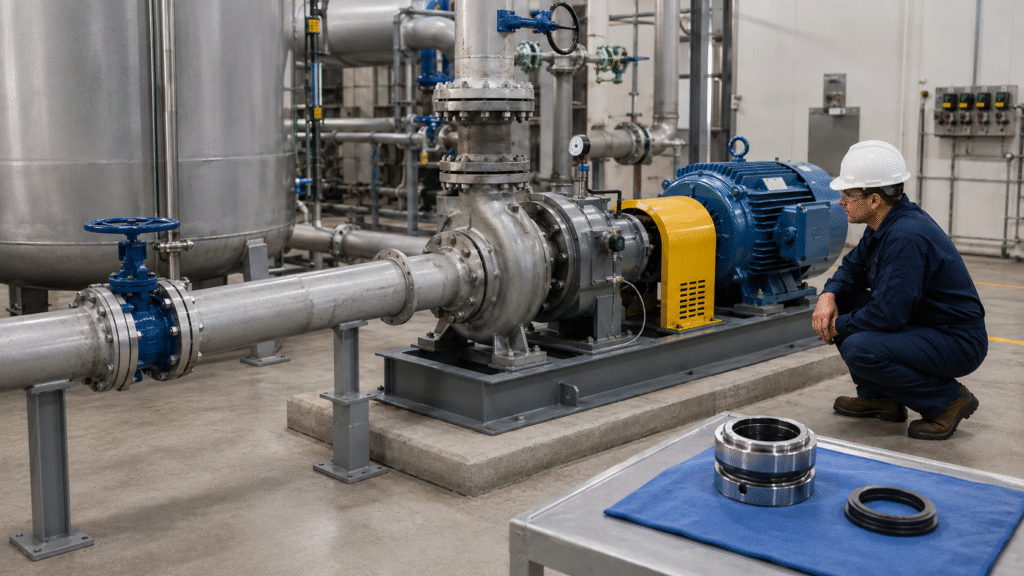
How to Prevent Cavitation- and Vibration-Related Seal Failures
Prevention begins with stable pump operation. Maintain adequate suction conditions and verify that the pump operates within the manufacturer’s permitted range.
Keep suction strainers and piping clear. Avoid unnecessary restrictions, air pockets, and leaking suction connections. Review the available NPSH when tank level, liquid temperature, pump speed, or process pressure changes.
Next, maintain the rotating assembly. Bearings, alignment, shaft condition, impeller balance, foundation stiffness, and pipe loads all influence vibration at the mechanical seal.
Trend data whenever the equipment is important enough to justify monitoring. Vibration measurements become more useful when technicians compare them with the pump’s established baseline, operating point, pressure, temperature, and flow.
Do not rely on one universal vibration number for every pump. Use the pump manufacturer’s limits, applicable machinery standards, and site reliability criteria for the specific machine.
Inspect the Failed Seal as Evidence
When a seal fails, keep the old components long enough to investigate them.
Record which face rotated, where wear appears, whether the face chipped, whether the O-rings show fretting, and whether deposits formed around the movable components. Inspect the impeller and bearings at the same time.
Also record when the leakage occurred. Startup-only leakage, intermittent leakage at low tank level, and continuous leakage at all operating points suggest different causes.
This failure history can reveal whether pump cavitation and vibration caused the seal damage or whether another condition deserves more attention.
Frequently Asked Questions
Can Cavitation Directly Break a Mechanical Seal?
Cavitation usually begins in the pump’s hydraulic passages rather than between the seal faces. However, it can create pressure fluctuations, vibration, unstable shaft loads, and poor seal-chamber conditions. Those effects can accelerate mechanical seal wear and leakage.
Can a New Mechanical Seal Stop Vibration?
No. A mechanical seal controls leakage around a rotating shaft. It does not correct bearing wear, misalignment, imbalance, pipe strain, resonance, or hydraulic instability. Repair the source of vibration before expecting normal seal life.
Can Cavitation Cause a Mechanical Seal to Leak Intermittently?
Yes. If cavitation causes changing shaft loads or unstable pressure around the seal, leakage may vary with the pump operating point. However, intermittent leakage can have other causes, so verify the hydraulic and mechanical condition before concluding that cavitation is responsible.
Should I Use Tungsten Carbide for a Pump with Vibration?
Tungsten carbide offers useful toughness in demanding services, but material selection alone does not solve excessive vibration. First correct the pump condition. Then select face materials for the actual fluid, pressure, temperature, solids, speed, and remaining mechanical loads.
How Can I Tell Whether the Problem Is Cavitation or a Bearing?
Look at the complete evidence. Cavitation often changes with suction conditions and flow and may produce characteristic hydraulic noise. Bearing problems may show different vibration patterns, temperature changes, or mechanical play. Reliable diagnosis may require vibration analysis and pump performance data.
Conclusion
Pump cavitation and vibration can cause mechanical seal failure because the seal depends on stable hydraulic conditions and controlled shaft movement. Cavitation can generate fluctuating hydraulic forces, while mechanical vibration can disturb face tracking, secondary seals, and the sealing film.
When repeated seal failures occur, do not replace the mechanical seal alone. Check suction conditions, pump operating point, bearings, alignment, shaft runout, impeller condition, and vibration history.
A stable pump gives the mechanical seal the operating environment it needs to achieve reliable service life.