Balanced vs unbalanced seals differ mainly in how hydraulic pressure loads the sealing faces. That design choice affects heat generation, wear, pressure capability, and fluid-film stability. Therefore, buyers should not judge the difference from spring size or outside appearance alone. They must review seal geometry, pump pressure, speed, fluid behavior, and failure consequences together.
When comparing balanced vs unbalanced seals, both designs can provide reliable service within suitable operating limits. However, a balanced seal is not automatically superior in every pump. An unbalanced seal can remain practical for clean liquids and moderate pressures. In addition, materials, installation quality, alignment, and lubrication often influence service life as much as hydraulic balance.
What Mechanical Seal Balance Means
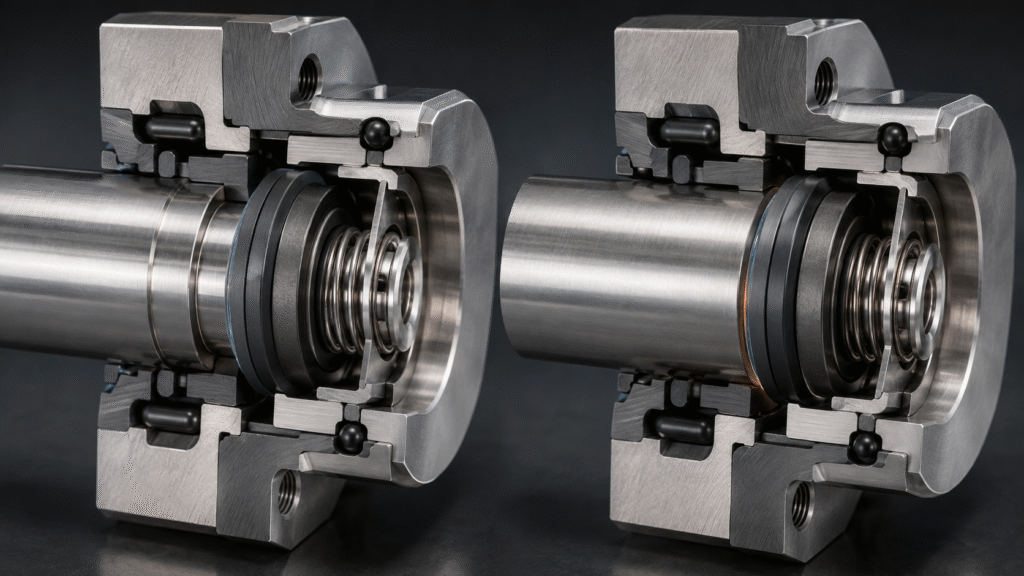
Mechanical seal balance describes the relationship between hydraulic closing area and the nominal sliding face area. Process pressure acts across part of the rotating face and pushes the faces together. Meanwhile, the fluid film creates an opening force between the lapped surfaces. Springs add closing force during startup and low-pressure operation.
For a conventional outside-pressurized liquid seal, designers create balance by changing the effective pressure area. They often use a stepped shaft, sleeve, or seal ring geometry to establish a balance diameter. As a result, process pressure acts on a smaller effective area. The faces still remain closed, but pressure creates less closing load.
Hydraulic Closing Area and Face Load
The balance ratio compares the effective hydraulic closing area with the face contact area. A ratio below one usually describes a balanced design in conventional outside-pressure service. By contrast, an unbalanced design commonly has a ratio near or above one. However, the exact definition and calculation must follow the seal orientation and pressure direction.
Net face load comes from hydraulic pressure, spring force, and the opening effect of the fluid film. Therefore, balance ratio alone does not predict every operating result. Face width, surface condition, fluid viscosity, vapor pressure, speed, and temperature also influence the film. A supplier should evaluate the complete design rather than one ratio.
How Balanced Mechanical Seals Work
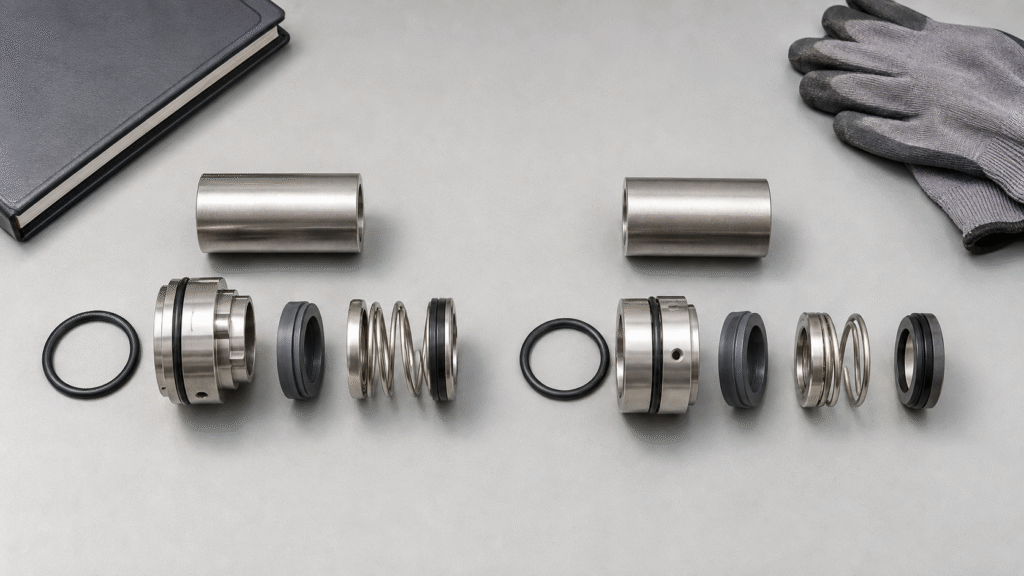
A balanced mechanical seal reduces the hydraulic force that presses the faces together. Consequently, friction and heat can decrease when other conditions remain similar. Lower face loading also helps the lubricating film remain stable at higher chamber pressures. This feature makes balanced designs common in process pumps and demanding industrial services.
The balance feature usually comes from a step beneath the rotating face or another controlled diameter. Process pressure then acts across a reduced annular area. However, springs and residual hydraulic force still maintain contact. Balanced does not mean unloaded, pressure-free, or able to run dry without damage.
Benefits Under Pressure and Heat
Balanced seals often handle higher pressure than a comparable unbalanced design from the same product family. For example, the EagleBurgmann balanced Class E seal carries a wider stated pressure range than its related unbalanced version. Nevertheless, those published limits apply only to the specified construction, materials, speed, temperature, and service conditions.
Reduced face loading can also lower heat generation. Therefore, balanced designs may help with fluids that have limited lubricity or operate near their vapor pressure. However, the seal still needs adequate cooling and a stable liquid film. Poor venting, blocked circulation, or dry running can damage balanced faces quickly.
How Unbalanced Mechanical Seals Work
An unbalanced mechanical seal exposes a larger effective area to process pressure. As chamber pressure rises, hydraulic closing force increases more strongly. Consequently, the faces may run with higher contact load than a comparable balanced design. This condition can increase friction, heat, and wear as pressure or speed rises.
However, unbalanced designs often use simple and compact geometry. They can fit narrow seal chambers and plain shafts without an added balance step. In addition, many pumps were originally designed around this arrangement. An unbalanced seal can therefore provide economical and reliable service when pressure, speed, and fluid conditions remain suitable.
Where Simplicity Helps
Clean water pumps, small multistage pumps, cooling pumps, and general industrial equipment often use unbalanced seals. The liquid usually offers adequate lubrication, while chamber pressure stays within the design limit. Therefore, a proven unbalanced replacement may remain the best choice when the pump and duty have not changed.
Product examples such as the 8731851 Lowara replacement seal show that an unbalanced designation belongs to a specific construction. It does not describe the quality of every seal for that pump brand. Likewise, the EagleBurgmann unbalanced Class E seal supports broad industrial applications within its published operating envelope.
Balanced vs Unbalanced Seals: Main Differences
The main difference concerns how strongly process pressure closes the faces. Balanced vs unbalanced seals can use similar face materials, springs, elastomers, and arrangements. However, a balanced design reduces the effective pressure area. An unbalanced design allows pressure to act across a larger closing area.
Balanced designs usually offer greater pressure capability and lower hydraulic face loading. In addition, they may run cooler in demanding liquid service. Unbalanced designs often provide simpler construction, compact dimensions, and lower initial cost. Therefore, the correct comparison should include operating pressure, heat, space, replacement availability, and maintenance skill.
Neither design prevents leakage by geometry alone. Both depend on flat faces, correct spring loading, suitable materials, stable lubrication, and accurate installation. As a result, converting to a balanced design cannot correct shaft runout, vibration, cavitation, or dry running. Before comparing balanced vs unbalanced seals, the pump must provide a stable mechanical and hydraulic environment.
Pressure, Speed, and Fluid Behavior
Seal chamber pressure is central when comparing balanced vs unbalanced seals. As pressure increases, an unbalanced face can develop excessive closing load. Therefore, balanced designs often suit higher-pressure pumps. Yet the actual limit comes from the complete seal, including faces, elastomers, metal parts, drive features, and stationary-seat retention.
Speed also matters because sliding velocity creates frictional heat. At higher speeds, excessive face load can raise temperature and disturb the liquid film. Consequently, a balanced seal may offer an advantage. However, a high-speed design also needs appropriate face materials, surface finish, cooling, and dynamic stability.
Vapor Margin and Lubricity
A hot or volatile liquid can flash if pressure at the face drops below its vapor pressure. Balanced geometry may reduce heat input and help preserve the film. Nevertheless, it cannot create vapor margin when the pump provides none. Therefore, seal chamber pressure, temperature, circulation, and venting still require attention.
Low-lubricity fluids also need careful review. Water, solvents, and light hydrocarbons can form thinner films than viscous oils. In addition, abrasive particles may disrupt the interface and score the faces. Flowserve balanced seal-face guidance notes that balanced faces can run cooler, but final reliability still depends on the full application.
Materials and Seal Geometry
Material selection remains separate in any balanced vs unbalanced seals review. Hydraulic geometry controls pressure-related face loading, while materials control chemical resistance, wear, thermal behavior, and secondary-seal compatibility. Therefore, both balanced and unbalanced designs may use carbon, silicon carbide, tungsten carbide, ceramic, EPDM, FKM, FFKM, or PTFE.
A mechanical seal material selection guide helps compare those options against the process liquid. However, changing from carbon to silicon carbide does not convert an unbalanced seal into a balanced one. Likewise, choosing a balanced design does not protect an incompatible O-ring or corroding spring.
Balance Is Not Material Selection
Hard faces can resist abrasive wear, but they still generate heat without proper lubrication. Soft carbon combinations may run smoothly in clean liquid, yet chemical attack can damage the carbon grade. Consequently, the supplier must review geometry and materials separately before combining them into one recommendation.
The UNE 25 mm replacement seal provides an example of a pump-specific product that the site identifies as balanced. However, buyers still need to confirm the pump model, dimensions, medium, pressure, temperature, and installation position. The balance label cannot replace a complete compatibility check.
Pump Fit and Installation Requirements
A balanced vs unbalanced seals conversion may require a stepped sleeve, different seal ring, special gland, or additional axial space. Therefore, technicians cannot assume that both versions will interchange directly. Even visually similar seals may use different working lengths, drive positions, seat profiles, and pressure directions.
Before ordering, confirm shaft diameter, sleeve geometry, seal chamber bore, gland dimensions, rotation, and available axial length. Clear photographs can help a supplier identify the correct mechanical seal. In addition, provide the old rotating assembly and stationary seat because each part can contain important locating features.
Installation quality remains critical for both designs. Technicians should inspect shaft runout, end play, sleeve condition, gland alignment, and chamber cleanliness. Next, they should protect the lapped faces and lubricate secondary seals with an approved product. Finally, they must set the working length exactly as the drawing requires.
Common Selection Mistakes
The first mistake is assuming balanced means better under every condition. A balanced seal may cost more or require modifications that a simple pump does not need. Therefore, a proven unbalanced design can remain sensible for clean, moderate-duty service. A balanced vs unbalanced seals choice should follow operating risk rather than marketing language.
Another mistake is using pump discharge pressure as the seal chamber pressure. Depending on pump design and piping, the chamber can see a different pressure. Consequently, the supplier needs realistic chamber data for normal operation, startup, shutdown, and upset conditions. Guessing can produce either excessive face load or poor closing stability.
A third mistake is ignoring reverse pressure. Some dual seals, vacuum services, and transient conditions can reverse the normal pressure direction. However, a seal balanced for one direction may respond differently when pressure reverses. The supplier should confirm pressure direction, stationary-seat retention, and whether the design needs double balancing.
How to Choose the Correct Design
First, collect the pumped fluid, concentration, solids, temperature, vapor pressure, and lubrication characteristics. Next, record seal chamber pressure, shaft speed, pump type, startup frequency, and dry-running risk. These details provide the reliable foundation for a balanced vs unbalanced seals decision.
Then review leakage consequences and maintenance capability. A high-pressure hazardous service may justify a balanced cartridge seal and monitored support system. However, a low-pressure clean-water pump may need only a standard unbalanced component seal. The pump mechanical seal range can help buyers compare available constructions after defining the duty.
Finally, compare lifecycle factors rather than purchase price alone. Include installation work, sleeve changes, downtime, spare-parts availability, support piping, and technician experience. Therefore, the most economical design is the one that meets the pressure and reliability target without adding unnecessary complexity.
Information to Send a Supplier
Provide the pump manufacturer, complete model, shaft size, speed, and seal chamber dimensions. In addition, send clear photographs of the old seal, sleeve, seat bore, and gland. Include the fluid, temperature, chamber pressure, solids, cleaning chemicals, and previous failure pattern.
Ask the supplier to confirm whether the offered design is balanced or unbalanced and explain the pressure direction. Also request face materials, elastomers, metal parts, working length, and installation drawing. As a result, the maintenance team can verify fit and operating suitability before dismantling the pump.
Final Balanced vs Unbalanced Seals Decision
Choose a balanced seal when pressure, speed, heat, vapor margin, or fluid lubricity requires lower hydraulic face loading. However, verify pump fit, pressure direction, materials, and support conditions. Balanced geometry improves the operating envelope, but it does not remove the need for correct installation and stable pump operation.
Choose an unbalanced seal when the pump uses a proven simple design and the service remains within its limits. It may offer compact dimensions, straightforward replacement, and lower initial cost. Ultimately, the best balanced vs unbalanced seals choice matches face loading, fluid behavior, equipment geometry, maintenance resources, and failure risk.