Rubber vs metal bellows is a practical comparison of flexibility, temperature resistance, chemical compatibility, cost, and pump fit. Both designs use flexible bellows to maintain face contact as wear and shaft movement occur. However, they use different materials and construction methods. Therefore, the correct choice depends on the complete service rather than one visible feature.
Rubber bellows seals often support water-based and general industrial pumps. Metal bellows seals can suit higher temperatures, aggressive chemicals, or duties where dynamic elastomers create problems. Nevertheless, neither option works everywhere. Face materials, pressure, speed, solids, installation dimensions, and maintenance quality still control the final sealing performance.
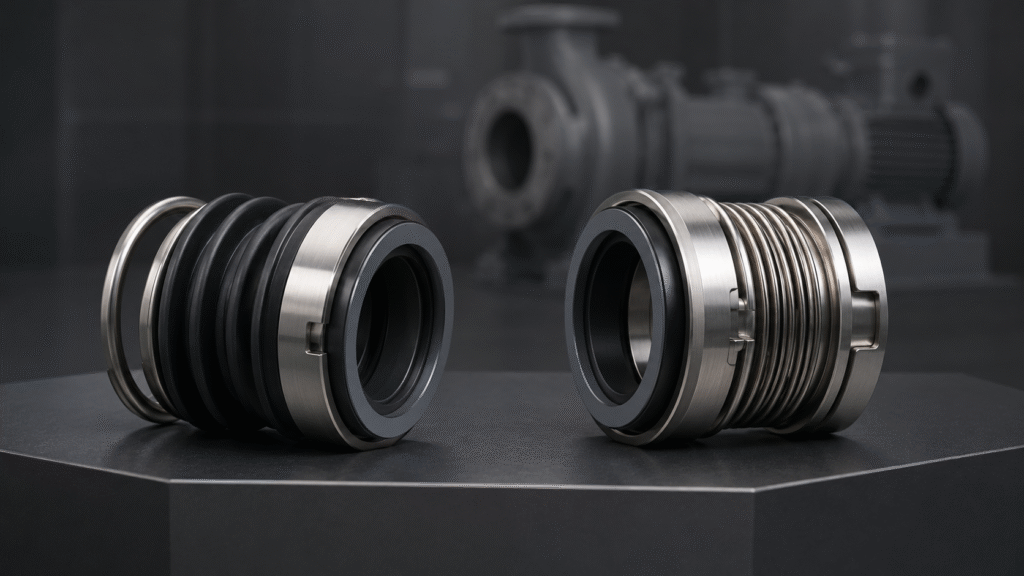
How the Flexible Element Works
A bellows seal uses a flexible element to provide axial movement within the rotating or stationary assembly. As the seal faces wear, the bellows helps maintain the required closing force. In addition, the flexible element can accommodate limited shaft movement and manufacturing tolerances without losing face contact.
Bellows designs are usually non-pusher seals because no dynamic O-ring must slide along the shaft or sleeve. Therefore, they can reduce hang-up caused by shaft deposits or fretting beneath a moving secondary seal. However, the bellows itself must remain flexible, chemically compatible, and mechanically sound throughout the operating cycle.
Rubber and Metal Bellows Use Different Structures
A rubber bellows is a molded elastomer component that seals against the shaft and flexes axially. Depending on the design, drive bands, tabs, collars, or spring hardware transmit torque. By contrast, a metal bellows uses thin alloy convolutions that act as both a flexible sealing element and a spring.
Metal bellows may use formed, rolled, hydroformed, or edge-welded construction. Consequently, two metal bellows seals can behave differently even when their outside dimensions look similar. Rubber vs metal bellows selection must therefore consider the exact seal design, not only the broad material category.
How Rubber Bellows Seals Work
A rubber bellows seal commonly grips the shaft or sleeve through elastic interference. The bellows flexes as the face tracks wear and axial movement. Therefore, the sealing action does not depend on a dynamic O-ring sliding across the shaft. This structure can be compact and suitable for many standard pump chambers.
Many designs combine the molded bellows with a single coil spring and a unitized rotating head. The John Crane Type 2100 elastomer bellows seal is one recognized example for water-based and general industrial applications. However, product suitability still depends on shaft size, materials, pressure, speed, temperature, and the pumped liquid.
Main Advantages of Rubber Bellows
Rubber bellows seals often provide simple installation, compact dimensions, and competitive purchase cost. In addition, the elastic bellows can tolerate minor shaft surface variation better than some rigid secondary-seal arrangements. These features make the design common in water pumps, wastewater equipment, HVAC systems, pools, irrigation pumps, and light process duties.
The bellows also protects part of the shaft from direct fluid contact. Consequently, it can reduce corrosion or deposits beneath the rotating assembly in suitable service. Nevertheless, the elastomer must grip the shaft correctly. Lubricant choice, shaft finish, and installation method can affect both retention and sealing.
Material Limits and Chemical Compatibility
The elastomer usually sets the main chemical and temperature limits. NBR, EPDM, FKM, and other compounds have different resistance to water, oils, solvents, oxidizers, and cleaning chemicals. Therefore, buyers should never approve a seal from the phrase “rubber bellows” alone. They must confirm the exact compound and actual fluid conditions.
Temperature cycling can harden, soften, swell, crack, or permanently deform an unsuitable bellows. In addition, ozone, storage conditions, and incompatible installation lubricants may damage the elastomer before operation. A mechanical seal material selection guide helps compare compounds, but the final supplier review should include concentration, temperature, pressure, and exposure time.
Deposits and Bellows Movement
Solids or dried product can collect around the bellows folds and restrict axial movement. As a result, the rotating face may stop following wear or shaft movement. A non-clogging external spring does not solve deposits trapped directly around the flexible element. Therefore, chamber circulation and cleaning behavior require attention.
Rubber bellows can also slip if the shaft is oily, undersized, damaged, or incorrectly lubricated. However, excessive assembly force may tear the bellows or distort the face position. Installers should follow the specified working length and use only an approved lubricant on the required surfaces.
How Metal Bellows Mechanical Seals Work
A metal bellows seal uses thin metal convolutions to generate spring force and permit axial movement. Therefore, the design can eliminate the dynamic elastomer found in many pusher seals. Some versions also remove all elastomers from the primary seal assembly, while others use static O-rings, gaskets, or flexible graphite in selected locations.
Metal bellows designs can be rotating or stationary. They can also use formed or edge-welded bellows, depending on temperature, pressure, size, and application. The MFL85N metal bellows seal illustrates a balanced rotating construction for industrial pumps. However, its published limits apply only to its specified materials and arrangement.
Why Metal Bellows Suit Difficult Service
Metal alloys can retain useful properties at temperatures that exceed many elastomer capabilities. Consequently, selected metal bellows designs suit hot hydrocarbons, heat-transfer fluids, chemical processing, and other high-temperature duties. The John Crane Type 1604 metal bellows seal, for example, uses a stationary welded bellows for demanding hot-process applications.
Because the bellows provides both flexibility and spring action, the seal can avoid dynamic secondary-seal hang-up. In addition, selected constructions can reduce coking problems around sliding O-rings. However, heat removal, vapor margin, face materials, and support piping remain essential. Metal bellows do not make dry running safe.
Fatigue, Corrosion, and Movement Risks
The thin bellows plates or formed convolutions experience repeated flexing during operation. Therefore, fatigue resistance matters during startups, pressure changes, vibration, and axial shaft movement. Excessive movement, misalignment, or pressure reversal can shorten bellows life. The manufacturer must evaluate the complete displacement and pressure cycle.
Corrosion can also attack the bellows alloy or weld areas. A metal that resists one chemical may fail in another concentration or temperature. Consequently, alloy selection requires the same care as face and gasket selection. Deposits between convolutions may restrict movement, while abrasive solids can erode exposed surfaces.
Bellows Construction and Repair
Formed bellows use shaped thin-wall metal, while edge-welded bellows join multiple diaphragms. Each construction offers different flexibility, stroke, pressure behavior, and manufacturing requirements. Therefore, buyers should not treat every metal bellows assembly as interchangeable. Bellows geometry and alloy are part of the engineered spring system.
Metal bellows seals often cost more than common rubber bellows units. Repair also requires specialist inspection because cracks, distorted convolutions, or damaged welds may remain difficult to see. However, a rebuildable cartridge or bellows assembly can still provide strong lifecycle value on critical equipment.
Rubber vs Metal Bellows: Temperature and Chemicals
Temperature often creates the clearest rubber vs metal bellows difference. Rubber bellows depend on the elastomer’s thermal stability and compression behavior. Metal bellows can extend the usable range when the alloy, faces, gaskets, and seal arrangement also support the temperature. Nevertheless, published temperature limits remain product-specific.
Chemical compatibility requires a similar review. An EPDM bellows may suit many water-based fluids but not petroleum oils. FKM may suit many oils and chemicals, yet it is not universal. Likewise, Alloy 20, Alloy C-276, stainless steel, or nickel alloys each have distinct corrosion limits.
For aggressive chemicals at moderate temperature, the answer may still be a suitable elastomer bellows. Conversely, a metal bellows may fail if the alloy cannot resist the process. Therefore, rubber vs metal bellows selection should start with a complete chemical list, including cleaning fluids, flush liquids, and shutdown residues.
Pressure, Speed, and Seal Balance
Bellows material alone does not determine pressure capability. Face balance, bellows effective area, face width, spring rate, and pressure direction all influence loading. Therefore, a rubber bellows seal may be balanced or unbalanced, while a metal bellows design may also use different hydraulic configurations.
Speed increases sliding velocity and heat at the faces. In addition, rotating metal bellows experience dynamic forces that stationary bellows avoid. High-speed equipment may therefore favor a stationary bellows arrangement. However, the complete seal and pump geometry must support that choice.
Pressure reversal deserves special attention. Vacuum, startup transients, dual-seal systems, and upset conditions can change the direction of force. Consequently, the supplier should confirm seat retention, bellows stability, and reverse-pressure capability. A general rubber vs metal bellows label cannot answer those questions.
Pump Fit and Installation Differences
Rubber bellows seals often fit compact pump chambers and plain shafts. Products such as an MG1 rubber bellows seal cover many standard pump applications, but similar sizes may use different working lengths or seats. Therefore, confirm the complete pump model, shaft diameter, seat dimensions, and installation position.
Metal bellows seals may require more axial space, a special sleeve, a cartridge gland, or defined port orientation. In addition, the bellows assembly may have strict installation and handling limits. Installers should not compress, twist, or pull the bellows beyond the manufacturer’s instructions.
Clear photographs and measurements help a supplier identify the correct mechanical seal. Keep the rotating assembly, stationary seat, gaskets, and sleeve together until identification is complete. Finally, verify shaft runout, end play, chamber alignment, and face cleanliness before safe startup.
Maintenance and Failure Patterns
Rubber bellows failures may include swelling, hardening, cracking, tearing, slipping, or blocked movement. Therefore, technicians should inspect both the elastomer and the shaft contact area. Deposits, incorrect lubricant, chemical attack, or excessive temperature often reveal the likely cause during service.
Metal bellows failures may appear as fatigue cracks, corrosion, distorted convolutions, broken welds, or restricted movement. However, visible damage may occur after another problem starts. Vibration, reverse pressure, poor alignment, coking, or excessive axial travel can overload the bellows during service.
In both designs, face damage still provides important evidence. Blistered carbon, cracked hard faces, heavy wear, or heat checking may indicate poor lubrication rather than bellows failure. Consequently, a complete inspection should include the pump, support system, bearings, shaft, and operating procedure.
How to Choose the Correct Design
First, collect the liquid name, concentration, temperature, pressure, speed, solids, and cleaning chemicals. Next, record shaft size, chamber dimensions, available axial space, and pressure direction. These details provide the technical basis for a reliable final rubber vs metal bellows decision.
Choose rubber bellows when the elastomer suits the fluid and temperature, while compact size and simple replacement matter. Choose metal bellows when temperature, chemical exposure, or dynamic secondary-seal hang-up justifies an alloy bellows. However, confirm that the bellows alloy and construction suit the exact duty.
Finally, compare lifecycle cost, downtime, maintenance skill, and replacement availability. A low-cost seal that fails repeatedly becomes expensive. Likewise, a complex metal bellows seal adds little value when a standard elastomer design already works reliably. The best rubber vs metal bellows choice matches the real pump and process.
Final Rubber vs Metal Bellows Decision
Rubber bellows seals provide flexible, compact, and economical sealing for many water-based and general industrial pumps. However, their elastomer controls much of the chemical and temperature capability. Correct compound selection, shaft condition, installation, and chamber cleanliness remain essential for long-term reliability.
Metal bellows seals can support higher temperatures and selected aggressive services while avoiding a dynamic elastomer. Nevertheless, they require suitable alloys, controlled movement, correct pressure direction, and careful handling. Ultimately, rubber vs metal bellows selection should balance fluid compatibility, temperature, pump fit, reliability risk, and total maintenance cost.