Dong Guan Hong Teng Mechanical seal CO.,LTD

Main products: mechanical seal, oil seal, transmission rubber

Food-Grade Mechanical Seals for Dairy and Beverage Pumps

Food-Grade Mechanical Seals for Dairy and Beverage Pumps

Food-grade mechanical seals for dairy and beverage pumps must control more than visible leakage. They must also support hygienic cleaning, protect product quality, and resist every fluid used during production.

Milk, cream, yogurt, juice, beer, soft drinks, and syrup create different sealing conditions. In addition, cleaning-in-place chemicals may be more aggressive than the product itself.

Therefore, buyers should not select a seal from shaft diameter or temperature alone. They must review the pump, product, cleaning cycle, seal arrangement, materials, documentation, and installation conditions together.

Our mechanical seal material selection guide explains the general relationship between fluid properties and seal components. This article focuses on the extra requirements of dairy and beverage processing.

Quick Answer: Which Mechanical Seal Is Best for Food Pumps?

There is no single mechanical seal that suits every food-processing pump.

A hygienic single seal with carbon against silicon carbide faces and a suitable EPDM compound can be a practical starting point for many clean, water-based products. However, fatty products, sticky syrups, fruit pulp, cleaning chemicals, high temperatures, or sterile processes may require different materials.

A reliable food-pump seal should provide:

  • Product-contact materials with suitable compliance documents
  • Crevice-minimizing hygienic construction
  • Good drainability and cleanability
  • Resistance to the complete CIP or SIP cycle
  • Low-friction seal faces
  • An elastomer compound matched to both product and cleaning chemicals
  • Smooth product-contact surfaces
  • Stable operation during startup and product changeover
  • A seal arrangement that prevents product buildup
  • Easy and repeatable installation
  • Traceable materials and replacement records

For difficult applications, a flushed or double mechanical seal may provide better control. Nevertheless, the final selection must match the actual pump and process.

What Makes a Mechanical Seal Food-Grade?

The term “food-grade” is often used too broadly. A stainless-steel spring and a white or blue O-ring do not automatically make a seal suitable for food contact.

Food-grade mechanical seals need a combination of hygienic design, compatible materials, cleanability, and documented suitability.

The complete assessment should cover:

  • Seal faces
  • Elastomers
  • Gaskets
  • Metal parts
  • Lubricants used during assembly
  • Adhesives or binders, when present
  • Surface condition
  • Product-contact geometry
  • Drainability
  • Cleaning access
  • Operating temperature
  • Cleaning chemicals
  • Contact time
  • Food type
  • Local regulatory requirements

The 3-A Sanitary Standard for Centrifugal and Positive Rotary Pumps is a relevant reference for hygienic pump construction. However, an individual replacement seal does not automatically make the complete pump 3-A compliant.

Likewise, a general statement such as “FDA material” is not enough. The supplier should identify the exact compound, applicable regulation, food-contact conditions, temperature range, and supporting declaration.

Why Dairy and Beverage Pumps Need Hygienic Seals

A conventional industrial seal mainly controls leakage. A hygienic seal must also reduce contamination risks around the pump shaft.

Product can collect in:

  • Deep grooves
  • Exposed threads
  • Open spring cavities
  • Sharp internal corners
  • Damaged O-ring grooves
  • Poorly drained seal chambers
  • Gaps behind stationary seats
  • Worn sleeves
  • Incorrectly compressed gaskets
  • Areas that receive weak CIP flow

These locations may retain milk solids, sugar, protein, fruit fibers, yeast, or cleaning residue. As a result, microbial growth and cross-contamination can occur even when the seal does not visibly leak.

The EHEDG guideline catalogue includes dedicated guidance for hygienic pumps, mechanical seals, elastomeric seals, and CIP installations. This highlights why the seal must be treated as part of the complete hygienic system.

Dairy Products vs Beverage Products

Dairy and beverage processes can place very different demands on mechanical seals.

ProductMain Seal ChallengesPractical Starting Considerations
MilkProtein deposits, fat, thermal cycling, frequent CIPHygienic single or flushed seal, low-friction faces, CIP-compatible elastomer
CreamHigher viscosity, fat, reduced cooling at the facesGood face lubrication, suitable elastomer, possible flush arrangement
YogurtHigh viscosity, product buildup, culture controlCrevice-minimizing design, gentle product handling, effective cleaning
Ice cream mixFat, sugar, viscosity, low temperatureMaterial compatibility across production and cleaning temperatures
Fruit juiceAcids, sugar, pulp, possible particlesCorrosion-resistant metals, compatible elastomer, wear-resistant faces
BeerYeast, carbonation, cleaning chemicals, oxygen controlCleanable seal chamber, controlled leakage, suitable flushed design when needed
Soft drinksAcidity, sugar, carbonationChemical compatibility and stable operation under changing pressure
SyrupHigh viscosity, crystallization, sticky depositsHeated or flushed arrangement, hard face pair when justified
Bottled waterClean product, sanitation, low lubricityLow-friction faces and strict contamination control
Plant-based drinksProtein, oil, suspended solidsProduct-specific testing and effective CIP around the seal

This table provides a starting point only. Product formulation and cleaning procedures can change the final material choice.

Hygienic Mechanical Seal Design Requirements

Cleanable Product-Contact Geometry

The product side of the seal should minimize narrow cavities and stagnant zones.

Springs should remain outside the product area whenever the pump design allows it. In addition, product-contact surfaces should be accessible to the cleaning flow.

A smooth appearance alone does not confirm cleanability. The complete geometry must allow cleaning liquid to reach, wet, and drain from every relevant surface.

Drainability

Residual product and cleaning solution should not remain trapped after shutdown.

Horizontal ledges, blind holes, deep grooves, and poorly positioned ports can prevent full drainage. Therefore, evaluate the seal chamber together with the pump orientation and piping layout.

Controlled Elastomer Compression

Too little compression may cause leakage. However, excessive compression can deform the gasket and create an internal projection.

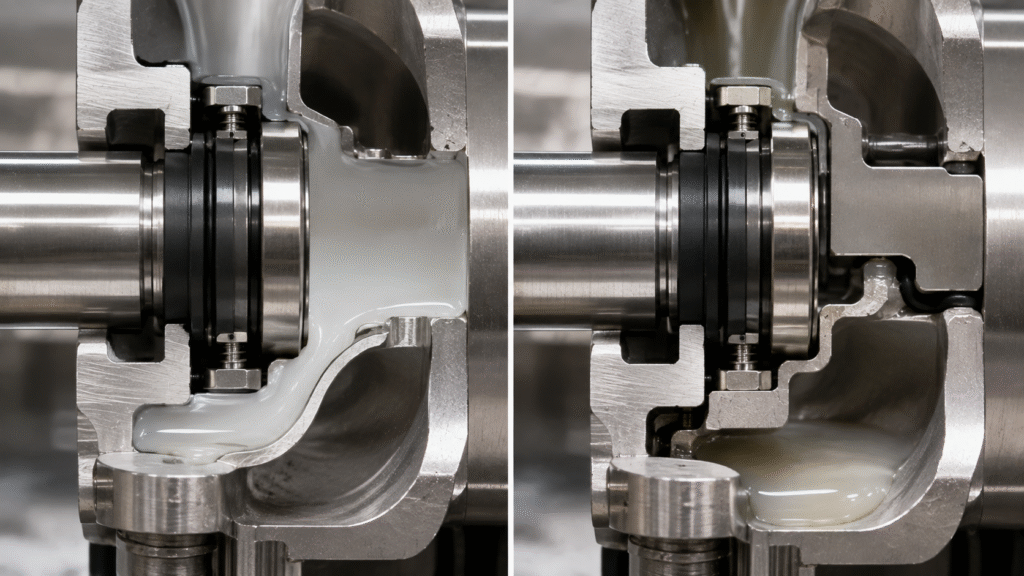
The projection may form a product trap. It can also obstruct cleaning flow.

Use the correct O-ring size, groove dimensions, hardness, and installation procedure. Do not install a thicker gasket simply to stop leakage.

Smooth Product-Contact Surfaces

Surface finish affects cleanability, but one roughness number does not define the entire hygienic condition.

Scratches, pits, damaged welds, burrs, exposed threads, and sharp transitions can still retain product. Consequently, inspectors should review the complete surface condition rather than one measurement alone.

Traceable Components

A replacement seal should have clear records for:

  • Supplier
  • Part number
  • Production batch
  • Pump model
  • Seal size
  • Face materials
  • Elastomer compound
  • Metal grade
  • Compliance documents
  • Installation date
  • Cleaning conditions
  • Service life
  • Failure observations

Traceability helps a plant investigate contamination, premature wear, or repeated leakage.

Single vs Double Mechanical Seals

Single Mechanical Seals

A single mechanical seal uses one primary set of seal faces.

It may suit clean products when:

  • The product lubricates the faces
  • Dry running is unlikely
  • The product does not crystallize quickly
  • The seal chamber receives effective CIP flow
  • Leakage risk is acceptable
  • The operating pressure remains within the design range

Single seals are relatively simple. They also require fewer support-system components.

However, a single seal may struggle with sticky, viscous, abrasive, or crystallizing products.

Flushed or Quenched Seals

A flush or quench can keep residue away from the atmospheric side of the seal. It may also prevent sugar, protein, or product solids from drying around the faces.

The flush liquid must be:

  • Compatible with the product
  • Acceptable for the process
  • Clean and controlled
  • Supplied at the correct pressure
  • Supplied at the correct flow rate
  • Available before pump startup
  • Maintained during the required shutdown period

An uncontrolled water hose is not a validated seal support system. Excess pressure may enter the product, while insufficient pressure may allow product into the flush chamber.

Double Mechanical Seals

A double seal uses two sets of seal faces with a controlled fluid between them.

This arrangement may suit:

  • Products that crystallize
  • Sticky concentrates
  • High-viscosity dairy products
  • Abrasive fruit pulp
  • Dry-running risk
  • Vacuum service
  • Hazardous cleaning chemicals
  • Aseptic or high-containment processes
  • Applications that need controlled leakage direction
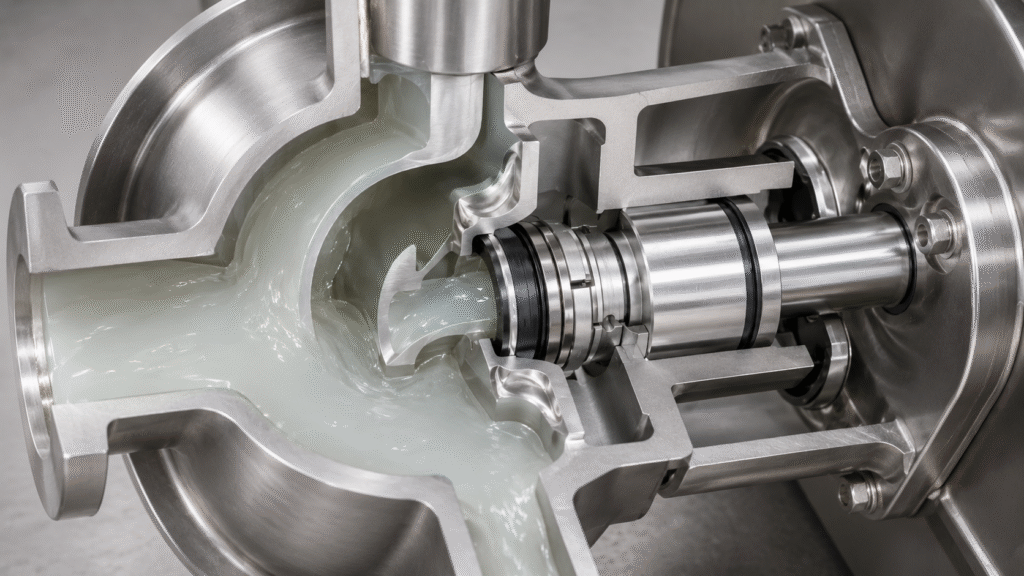
Double mechanical seal system for a hygienic food processing pump

The support fluid can lubricate and cool the faces. It can also reduce product buildup.

However, a double seal adds complexity. The plant must monitor fluid quality, pressure, temperature, level, and possible product dilution.

Balanced vs Unbalanced Seals

An unbalanced seal can work well in moderate-pressure applications. It is also common in compact sanitary pumps.

However, process pressure creates closing force on the seal faces. Excessive closing force can increase friction, temperature, and wear.

A balanced seal reduces the effective hydraulic load. Therefore, it may provide advantages when the application has:

  • Higher pressure
  • Limited product lubricity
  • Temperature changes
  • Frequent starts
  • Viscous products
  • High shaft speed
  • Increased vaporization risk

Do not identify the balance ratio from appearance alone. Confirm it from the seal design or manufacturer’s data.

Best Seal Face Materials for Dairy and Beverage Pumps

Carbon Graphite

Carbon graphite commonly runs against silicon carbide, tungsten carbide, or ceramic.

Possible advantages include:

  • Low friction
  • Good running behavior
  • Moderate dry-running tolerance in selected designs
  • Good thermal properties
  • Wide availability

However, carbon grades differ. The resin, impregnation, porosity, strength, and food-contact documentation can all vary.

A general label such as “carbon” does not confirm suitability. Ask for the exact grade and its supporting documents.

Silicon Carbide

Silicon carbide provides strong wear resistance, corrosion resistance, hardness, and thermal conductivity.

It can suit:

  • Milk
  • Water-based beverages
  • Fruit juice
  • CIP chemicals
  • Products with fine particles
  • High-speed hygienic pumps
  • Carbon against silicon carbide face pairs
  • Silicon carbide against silicon carbide face pairs

Nevertheless, reaction-bonded and sintered silicon carbide are not identical. Their composition and chemical resistance can differ.

Carbon vs Silicon Carbide

Carbon against silicon carbide is a common starting combination for many dairy and beverage pumps.

The carbon face helps reduce friction. Meanwhile, the silicon carbide face transfers heat and resists wear.

This combination may suit clean liquids and products with good face lubrication. However, the exact carbon grade must resist the product, cleaning chemicals, and operating temperature.

Silicon Carbide vs Silicon Carbide

Silicon carbide against silicon carbide can provide stronger resistance to abrasive particles and crystallized solids.

It may suit:

  • Fruit pulp
  • Suspended ingredients
  • Sugar crystals
  • Product fines
  • Selected syrup applications
  • Processes where carbon contamination is undesirable

However, hard-on-hard faces can be less forgiving during dry running. They still require a stable lubricating film.

Tungsten Carbide

Tungsten carbide offers toughness and wear resistance. It may suit selected high-load or particle-containing applications.

However, binder chemistry affects corrosion performance. Therefore, the supplier must identify the complete grade rather than stating only “TC.”

Ceramic

Ceramic mating rings remain common in some simple food and water pump seals.

They can provide good corrosion resistance at a reasonable cost. However, ceramic can be more brittle than silicon carbide. It may also provide lower thermal performance in demanding conditions.

Use it only when the pressure, temperature, product, and pump design support the choice.

Best Elastomers for Food-Grade Mechanical Seals

Elastomer selection must cover both production and cleaning. In many plants, the CIP cycle creates the highest temperature and strongest chemical exposure.

EPDM

EPDM often performs well with:

  • Hot water
  • Steam in suitable compounds
  • Dilute acids
  • Dilute alkalis
  • Many water-based products
  • Common alkaline CIP solutions
  • Selected sanitizers

However, EPDM is generally unsuitable for petroleum oils and many hydrocarbons. Fat-rich products and processing aids also require a compound-specific review.

FKM

FKM can provide good resistance to:

  • Oils
  • Fats
  • Many acids
  • Some aggressive chemicals
  • Higher operating temperatures

However, FKM is not automatically suitable for hot water, steam, strong alkalis, or amine-based chemicals.

Review the exact compound and CIP conditions before selecting it.

NBR

NBR offers good resistance to many oils and fats. It is also widely available and economical.

However, standard NBR may have limitations with:

  • High-temperature water
  • Steam
  • Ozone
  • Repeated hot CIP cycles
  • Strong oxidizing chemicals
  • Long thermal exposure

Therefore, NBR should not become the default choice only because it worked in the original pump.

FFKM

FFKM provides broad chemical and temperature resistance. It may suit severe cleaning cycles or processes that expose the seal to several incompatible fluids.

Nevertheless, FFKM is expensive. Different FFKM compounds also have different performance limits.

Use it only when the application and compliance documents justify the cost.

PTFE-Based Secondary Seals

PTFE provides broad chemical resistance and low product absorption.

However, PTFE does not behave like a rubber O-ring. It has limited elasticity and may require a special profile, energizer, groove, and installation procedure.

Do not replace a standard elastomer with a simple PTFE ring unless the seal design supports it.

In the United States, 21 CFR 177.2600 covers specified rubber articles intended for repeated food contact. Buyers should request documentation for the exact finished compound and intended contact conditions rather than relying on rubber type or color.

Stainless Steel and Other Metal Components

316L stainless steel is common for hygienic product-contact equipment because it offers good corrosion resistance and cleanability.

However, the material name alone is not enough. The plant should also review:

  • Surface finish
  • Weld quality
  • Passivation
  • Crevices
  • Pitting
  • Chloride exposure
  • Spring material
  • Cleaning chemicals
  • Stress and fatigue
  • Product-contact area
  • Traceability

Some seals contain springs or drive components outside the product zone. Even so, condensate and cleaning fluid may reach them.

Therefore, verify every metal component that can contact the process or cleaning solution.

How CIP and SIP Affect Mechanical Seals

Cleaning-in-place exposes the seal to changing chemicals, temperatures, and pressures.

A typical cycle may include:

  1. Product recovery
  2. Pre-rinse
  3. Alkaline cleaning
  4. Intermediate rinse
  5. Acid cleaning
  6. Final rinse
  7. Sanitizing
  8. Production restart
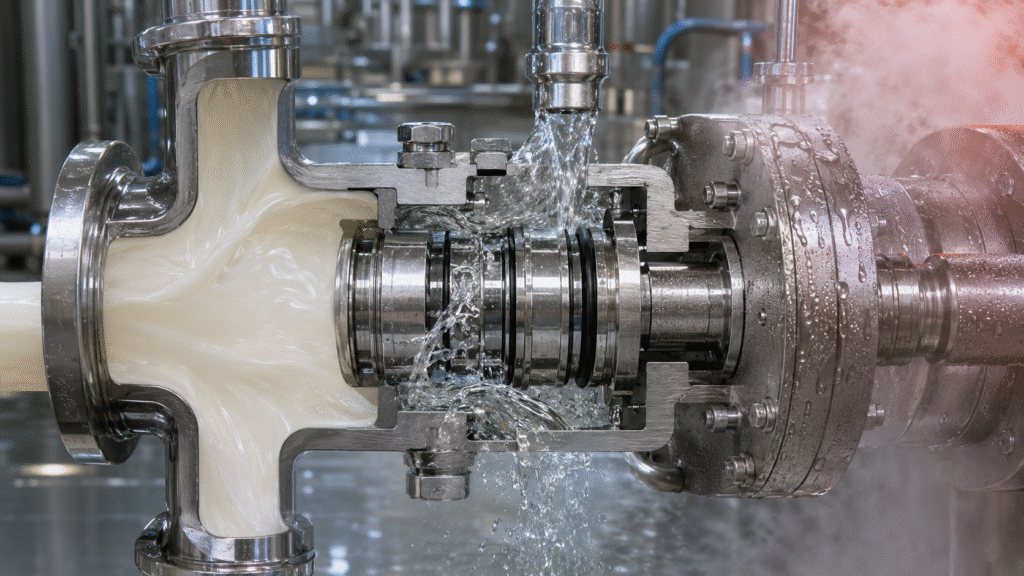
CIP-compatible seal materials for dairy and beverage pumps

Not every plant uses this exact sequence. However, each stage can change elastomer volume, face lubrication, temperature, and deposit behavior.

Steam-in-place adds further thermal stress where the process uses it. Rapid heating can expand metal, faces, and elastomers at different rates.

Potential problems include:

  • O-ring swelling
  • Elastomer hardening
  • Loss of elasticity
  • Face distortion
  • Thermal cracking
  • Carbon blistering
  • Dry face contact
  • Crystallized product
  • Cleaning residue
  • Loss of flush pressure
  • Leakage during cooling
  • Leakage at production restart

Record the actual chemical name, concentration, temperature, contact time, pressure, and frequency. Do not select materials from the product temperature alone.

Why CIP Flow May Not Clean the Seal Chamber

Strong flow through the pump casing does not guarantee strong flow behind the seal.

The seal chamber can contain narrow gaps or shielded areas. Moreover, product can remain behind O-rings, seats, sleeves, and drive components.

To improve cleaning reliability:

  • Use the pump manufacturer’s approved CIP procedure
  • Confirm the required pump speed during cleaning
  • Verify valve positions
  • Maintain sufficient cleaning flow
  • Prevent air pockets
  • Check drainability
  • Inspect the seal chamber during scheduled maintenance
  • Validate cleaning after design changes
  • Review the effect of replacement seal geometry

A replacement seal that fits the shaft may still change the internal cleaning pattern.

How to Select Food-Grade Mechanical Seals Step by Step

Step 1: Identify the Pump and Existing Seal

Record the complete pump manufacturer, model, serial number, shaft size, seal code, and installation position.

When the seal code is missing, use our mechanical seal identification guide. Compare photographs, dimensions, pump information, and operating data before selecting a replacement.

Step 2: Define Every Product

List all products that pass through the pump.

Include:

  • Main ingredients
  • Fat content
  • Sugar content
  • Acidity
  • Viscosity
  • Solids
  • Fibers
  • Alcohol
  • Carbonation
  • Product temperature
  • Possible allergens
  • Product changeovers

Do not evaluate only the primary product if the line handles several recipes.

Step 3: Record the Complete Cleaning Cycle

Collect the actual CIP and SIP conditions.

Record:

  • Chemical names
  • Concentrations
  • Temperatures
  • Contact times
  • Flow rates
  • Pump speeds
  • Sanitizers
  • Steam temperature
  • Cycle frequency
  • Rinse-water quality
  • Shutdown duration

The most severe condition may occur during cleaning rather than production.

Step 4: Select the Seal Arrangement

Choose between:

  • Single seal
  • Single seal with quench
  • Flushed seal
  • Double unpressurized seal
  • Double pressurized seal
  • Component seal
  • Cartridge seal
  • Balanced seal
  • Unbalanced seal

Base the decision on leakage control, dry-running risk, viscosity, crystallization, sanitation, and process reliability.

Step 5: Select the Materials

Choose the face pair, elastomer, metal parts, and gaskets as one system.

Our mechanical seal material selection guide can help compare chemical resistance, wear, temperature, and mechanical strength.

Step 6: Verify Compliance Documents

Request documentation for the exact materials supplied.

The file should identify:

  • Component or compound
  • Manufacturer
  • Grade
  • Batch, when required
  • Applicable regulation or standard
  • Food type
  • Contact conditions
  • Temperature limitations
  • Extraction or migration conditions
  • Document date

Avoid accepting a general certificate that does not identify the actual seal material.

Step 7: Confirm Pump-Specific Compatibility

The same food plant may use APV, Fristam, INOXPA, GEA, Alfa Laval, or other sanitary pumps.

For example, review our APV pump mechanical seals when checking selected APV applications. For selected Fristam equipment, compare the pump data with our BB14C Fristam pump mechanical seal.

These pages provide replacement references only. Final suitability still depends on the pump model, dimensions, product, cleaning cycle, and documented material configuration.

Step 8: Install and Validate the Seal

Follow the pump and seal manufacturers’ procedures.

Our mechanical seal installation guide covers face handling, working length, O-ring protection, alignment, and startup checks.

After installation, confirm:

  • Correct seal setting
  • Correct rotation
  • Stable flush supply
  • No dry start
  • Acceptable leakage
  • Clean drainage
  • Effective CIP
  • No retained product
  • Correct support-fluid pressure
  • Traceable maintenance records

Common Food-Pump Seal Failures

Failure EvidencePossible Cause
Product around the glandFace leakage, damaged gasket, poor setting, or pressure change
Sticky deposit behind the seatWeak CIP access, poor drainage, or incorrect geometry
Cracked carbon faceDry running, thermal shock, impact, or incorrect installation
Rapid carbon wearPoor lubrication, excessive face loading, or abrasive product
Polished dry facesAir entry, empty pump, blocked product flow, or lost flush
Scratched hard faceFruit fibers, crystals, solids, or dirty assembly
Swollen O-ringChemical or product incompatibility
Hardened O-ringExcessive temperature, steam, oxidation, or ageing
Extruded gasketExcessive pressure, incorrect hardness, or wrong groove
Corroded springIncompatible metal or cleaning chemical
Leakage only during CIPThermal distortion, chemical attack, or pressure change
Leakage after CIPElastomer volume change, trapped residue, or damaged faces
Black particles in productCarbon wear, dry running, or unstable face contact
Repeated microbial result near pumpProduct retention, poor cleanability, or damaged surfaces
Flush fluid entering productIncorrect pressure control or damaged inboard seal
Product entering flush chamberInsufficient support pressure or inboard face leakage

If a new seal begins leaking immediately, review our mechanical seal leaking after installation guide before replacing it again.

Installation Practices for Hygienic Pump Seals

Small installation errors can create both leakage and sanitation risks.

Important practices include:

  • Lock out and isolate the pump
  • Drain and rinse the system
  • Follow plant hygiene procedures
  • Keep replacement parts in clean packaging
  • Clean the seal chamber
  • Inspect the shaft and sleeve
  • Remove burrs and sharp edges
  • Replace damaged gaskets
  • Use an approved assembly lubricant
  • Keep seal faces clean
  • Do not touch faces with bare hands
  • Install O-rings without twisting
  • Press the stationary seat evenly
  • Set the correct working length
  • Tighten gland bolts evenly
  • Connect flush lines correctly
  • Vent the pump and seal chamber
  • Confirm the direction of rotation
  • Start the flush before the pump when required
  • Record the installed material configuration

Do not use ordinary grease unless the pump and seal manufacturers approve it for the application.

Maintenance and Inspection Checklist

During scheduled inspections, check:

  • Visible leakage
  • Dried product around the gland
  • Cleaning residue
  • Flush pressure
  • Flush flow
  • Support-fluid condition
  • Seal-chamber temperature
  • Pump vibration
  • Shaft movement
  • Bearing condition
  • Damaged surfaces
  • Elastomer condition
  • Face wear pattern
  • Drainability
  • Product retention
  • CIP records
  • Service life
  • Repeated microbiological findings

Record actual readings and observations. A note that says only “seal normal” provides little value during a later investigation.

Common Selection Mistakes

Treating “Food-Grade” as a Material Name

Food-grade is not one universal material specification.

Ask for the exact face grade, elastomer compound, metal grade, and supporting documents.

Choosing the Elastomer by Color

Blue, white, black, or red rubber can represent many different compounds.

Color does not confirm chemical compatibility or food-contact compliance.

Checking Only the Product

The seal also contacts rinse water, caustic cleaner, acid cleaner, sanitizer, steam, and flush fluid.

Review the complete process cycle.

Using One Seal for Every Product

Milk, beer, fruit juice, and syrup do not create the same conditions.

Standardize seals only after grouping truly similar applications.

Ignoring Dry-Running Risk

A hygienic pump may run briefly without enough product during tank emptying or line changeover.

Even a short dry period can overheat the seal faces.

Assuming Stainless Steel Is Automatically Hygienic

Material grade matters. However, surface finish, geometry, welds, drainage, and cleaning access matter as well.

Reusing Old Elastomers

A used O-ring may look acceptable but have a permanent compression set or chemical damage.

Replace secondary seals during approved maintenance work.

Changing Seal Geometry Without Cleaning Validation

A replacement that fits mechanically may create a new product trap.

Review and validate the cleaning result after any design change.

Information to Send to a Seal Supplier

Before requesting a quotation, prepare:

  • Pump manufacturer
  • Complete pump model
  • Serial number
  • Existing seal code
  • Shaft or sleeve diameter
  • Seal working length
  • Stationary-seat dimensions
  • Seal-chamber dimensions
  • Single or double arrangement
  • Clear photographs
  • Product names
  • Ingredient characteristics
  • Viscosity
  • Solids or fibers
  • Normal and maximum temperature
  • Normal and maximum pressure
  • Shaft speed
  • CIP chemicals
  • CIP concentration
  • CIP temperature
  • CIP duration
  • SIP conditions
  • Required food-contact regulations
  • Required certificates
  • Current face materials
  • Current elastomer
  • Flush-fluid information
  • Previous seal life
  • Previous failure evidence

Complete information reduces the risk of receiving a seal that fits physically but fails during cleaning or production.

Frequently Asked Questions

Are All EPDM Seals Food-Grade?

No. EPDM describes a polymer family, not one finished compound.

The additives, curing system, manufacturing process, and compliance documents can differ. Therefore, request information for the exact compound.

Is FKM Better Than EPDM for Dairy Pumps?

Not always. FKM may resist fats and oils well. However, EPDM can perform better in many hot-water, steam, and alkaline-cleaning conditions.

Compare both the product and CIP cycle.

Which Seal Faces Are Best for Milk Pumps?

Carbon against silicon carbide is a common starting point. It offers low friction and good wear resistance.

However, the exact grades and seal arrangement must match temperature, pressure, cleaning, and dry-running risk.

Should Fruit Juice Pumps Use Silicon Carbide Faces?

Silicon carbide can suit acidic products and fine particles. Silicon carbide against silicon carbide may help when pulp or abrasive solids create wear.

However, hard faces still require lubrication.

Does an FDA-Compliant O-Ring Make the Complete Pump Compliant?

No. Compliance of one component does not confirm the hygienic design or certification of the complete pump.

Review all product-contact components and the assembled equipment.

When Is a Double Seal Necessary?

A double seal may help with sticky products, crystallization, dry-running risk, vacuum, abrasive solids, or aseptic requirements.

However, it needs a properly controlled support system.

Can the Same Seal Handle Production and CIP?

Yes, if every material and the complete design suit both conditions.

Always compare the most severe production, cleaning, sanitizing, and shutdown conditions.

Why Does a Seal Leak Only During CIP?

CIP can create rapid temperature changes, different pressure, low lubrication, and aggressive chemical exposure.

These conditions may distort the faces or affect elastomer volume.

Why Is Product Collecting Behind the Seal?How CIP and SIP Affect Mechanical Seals

Possible causes include poor cleaning access, weak flow, incorrect geometry, damaged surfaces, inadequate drainage, or product crystallization.

Inspect the entire seal chamber rather than replacing only the faces.

Final Recommendations

Food-grade mechanical seals must protect product quality while maintaining reliable pump operation.

Start by identifying the exact pump and seal. Next, document every product, cleaning chemical, temperature, pressure, and operating stage.

Then select the seal arrangement, face pair, elastomer, and metal components as one hygienic system. Request compound-specific compliance documents instead of accepting general “food-grade” claims.

Finally, install the seal correctly and validate cleaning after any design change. This structured approach reduces leakage, retained product, premature wear, contamination risk, and unplanned downtime.

Leave a Comment

Your email address will not be published. Required fields are marked *

Scroll to Top