Mechanical seal elastomers can determine whether a pump runs reliably or starts leaking after only a short service period. NBR, EPDM, FKM, and FFKM may look similar as O-rings, gaskets, or molded rubber parts. However, their resistance to oils, water, steam, solvents, acids, cleaning chemicals, and heat can differ greatly.
The correct choice depends on more than the normal operating temperature. Engineers should review the complete fluid composition, concentration, pressure, startup and shutdown conditions, cleaning cycle, seal design, and elastomer location. A low-cost material can be ideal in mild service, while an expensive compound adds value only when the duty requires it.
Why Mechanical Seal Elastomers Matter
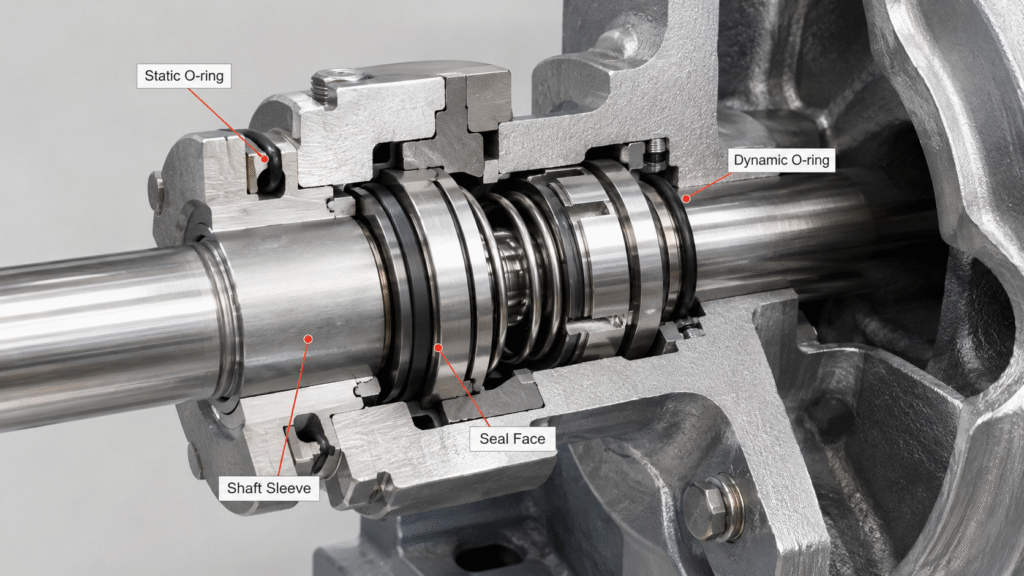
Mechanical seal faces control leakage at the rotating interface, but secondary seals close the other leakage paths. Depending on the design, elastomers may seal between the rotating unit and shaft, stationary seat and housing, gland and seal chamber, or several cartridge components. If one O-ring swells, hardens, cracks, or loses compression, good seal faces cannot prevent leakage around it.
This is why a mechanical seal material selection guide should treat elastomers separately from carbon, ceramic, silicon carbide, tungsten carbide, and metal parts. Face materials mainly handle friction, wear, heat transfer, and chemical exposure. Elastomers must also retain flexibility, sealing force, dimensional stability, and recovery while compressed inside a groove.
Static and Dynamic Secondary Seals Have Different Demands
A static O-ring remains compressed between surfaces that do not slide relative to each other during normal operation. A pusher mechanical seal may also contain a dynamic O-ring that moves axially along a shaft or sleeve as the face follows wear and shaft movement. That dynamic location adds friction, deposit sensitivity, and surface-finish requirements.
Rubber bellows designs create another case. The elastomer can act as both a secondary sealing element and a flexible moving component. Therefore, a rubber vs metal bellows decision should include chemical resistance, temperature, flexibility, shaft grip, deposits, and installation method rather than rubber type alone.
NBR Mechanical Seal Elastomers for General Service
NBR, or nitrile rubber, remains a practical material for many mechanical seals because it combines useful mechanical properties with moderate cost. It commonly performs well with mineral oils, lubricants, greases, and many general industrial fluids. Therefore, NBR is often a sensible starting point for oil-related duties and standard pump applications where the chemical environment is not severe.
However, NBR should not be treated as a universal “water-pump rubber.” Its performance varies by formulation, acrylonitrile content, hardness, temperature, and fluid exposure. Weathering, ozone, strong oxidizing media, and some aggressive chemicals can limit service. High heat can also accelerate hardening and permanent compression.
The Parker O-Ring Material Selection Guide is a useful reference when comparing general elastomer families, but the exact compound datasheet still matters. A supplier may offer several NBR grades with different hardness, low-temperature behavior, approvals, and compression-set performance. For mechanical seals, confirm the actual O-ring or bellows compound rather than accepting “NBR” as a complete specification.
EPDM for Water, Steam, and Cleaning Chemicals
EPDM is often selected for water-based service because it offers strong resistance to water, weathering, ozone, and many polar fluids. Suitable EPDM compounds can also perform well in hot-water, steam, and cleaning environments. As a result, EPDM is common in water treatment, HVAC, food processing, beverage equipment, and pumps exposed to aqueous cleaning cycles.
The major warning is petroleum exposure. EPDM is generally a poor choice for mineral oils, fuels, and many hydrocarbon lubricants. This matters when the process liquid is water but the elastomer also contacts an oil-based assembly lubricant, contaminated wastewater, or another hydrocarbon during cleaning or maintenance.
For sanitary or cleaned systems, do not select EPDM only because the main product is water-based. Record every CIP or SIP chemical, concentration, temperature, and contact time. Also confirm any required food, drinking-water, pharmaceutical, or hygiene approval. A technically compatible EPDM compound without the required certification may still be unsuitable for the application.
FKM for Oils, Heat, and Broader Chemical Duty
FKM fluoroelastomers are widely used when NBR lacks enough heat, oil, fuel, or chemical resistance. They generally offer strong resistance to petroleum fluids, many lubricants, ozone, and a broad range of industrial chemicals. Consequently, FKM is common in process pumps, chemical equipment, oil-handling systems, and mechanical seals that operate above ordinary NBR temperature capability.
Still, “FKM” describes a material family rather than one universal compound. Fluorine content, cure system, polymer structure, fillers, and formulation can change chemical and low-temperature performance. Standard FKM may also be unsuitable for certain hot water, steam, amines, ketones, organic acids, or other specific chemicals.
When a pump handles corrosive media, use the actual chemical name and concentration instead of selecting FKM from a broad compatibility statement. Our guide to mechanical seals for acids and corrosive fluids explains why the face materials, metal parts, elastomers, and process conditions must be checked together. The same rule applies to solvents and mixed chemical streams.
When FFKM Becomes Worth the Cost
FFKM, or perfluoroelastomer, provides the broadest chemical and high-temperature capability among these four elastomer families. Selected compounds can tolerate environments that rapidly attack common NBR, EPDM, or FKM. Therefore, FFKM is often considered for aggressive chemical processing, high-temperature service, semiconductor equipment, pharmaceutical systems, and other critical duties.
The advantage comes with a large cost increase. FFKM should not be specified simply because it is the premium option. In ordinary water, mild oil, or moderate chemical service, a correctly selected NBR, EPDM, or FKM compound may provide reliable life at a much lower replacement cost.
DuPont Kalrez Chemical Resistance resources show why compound-level verification remains important even within FFKM. Different grades target different combinations of chemicals, steam, temperature, purity, and mechanical properties. Therefore, compare the exact fluid and maximum temperature with the proposed FFKM grade rather than assuming every perfluoroelastomer has the same limits.
NBR vs EPDM vs FKM vs FFKM at a Glance
The table below is a selection shortcut, not a final compatibility chart. Actual limits depend on compound grade, seal design, pressure, exposure time, and manufacturer data.
| Elastomer | Typical Strengths | Common Concerns | Best Starting Point |
|---|---|---|---|
| NBR | Mineral oils, lubricants, good mechanical value, low cost | Ozone, high heat, strong oxidizers, some chemicals | General industrial and oil-related service |
| EPDM | Water, hot water, steam-capable grades, weathering, many polar fluids | Petroleum oils, fuels, hydrocarbon contamination | Water, HVAC, cleaning and aqueous service |
| FKM | Oils, fuels, higher temperature, broad chemical resistance | Some steam, amines, ketones, and special chemicals depending on grade | Process pumps and hotter oil/chemical service |
| FFKM | Very broad chemical resistance and very high temperature capability in selected grades | High cost; compound selection still required | Aggressive chemicals and critical high-value service |
Manufacturer examples also show why one universal temperature table can mislead. Published NBR, EPDM, FKM, and FFKM grades cover different temperature windows, and special formulations can extend or reduce those ranges. Therefore, use temperature as a screening factor, then verify the exact compound under the real fluid and pressure conditions.
Cost should follow the same logic. Moving from NBR to FKM or FFKM can reduce failures when the original elastomer is chemically or thermally overloaded. However, upgrading the O-ring will not correct dry running, vibration, damaged faces, wrong installation length, or poor shaft condition.
Match the Elastomer to the Complete Pump Duty
Start with the fluid. For clean water at moderate conditions, several elastomers may appear acceptable. However, the correct answer changes when the water contains chlorine, oxidizers, oil, glycol, detergent, solvent, or process contamination. Wastewater can be especially variable because its chemistry may change with upstream discharge.
Next, record normal and maximum temperature. Include steam cleaning, hot flushes, shutdown soak, and short process spikes. An elastomer may survive the normal operating temperature but fail during cleaning. Likewise, low-temperature flexibility can matter during outdoor storage, cold startup, or refrigeration-related service.
Pressure also matters because a softened or swollen O-ring can extrude into clearances. Check elastomer hardness, groove dimensions, extrusion gaps, and whether backup rings are required. In a dynamic secondary seal, shaft finish and deposits also influence movement. For replacement work, the pump mechanical seal range can help identify possible seal constructions after the pump model and dimensions are confirmed.
Read Elastomer Failure Patterns Before Replacing the Seal
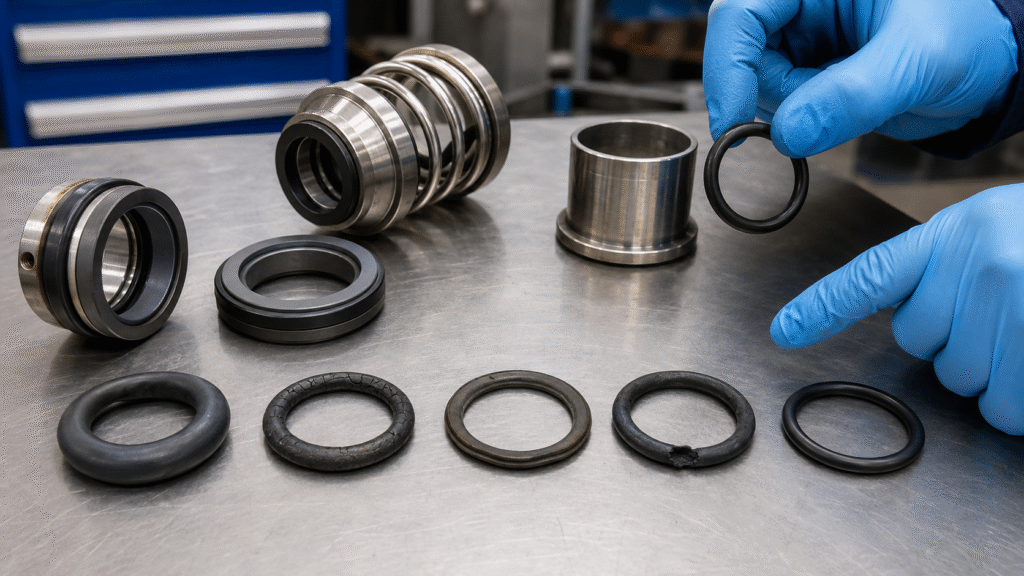
A failed O-ring often provides useful evidence. Swelling and softening usually suggest fluid absorption or chemical incompatibility. Hardening, cracking, or loss of elasticity may indicate heat, aging, oxidation, or incompatible chemistry. A permanently flattened O-ring can indicate compression set, excessive temperature, or long service under compression.
Cuts and spiral damage usually point toward installation or movement problems rather than chemical attack. Threads, keyways, sharp shaft shoulders, burrs, or incorrect tools can slice an O-ring during assembly. Excessive pressure may also force rubber into a clearance and create nibbling or extrusion damage.
If a mechanical seal leaking after installation shows a damaged O-ring, do not automatically change the compound. First determine whether the rubber was incompatible or simply cut, twisted, pinched, or incorrectly lubricated. Replacing NBR with FKM will not solve a sharp shaft edge or an undersized groove.
A Practical Mechanical Seal Elastomer Selection Workflow
First, identify every liquid that can contact the elastomer. List the process fluid, concentration, water content, contaminants, flush liquid, assembly lubricant, cleaning chemicals, and shutdown residues. For mixed chemicals, provide the full composition where possible instead of only the trade name.
Second, record minimum, normal, and maximum temperature. Then add pressure, vacuum conditions, pressure spikes, shaft size, seal type, O-ring dimensions, groove condition, and whether the secondary seal moves dynamically. Also note required hardness and any certification requirements.
Third, shortlist NBR, EPDM, FKM, or FFKM by fluid family and temperature. Verify the proposed compound with manufacturer compatibility data at the actual concentration and temperature. For critical chemical service, laboratory immersion testing or supplier validation may be justified before a plant-wide change.
Finally, examine the previous failure. If the old elastomer is swollen, hardened, cracked, extruded, or permanently flattened, record that condition before disposal. Combine this evidence with pump history and seal-face condition. The best material choice solves the real failure mechanism rather than simply increasing material cost.
Frequently Asked Questions
Is FKM Always Better Than NBR?
No. FKM usually provides broader heat, oil, and chemical resistance, but NBR can be more economical and completely suitable in mild oil or general industrial service. Choose the least expensive compound that reliably meets the real operating conditions and required service life.
Should I Use EPDM or FKM for Hot Water?
The answer depends on temperature, water chemistry, steam exposure, cleaning chemicals, and the exact compound. EPDM is often a strong starting point for hot-water and steam-related service. However, special FKM grades may also suit selected conditions. Verify manufacturer data for the proposed grade.
When Should I Upgrade to FFKM?
Consider FFKM when aggressive chemicals, very high temperature, contamination requirements, or repeated elastomer failures justify its cost. Before upgrading, confirm that the existing failure actually comes from elastomer incompatibility. Pump vibration, dry running, face damage, and installation errors require different corrections.
Can I Identify NBR, EPDM, or FKM by Color?
No reliable field rule can identify an elastomer from color alone. Different compounds may use similar pigments, and service exposure can darken, stain, swell, or harden the material. Use material markings, purchasing records, supplier data, or controlled material testing when identification matters.
Conclusion
Mechanical seal elastomers should be selected from the complete duty, not from price or a familiar material name. NBR suits many economical oil and general-service applications. EPDM is strong in many water-based duties. FKM expands oil, heat, and chemical capability, while FFKM targets the most demanding services.
Always verify the exact compound, fluid concentration, temperature, pressure, seal design, cleaning cycle, and previous failure pattern. This approach prevents unnecessary upgrades while reducing the risk that an inexpensive secondary seal becomes the weak point of the entire mechanical seal.