Silicon carbide vs tungsten carbide is useful when a mechanical seal needs a hard face. However, the material names alone do not decide the answer. Silicon carbide, or SiC, usually offers very high hardness, strong wear resistance, favorable thermal behavior, and broad chemical resistance. Tungsten carbide, or TC/WC, combines high wear resistance with greater mechanical toughness. The decision depends on grade, fluid, solids, lubrication, temperature, geometry, speed, and pump condition. Therefore, this guide compares only SiC and TC seal faces rather than the complete material system.
Silicon Carbide vs Tungsten Carbide: The Short Answer
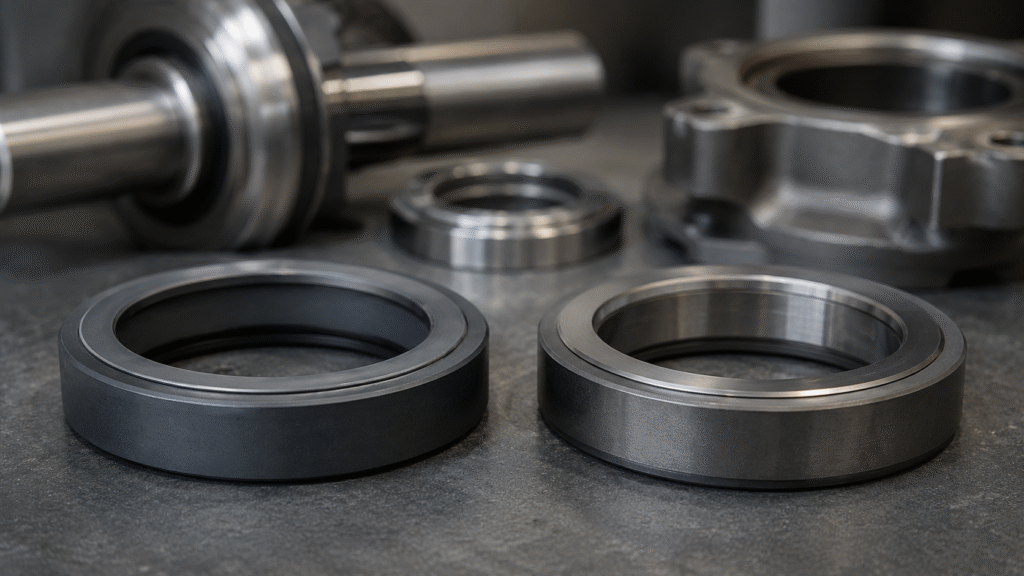
For corrosive or abrasive service, sintered SiC may be attractive for its chemical stability, hardness, and thermal properties. For service that combines abrasion with mechanical shock or edge-loading risk, a suitable TC grade may offer useful toughness. However, neither rule is automatic.
A reaction-bonded SiC face can behave differently from a sintered grade. Likewise, cobalt-bonded and nickel-bonded TC can differ significantly in wet corrosion. Therefore, silicon carbide vs tungsten carbide should always become a grade-level comparison before the final seal is approved.
Why Material Grade Matters
“SiC” and “TC” each describe material families rather than one identical product. Manufacturing route, binder chemistry, grain structure, and formulation change seal-face properties. Material-grade differences become especially important in corrosive fluids and mechanically severe duty where composition directly affects performance.
Reaction-Bonded vs Sintered Silicon Carbide
Reaction-bonded silicon carbide is produced with silicon infiltration and normally contains a free-silicon phase. It can provide excellent hardness and wear resistance, but free silicon can change compatibility in some aggressive services. Sintered SiC contains little or no free silicon and is often considered when broad corrosion resistance matters. Exact grade data should therefore be checked rather than assuming every SiC ring behaves identically. Silicon carbide material data shows clear differences among manufacturing routes.
Cobalt vs Nickel-Bonded Tungsten Carbide
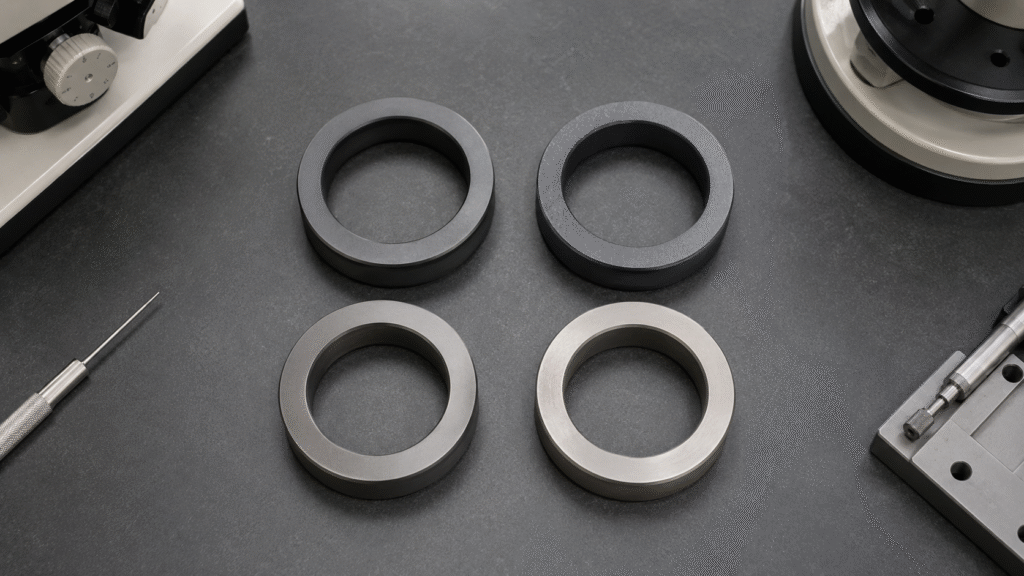
Tungsten carbide seal faces use hard WC particles held together by a metallic binder. Cobalt-bonded grades can provide high toughness and wear resistance, while nickel-containing or alloyed systems may improve wet-corrosion performance. Binder attack matters because corrosion can remove the phase supporting the carbide grains. Therefore, “tungsten carbide” alone may be incomplete for chemical service. Cemented carbide corrosion data shows why binder chemistry and the actual liquid must be reviewed together.
Silicon Carbide vs Tungsten Carbide: Key Differences
The table below compares practical tendencies rather than fixed specifications. Actual behavior depends on grade, face design, mating face, liquid, lubrication, and operating conditions. Therefore, each row should be treated only as a selection clue rather than a universal rule.
| Factor | Silicon Carbide | Tungsten Carbide | What It Means for Selection |
|---|---|---|---|
| Hardness | Very high | Very high | Both can resist abrasive wear; hardness alone does not decide |
| Abrasion resistance | Excellent in many grades | Excellent in many grades | Check particles, concentration, lubrication, and impact |
| Fracture toughness | Lower in general | Usually higher | TC may be attractive where edge damage or shock is credible |
| Impact resistance | More brittle | Usually better | Pump condition still needs correction if disturbance is abnormal |
| Chemical resistance | Often broad; grade-dependent | Strongly binder-dependent | Verify exact chemistry, concentration, and temperature |
| Thermal conductivity | Favorable in many SiC grades | Useful but grade-dependent | Heat behavior depends on the full face system |
| Density | Relatively low | Much higher | Rotating mass may matter in large or high-speed designs |
| Rotating mass | Lower for similar geometry | Higher for similar geometry | Face orientation remains a seal-design decision |
| Grade sensitivity | Reaction-bonded vs sintered matters | Binder system matters greatly | Specify the actual material grade |
| Main selection concern | Brittleness and grade compatibility | Binder corrosion and rotating mass | Compare the complete operating environment |
Hardness, Wear and Abrasive Solids
Both SiC and TC are hard-face materials with strong abrasion resistance. However, abrasive service is not defined only by hardness. Particle size, particle hardness, solids concentration, particle shape, circulation, face lubrication, and seal-chamber geometry can significantly change the wear mechanism.
For fine abrasive solids, SiC may provide excellent wear performance. TC can also perform strongly, particularly when abrasion is combined with impact or mechanical disturbance. Yet “fine solids equals SiC” and “heavy solids equals TC” are too simplistic. The wastewater and slurry materials guide is better for evaluating the complete dirty-service environment. A hard face also cannot stop solids from blocking springs or accumulating in the chamber. Filtration, separation, circulation, or chamber design may matter as much as face material.
Toughness, Impact and Mechanical Shock
One important difference in silicon carbide vs tungsten carbide is fracture behavior. SiC is a hard technical ceramic and can be more vulnerable to chipping from rough handling, edge loading, or severe mechanical disturbance. TC generally offers greater fracture toughness because of its cemented-carbide structure.
That advantage does not mean vibration should be “fixed” with TC. Worn bearings, excessive shaft runout, misalignment, pipe strain, or cavitation can repeatedly disturb the faces and damage either material. A shaft runout and misalignment guide should be used when an abnormal running track or repeated edge damage points toward the pump. Therefore, choose toughness for a real shock or impact requirement, not as a substitute for repairing the pump.
Chemical Resistance and Binder Attack
Chemical compatibility is another major separator. Sintered SiC often provides strong resistance in many aggressive fluids, while reaction-bonded SiC may have different limitations because of its free-silicon phase. However, no SiC grade should be described as resistant to every acid, alkali, solvent, or cleaning chemical.
TC requires even closer attention to binder chemistry. Cobalt-bonded material can suffer binder attack in some wet or corrosive environments, while nickel-containing grades may offer better resistance in selected media. Temperature, ion concentration, pH, contaminants, and cleaning chemicals can all influence exposure. Therefore, identify the exact chemical, concentration, temperature, contaminants, and cleaning cycle before comparing grades. For a complete wetted-material review beyond the hard face, use the mechanical seal material selection guide.
Heat Transfer, Thermal Stress and Rotating Mass
Seal faces generate heat through friction and fluid shear. Their temperature also depends on face loading, speed, seal diameter, fluid-film stability, process temperature, and cooling. Material thermal conductivity can influence how heat moves away from the interface, but it is only one part of the thermal balance.
SiC combines favorable thermal properties with relatively low density. Therefore, it can be attractive in some high-speed, large-diameter, or thermally demanding designs. TC is much denser, so rotating mass can become a consideration when the hard face rotates. Face orientation still comes from the complete seal design. TC should not automatically be placed on the stationary side, and high speed does not automatically require SiC.
Lubrication and Face Pairing
Actual friction cannot be predicted from “SiC” or “TC” alone. It depends on the mating material, surface finish, fluid viscosity, pressure, speed, temperature, face geometry, and the stability of the lubricating film. Therefore, claims that SiC always runs with lower friction than TC are not reliable.
Likewise, a hard/hard pair does not create dry-running capability. SiC/SiC, TC/TC, and SiC/TC combinations still require lubrication unless a specific seal design has been engineered for another regime. The guide on what happens when a mechanical seal runs dry explains why loss of the fluid film can generate damaging heat even with hard faces.
Which Material Fits Different Pump Conditions?
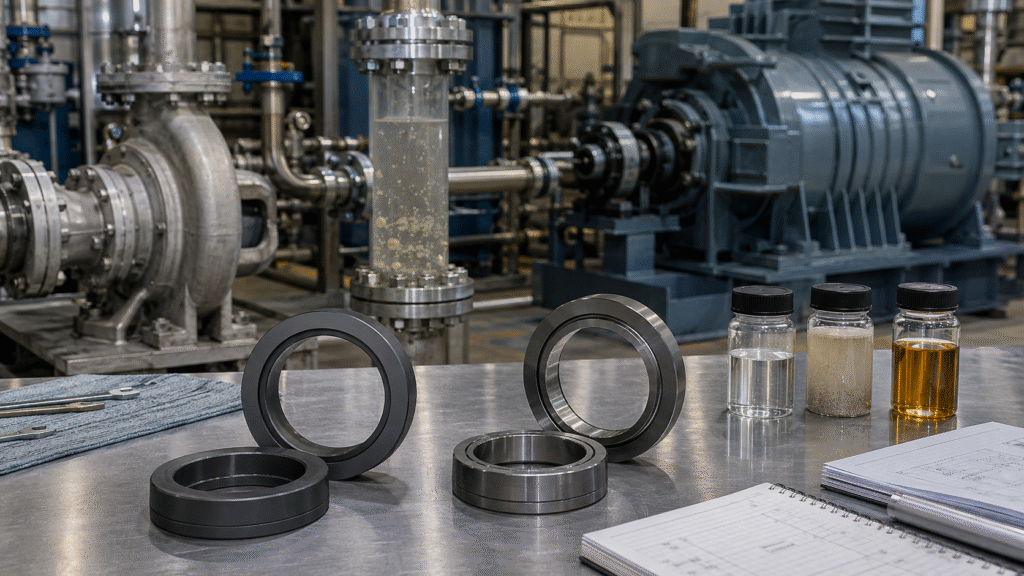
| Application Condition | What to Evaluate |
|---|---|
| Corrosive chemical | Sintered SiC may be attractive; verify exact chemistry, temperature, grade, and all wetted components |
| Fine abrasive solids | SiC may offer strong wear resistance; also review lubrication, particle behavior, and solids control |
| Abrasion plus mechanical impact | A suitable TC grade may provide useful toughness; verify binder compatibility |
| Wastewater | Either material may work depending on solids, impact, chemistry, lubrication, and pump condition |
| Clean water | Hard/hard faces may not be necessary; compare the complete face pairing and cost |
| Hot or high-speed service | Evaluate thermal behavior, rotating mass, film stability, geometry, and cooling |
| Crystallizing service | Consider wear plus deposit control; material alone does not solve crystal accumulation |
These examples show why silicon carbide vs tungsten carbide is a comparison step rather than a complete application specification. If the decision also involves elastomers, metals, arrangement, temperature limits, or support systems, use the broader material-selection workflow and verify the complete seal rather than selecting only the hard face.
When Hard/Hard Faces Are Not Necessary
Many clean or moderately demanding pumps do not require a hard/hard pairing. A carbon face against SiC or TC can sometimes provide more forgiving friction and startup behavior while the hard face supplies wear resistance. The correct pairing still depends on lubrication, cleanliness, chemistry, loading, and design. Therefore, do not upgrade both faces simply because hard materials sound more durable. The mechanical seal materials guide explains hard/soft and hard/hard pairing fundamentals.
Common SiC vs TC Selection Mistakes
A common mistake is choosing only by hardness. Another is assuming TC is automatically better because it is tougher, or assuming SiC is automatically best for every chemical pump. Both shortcuts ignore material grade and the actual operating mechanism involved.
Other errors include ignoring the TC binder or the exact SiC grade. They also include using hard/hard faces without checking lubrication or changing the original material without reviewing the application. Likewise, high vibration should trigger pump diagnosis rather than an automatic switch to TC. Finally, hardness does not make SiC or TC safe for ordinary dry running. Loss of the liquid film can still create damaging frictional heat.
A Practical SiC vs TC Selection Checklist
- Identify the exact fluid, concentration, contaminants, and cleaning chemicals.
- Check solids concentration, particle size, hardness, and impact potential.
- Check pump condition, mechanical shock, runout, and vibration.
- Review temperature, vaporization risk, lubricity, pressure, and speed.
- Identify the exact SiC or TC grade, not only the material family.
- Check the mating face and whether hard/hard operation is actually needed.
- Review density and rotating mass when geometry or speed makes them relevant.
- Confirm the complete seal design and manufacturer or application compatibility.
This sequence keeps silicon carbide vs tungsten carbide focused on the real differences between two hard-face choices instead of turning the decision into a simple material ranking. If several steps remain uncertain, confirm the application data and exact material grades before changing the original face specification.
Silicon Carbide vs Tungsten Carbide FAQ
Is Silicon Carbide Harder Than Tungsten Carbide?
Many SiC grades are extremely hard, and TC is also a very hard wear material. However, hardness alone does not predict seal performance. Abrasive wear also depends on particle properties, lubrication, face pairing, loading, surface condition, and the exact material grade used in the seal.
Is Tungsten Carbide Better for Pump Vibration?
Not as a repair strategy. TC may offer greater mechanical toughness, but abnormal vibration, worn bearings, runout, misalignment, or cavitation should be corrected. A tougher face cannot make an unhealthy pump mechanically stable, and repeated vibration can still disturb lubrication and face tracking.
Which Is Better for Corrosive Chemicals?
Sintered SiC can be attractive for many corrosive services, while TC compatibility depends strongly on its binder. However, exact chemistry, concentration, temperature, contaminants, cleaning fluids, and the rest of the wetted seal components must be checked before either hard face is approved.
Can SiC or TC Run Dry?
Do not assume so. Ordinary wet-running hard-face combinations still rely on a stable lubricating film. Dry-running capability depends on the complete seal design, face technology, operating regime, heat removal, and manufacturer qualification. It does not come simply from choosing SiC or TC because both materials are hard.
Does Tungsten Carbide Always Cost More?
No universal cost ranking applies. Grade, binder, component size, geometry, finishing, quantity, sourcing, and quality requirements all affect price. Selection should therefore be based on technical need first, followed by a commercial comparison of the specific grades and face geometries being purchased.
Silicon carbide vs tungsten carbide is ultimately a grade-and-application decision. SiC may provide an attractive combination of hardness, corrosion resistance, thermal behavior, and low mass, while TC can add valuable toughness. Confirm chemistry, solids, lubrication, shock, face pairing, and seal design before choosing either hard face.