OEM vs original mechanical seals can sound like a simple brand-versus-price comparison, but the terminology is often inconsistent. OEM means Original Equipment Manufacturer. It describes the role of a manufacturer, but the word “OEM” alone does not prove that a seal is genuine, supplied through an authorized channel, or technically suitable for the pump.
Before comparing price or lead time, identify the supply category and verify the technical specification. Buyers should distinguish original parts from independently manufactured compatible replacements, broad aftermarket products, and sample-matched or custom seals.
Understand the Four Supply Categories
Original or Genuine Mechanical Seal
An original or genuine mechanical seal normally comes from the original pump manufacturer, original seal manufacturer, or an authorized supply channel. The source should be supported by purchasing records, packaging, traceability, technical documentation, and the warranty provider.
Original supply may be important when the equipment remains under warranty, the contract requires original components, or a validated process depends on a documented configuration. It may also be appropriate for proprietary designs, safety-critical equipment, or applications where reliable dimensional and operating information is unavailable.
Compatible Replacement Mechanical Seal
A compatible replacement is independently manufactured for selected equipment after verifying the dimensions, stationary seat, working length, seal arrangement, materials, and operating conditions. It should be described as a compatible replacement rather than represented as a genuine original part.
A compatible seal may follow the original geometry closely, or it may use a different internal construction where technically justified. The supplier should explain what remains equivalent, what has changed, and how compatibility was confirmed.
Aftermarket Mechanical Seal
Aftermarket is a broad term. It can describe a carefully engineered replacement or a poorly matched generic product. The label itself does not establish quality, compatibility, documentation, or manufacturing control.
Buyers should judge an aftermarket seal by evidence: dimensional accuracy, materials, face quality, application verification, repeat-order consistency, and the supplier’s responsibility for the product.
Sample-Matched or Custom Mechanical Seal
When the original reference is unavailable, a supplier may work from the old seal, drawings, dimensions, pump information, and operating conditions. This can be practical for legacy or discontinued equipment, but it requires stronger dimensional control and application verification.
A sample should not be copied blindly. The installed seal may already be modified, worn, incorrectly repaired, or assembled from mixed components.
OEM vs Original Mechanical Seals: Comparison at a Glance
| Supply Category | Source | Verification Required | Documentation and Warranty | Typical Purchasing Situation |
|---|---|---|---|---|
| Original / genuine | Original manufacturer or authorized channel | Confirm the current pump still matches the original specification | Normally follows the original supply chain | Warranty, validated, proprietary, regulated, or owner-controlled applications |
| “OEM replacement” | Meaning depends on the seller | Clarify who manufactured it and whether the part number is original or only a cross-reference | Depends on the actual supplier | Requires terminology and source clarification before comparison |
| Compatible replacement | Independent manufacturer | Confirm critical dimensions, materials, arrangement, and operating duty | Follows the replacement supplier’s terms | Legacy, discontinued, standard, or independently verified equipment |
| Sample-matched / custom | Independent specialist | Strong sample, dimensional, material, and application control required | Agreed specification should be documented | Original data or parts are unavailable, obsolete, or modified |
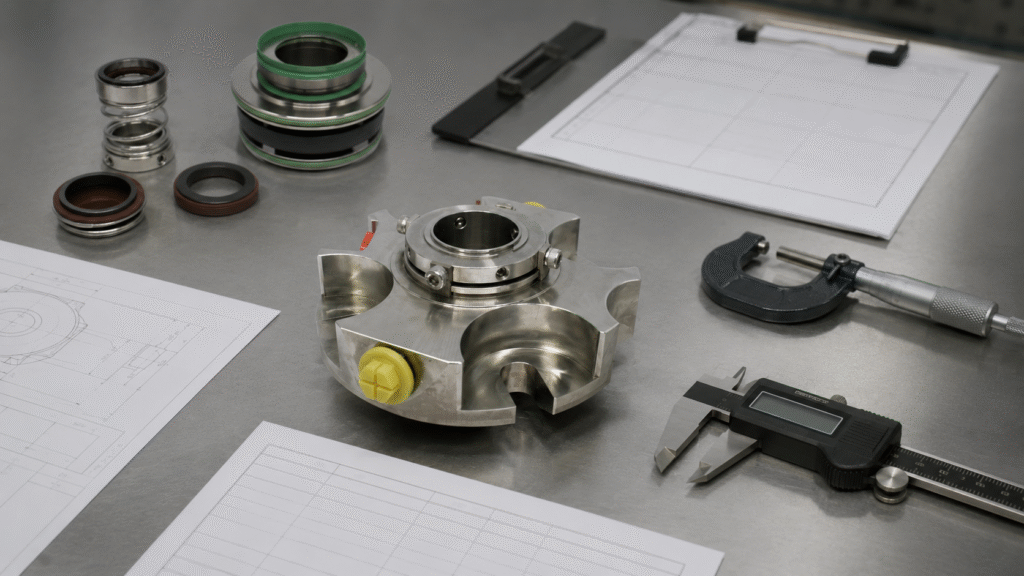
The table is a purchasing framework, not a quality ranking. Price, lead time, documentation, customization, traceability, and warranty can vary within every category.
Why OEM Terminology Causes Confusion
An Original Equipment Manufacturer (OEM) produces equipment or components for another finished product or brand. In mechanical-seal purchasing, suppliers may use “OEM seal,” “OEM replacement,” “OEM equivalent,” or “OEM-compatible” for different types of products.
Ask the seller to define the term clearly:
- Who manufactured the seal?
- Who supplies and warrants it?
- Is the sales channel authorized?
- Does the original part number identify a genuine part or only a compatibility reference?
- Is the seal manufactured from an original specification, an independent drawing, or a physical sample?
Clear answers are more useful than the word “OEM” on its own.
When an Original Mechanical Seal Makes Sense
Original supply is often the safer purchasing route when:
- The pump or equipment remains under an active manufacturer warranty.
- The purchase contract or equipment owner requires original parts.
- A validated or regulated process depends on the documented configuration.
- The seal design is proprietary or difficult to verify independently.
- Safety, certification, or owner approval limits substitutions.
- Reliable pump, seal, dimensional, or operating information is unavailable.
Original supply does not remove the need to check the current equipment. Older pumps may have modified sleeves, glands, spacers, or previous aftermarket conversions that no longer match the original factory configuration.
When a Compatible Replacement Makes Sense
An independently manufactured compatible replacement may be practical when:
- The original seal is discontinued or difficult to obtain.
- The pump is old and no longer supported through the original channel.
- The original lead time creates unacceptable downtime or inventory risk.
- The purchase cost is difficult to justify for standard or noncritical equipment.
- Reliable drawings, samples, dimensions, and operating data are available.
- The buyer needs a documented material or design variation for a defined application problem.
The replacement must still match the shaft, stationary seat, working length, gland or chamber geometry, seal arrangement, materials, and operating conditions.
A Practical Buyer Verification Process
Use the following sequence before approving an original or compatible mechanical seal.
- Define the supply category and identify who manufactures, supplies, and warrants the seal.
- Confirm the pump manufacturer, complete model, product number, and serial number.
- Record the original seal, service-kit, or spare-part reference where available.
- Compare the actual rotating assembly, stationary seat, and installation position.
- Confirm shaft size, seat dimensions, working length, and other critical geometry.
- Verify face materials, elastomers, wetted metals, fluid, pressure, temperature, speed, and solids.
- Confirm the exact purchasing scope, documentation, inspection, testing, lead time, and warranty responsibility.
- Resolve conflicts between the part number, current pump, installed seal, and historical records before ordering.
The How to Identify the Correct Mechanical Seal for a Pump guide explains the wider identification workflow.
If dimensions are uncertain, use the How to Measure a Mechanical Seal guide. If a material change is proposed, refer to the Mechanical Seal Material Selection guide.
Why Part Numbers and Cross-References Are Not Always Enough
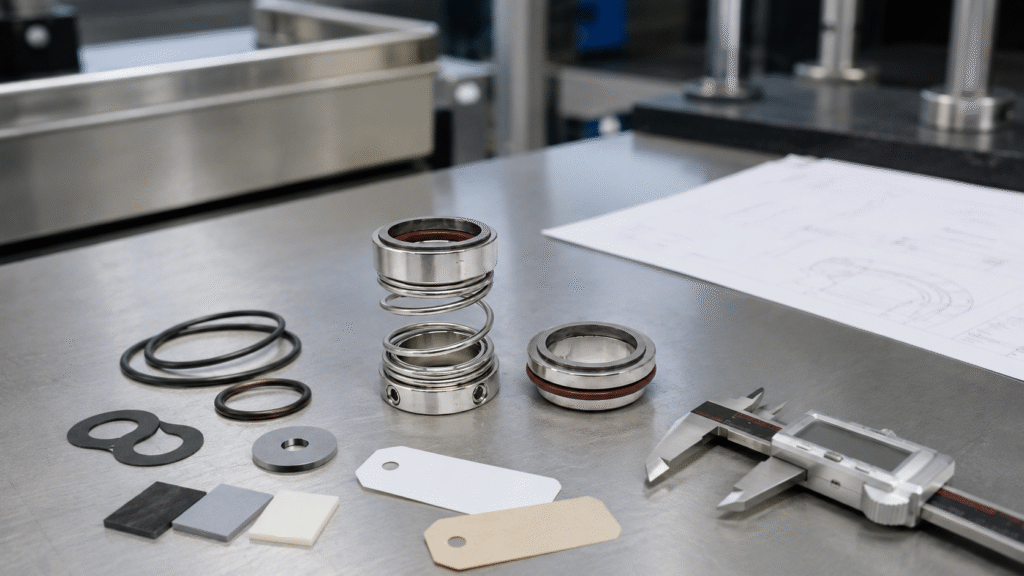
Part numbers, service-kit references, old quotations, and cross-reference tables are useful evidence, but they are not always the complete specification.
Older equipment may contain:
- A modified shaft or replacement sleeve
- A different production revision
- A converted gland or seal chamber
- A previous aftermarket seal
- Changed face or elastomer materials
- Mixed components from different repairs
The installed seal is not automatically the factory-original seal. A previous replacement may be correct, modified, or unsuitable. If the part number, physical components, and pump geometry disagree, investigate the conflict before placing the order.
Service Kit vs Individual Mechanical Seal
A mechanical seal and a complete service kit are not the same purchasing scope. A service kit may include the seal, O-rings, casing gaskets, sleeves, washers, clips, shims, or other service components.
State clearly whether the quotation should cover:
- The mechanical seal only
- The rotating assembly and stationary seat
- A complete pump service kit
- Additional gaskets, sleeves, clips, or installation parts
Two quotations can appear to have very different prices because they include different components.
Can Materials or Seal Design Be Changed?
A material or design change can be technically justified, but different does not automatically mean better. If a supplier proposes carbon/ceramic to carbon/SiC, NBR to FKM, FKM to FFKM, 304 to 316, or component to cartridge construction, ask what specific problem the change is intended to solve.
Confirm:
- Fluid and cleaning-chemical compatibility
- Normal and maximum temperature
- Pressure, speed, and lubrication conditions
- Dimensional and working-length compatibility
- Changes to gland, sleeve, chamber, or installation procedure
- Manufacturer, owner, warranty, or validation restrictions
- The expected benefit and the evidence supporting it
Avoid unsupported descriptions such as “premium material,” “upgraded seal,” or “longer life” without a clear engineering basis.
How to Compare Mechanical Seal Quality
Quality comparison should focus on evidence that affects fit, operation, and repeat supply.
- Dimensional control: critical shaft, seat, gland, and axial dimensions are checked against an agreed drawing or sample.
- Material control: face, elastomer, and metal specifications match the agreed duty.
- Seal-face quality: the mating surfaces are manufactured and inspected for the intended design.
- Assembly consistency: springs, drive features, setting dimensions, and component relationships remain repeatable.
- Drawing control: revisions and approved configurations are identifiable.
- Repeat-order consistency: later batches can be supplied to the same confirmed specification.
- Application support: the supplier can explain the compatibility basis and limitations.
- Traceability: certificates, batch records, or inspection documents are available where required.
Possible documentation includes dimensional drawings, material specifications, inspection reports, material certificates, batch traceability, installation instructions, and compatibility statements. Documentation supports a correct design; it cannot make an incompatible seal fit or operate correctly.
Testing requirements depend on the seal type and application. Do not assume every mechanical seal requires the same pressure, dynamic, hydrostatic, or leakage test. Agree on inspection and testing requirements that match the purchased product and operating risk.
Cost, Lead Time, and Warranty
The lowest purchase price is not always the lowest total cost. Compare:
- Purchase price and freight
- Lead time and downtime exposure
- Installation labor
- Repeat-failure risk
- Inventory and minimum-order requirements
- Engineering or sample-development cost
- Technical support and documentation
- Warranty responsibility
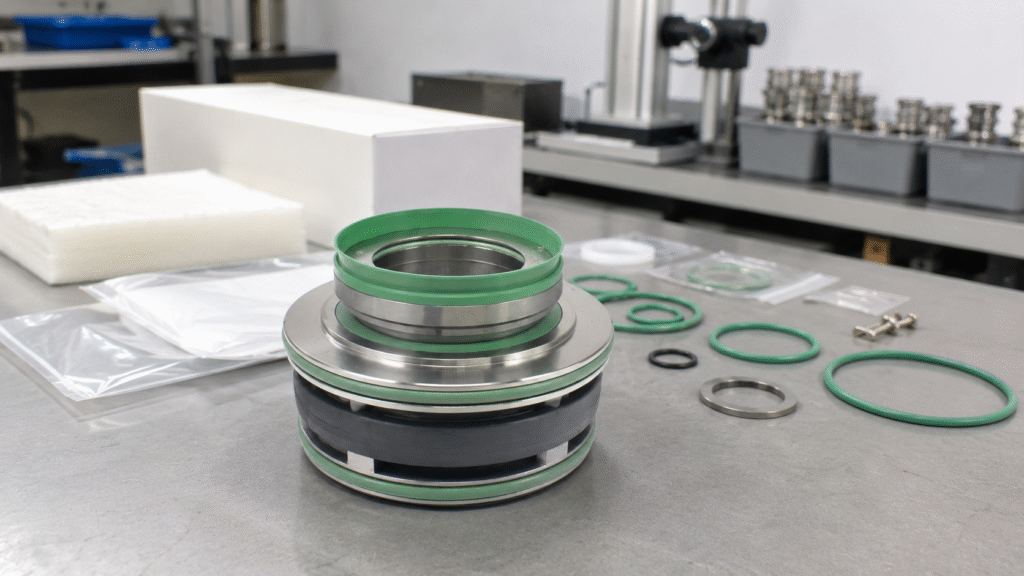
A compatible replacement may offer more flexible cost or lead time in some situations, especially for legacy or discontinued equipment. It is not automatically cheaper or faster. Tooling, engineering work, materials, stock, quantity, production capacity, destination, and supplier workload all affect the result.
Warranty responsibility also changes with the source. Original parts normally follow the original supply chain’s terms, while independent replacements follow the replacement supplier’s terms. Flowserve user instructions illustrate why equipment manufacturers may place conditions on non-original parts.
Check the actual pump warranty, purchase contract, validation requirements, and owner approval before making a substitution.
Common Buying Mistakes
- Assuming “OEM” always means genuine original
- Buying by shaft diameter alone
- Comparing purchase price without comparing scope
- Ignoring the stationary seat or working length
- Matching only by appearance
- Accepting vague material descriptions
- Assuming the installed seal is the original factory configuration
- Confusing a mechanical seal with a complete service kit
- Changing materials without reviewing the fluid and operating duty
- Using an original part number without dimensional confirmation
- Accepting “premium” or “upgraded” claims without technical evidence
- Failing to identify who is responsible for warranty and technical support
Buyer Checklist Before Approval
Before approving an original or compatible replacement mechanical seal, confirm:
- Supply identity: original, compatible, aftermarket, or sample-matched
- Manufacturer and supplier: who manufactured, supplied, and warrants the product
- Pump identity: complete model, serial number, and product number
- Reference: original part, seal, service-kit, or cross-reference number
- Current components: rotating seal, stationary seat, springs, drive features, and elastomers
- Critical dimensions: shaft or sleeve, seat, working length, gland, and chamber geometry
- Materials: both faces, secondary seals, and wetted metals
- Operating duty: fluid, concentration, pressure, temperature, speed, solids, and cleaning media
- Purchasing scope: seal only, seal set, or complete service kit
- Documentation: drawings, material records, inspection, testing, and traceability where required
- Changes: all design or material substitutions confirmed in writing
- Commercial responsibility: price, lead time, freight, warranty, and technical support
- Restrictions: manufacturer warranty, owner approval, validation, certification, or contract requirements
Compatibility notice: Pump brand names, model numbers, and original part references should be used only to identify compatibility clearly. Independently manufactured replacement mechanical seals should not be represented as genuine original parts unless reliable manufacturer, authorized-channel, or purchasing records document their origin.
OEM vs Original Mechanical Seal FAQ
Does “OEM Mechanical Seal” Always Mean a Genuine Original Part?
No. Suppliers use OEM-related terminology differently. Ask who manufactured and supplies the seal, whether the channel is authorized, and whether the original part number identifies a genuine part or only a compatibility reference.
Are Aftermarket Parts Lower Quality?
Not necessarily. Aftermarket products have different engineering and manufacturing controls. Compare dimensional accuracy, materials, face quality, assembly consistency, documentation, application verification, and repeat-order control.
Is an Original Mechanical Seal Always the Better Choice?
No. Original supply may be appropriate for warranty, validation, proprietary, safety-critical, or owner-controlled equipment. A verified compatible replacement may be practical for legacy, discontinued, or standard equipment when the dimensions, materials, arrangement, and operating conditions are known.
Can I Buy a Replacement From the Original Part Number Alone?
Sometimes the part number is a strong starting point, but older equipment may have modifications, production revisions, converted components, or previous replacements. Cross-check the reference against the current seal, critical dimensions, and pump configuration.
Is a Compatible Replacement Always Cheaper or Faster?
No. A compatible replacement may provide flexibility, particularly for legacy equipment, but tooling, materials, engineering work, stock, quantity, freight, production capacity, and supplier workload can change both price and lead time.
Conclusion
Buyers should compare OEM vs original mechanical seals by supply identity, technical compatibility, documentation, quality evidence, total cost, lead time, and warranty responsibility. The word “OEM” alone cannot prove that a seal is genuine, compatible, or suitable for the actual pump.
Use original parts when warranty, validation, proprietary design, documentation, or owner requirements justify them. Consider a compatible replacement when the application can be verified and there is a clear maintenance or supply advantage. In every case, confirm the pump, reference, actual seal, dimensions, materials, operating conditions, purchasing scope, and responsibility before ordering.
If you need an independently manufactured replacement based on drawings, dimensions, samples or application requirements, browse our OEM mechanical seals and custom replacement solutions.