Select food-grade mechanical seals from the complete hygienic duty, not from appearance or shaft size alone. Dairy and beverage pumps must control leakage while also supporting cleanability, drainability, product quality, and documented food-contact suitability. In addition, the seal must survive production, cleaning, sanitizing, and any steam cycle without creating avoidable product traps or contamination risks.
A white O-ring, blue elastomer, stainless-steel spring, or polished surface does not prove food-contact suitability. Instead, engineers should verify the exact materials, compound grades, hygienic geometry, cleaning access, operating conditions, and supporting documents. Therefore, this guide focuses on dairy and beverage service rather than repeating a general mechanical seal materials or elastomer reference.
What Makes Food-Grade Mechanical Seals Suitable for Food Processing?
A seal becomes suitable for hygienic food service only when its complete configuration matches the intended application. The review should cover seal faces, secondary seals, product-contact metals, geometry, surface condition, and auxiliary fluids. In addition, every component exposed to product or cleaning solution should have suitable documentation for the required contact conditions.
What “Food-Grade” Should Actually Mean
The term “food grade” is often used too loosely in purchasing. Color does not identify an elastomer compound, and stainless steel alone does not confirm hygienic design. Likewise, a smooth external appearance says little about hidden crevices. Therefore, buyers should ask what exact material, compound, grade, regulation, and contact condition support the supplier’s statement.
Hygienic suitability also depends on how the seal fits the pump. A replacement can match the shaft diameter yet create a deeper cavity, exposed thread, or poorly drained pocket. As a result, dimensional interchangeability does not automatically preserve cleanability. Evaluate the seal and pump together as one product-contact system.
Why Dairy and Beverage Pumps Create Different Seal Problems
Dairy and beverage products differ in viscosity, acidity, solids, fat, sugar, carbonation, and deposit behavior. Consequently, one food-pump seal arrangement cannot cover every product. Milk may lubricate differently from syrup, while fruit pulp can introduce particles. Beer and soft drinks add carbonation, while yogurt increases viscosity and product-retention risk.
| Product | Main conditions to evaluate |
|---|---|
| Milk / cream | Fat, protein, thermal cycling, product film, frequent CIP |
| Yogurt | Viscosity, cultures, product retention, gentle flow, cleaning access |
| Fruit juice | Acids, sugar, pulp, suspended particles, cleaning chemistry |
| Beer | Yeast, carbonation, cleaning, oxygen-control requirements |
| Soft drinks | Acidity, sugar, carbonation, pressure changes |
| Syrup | High viscosity, sticky deposits, crystallization, reduced face lubrication |
This table is a screening tool rather than a material prescription. For example, two juice plants may use different formulations and cleaning programs. Therefore, select food-grade mechanical seals from the actual product recipe, process temperature, solids, viscosity, pressure, and changeover conditions.
Hygienic Seal Design: Cleanability and Drainability
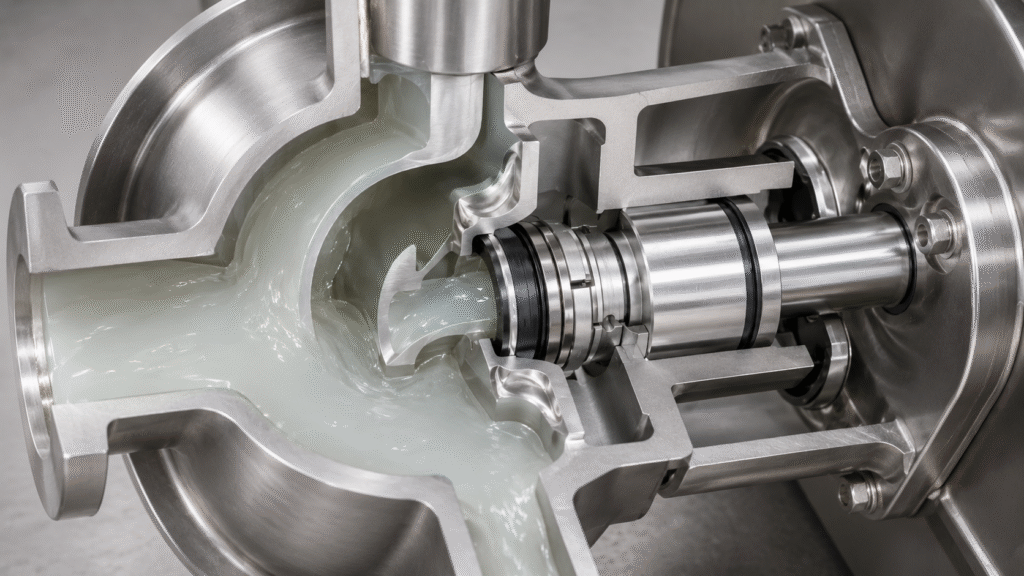
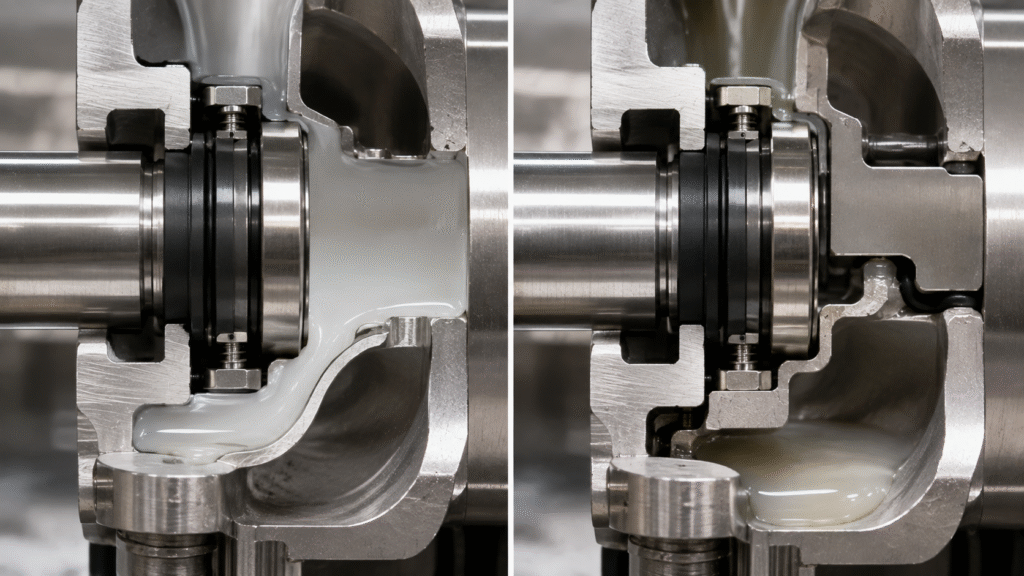
Hygienic design should minimize places where product can remain after production or cleaning. Deep crevices, shielded cavities, damaged grooves, and exposed threads in the product zone can retain residue. In addition, springs and drive features should avoid unnecessary product exposure where the pump design allows. Effective CIP flow must reach the areas that actually contact product.
Drainability matters for the same reason. Product, rinse water, and sanitizer should drain from intended drainable areas after shutdown. Therefore, evaluate the seal chamber, stationary-seat geometry, gasket interfaces, and pump orientation together. The EHEDG guidance on hygienic mechanical seals is useful because it treats cleanability and auxiliary-system design as part of seal selection.
Controlled gasket compression also matters. Too little compression can leak, while excessive compression may distort an elastomer into the product zone. Furthermore, scratches, pits, burrs, and damaged product-contact surfaces can create new retention sites. A replacement seal should preserve smooth, undamaged surfaces and the intended cleaning path.
How CIP and SIP Change Food-Grade Mechanical Seal Selection
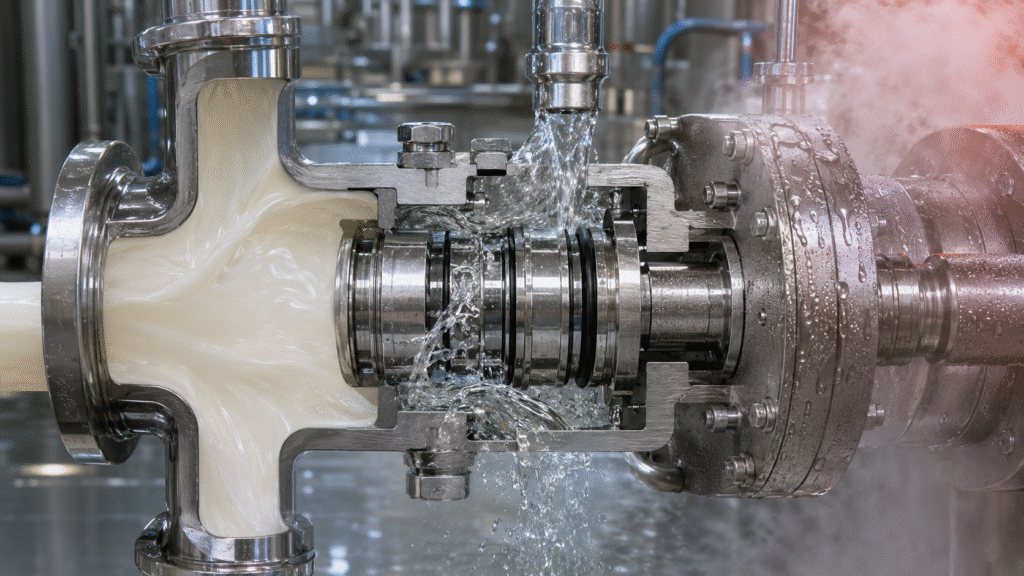
For many food-grade mechanical seals, the most severe exposure may occur during CIP or SIP rather than production. Cleaning can introduce stronger chemicals, higher temperatures, rapid thermal changes, or longer exposure. Therefore, never select the seal from product temperature alone. Record each cleaning condition that reaches faces, elastomers, metals, gaskets, and support-system components.
Document the cleaning chemical, concentration, temperature, contact time, cycle frequency, sanitizer, and rinse-water conditions. Where steam-in-place applies, also record steam conditions and heating or cooling transitions. However, do not assume every plant uses the same CIP sequence. The actual validated process should control the compatibility review.
CIP performance is also a geometry issue. Strong flow through the pump casing does not guarantee strong cleaning flow behind a seat or around a seal cavity. Consequently, replacement geometry may change cleaning access even when the seal runs correctly. 3-A hygienic design guidance and EHEDG principles can help plants evaluate cleanable and drainable equipment features.
Selecting Seal Faces for Dairy and Beverage Pumps
Seal-face selection should stay application-specific. Carbon/SiC can be practical for clean, well-lubricating products when the exact carbon grade and contact documentation are suitable. Consider SiC/SiC where particles, crystallization, or wear justify hard faces. However, hard/hard faces still need adequate lubrication and a seal design that supports stable running.
Ceramic may remain suitable in selected mild, cleaner duties when the pump and cleaning conditions support it. Consider tungsten carbide where mechanical toughness or wear conditions justify that choice. Nevertheless, binder chemistry and exact grade still matter. For broader properties and pairings, use the mechanical seal materials guide rather than turning this food article into a materials encyclopedia.
No face material is universally compatible with every CIP chemical. Therefore, check the product and cleaning solution together at realistic temperatures and concentrations. In addition, confirm whether contamination limits or product-quality requirements affect the acceptable face grade or impregnation system.
Selecting Food-Contact Elastomers
Elastomers must tolerate both the product and the complete cleaning cycle. EPDM, FKM, NBR, FFKM, and PTFE-based designs can all have valid uses, but their performance depends on the exact compound. Therefore, never approve food-grade mechanical seals from an elastomer family name or color alone.
For example, an EPDM compound may suit many aqueous cleaning duties, while oil exposure can change the decision. FKM may help with fats or oils in some services, yet certain hot-water, steam, or cleaning chemistries require careful verification. NBR can work in selected duties, while severe chemistry may justify FFKM. However, none of these materials is automatically the “best” food elastomer.
PTFE-based secondary seals create another case because PTFE does not behave like a conventional rubber O-ring. Geometry, energizing method, installation, and recovery characteristics can differ. For a detailed family comparison, use the mechanical seal elastomers guide and then verify the exact food-contact compound supplied.
Single, Flushed or Double Mechanical Seal?
A single seal can suit clean products that provide stable face lubrication and do not create severe deposits. It also reduces support-system complexity. However, the decision still depends on leakage consequences, CIP access, viscosity, crystallization, and operating stability. The broader single vs double mechanical seals guide explains arrangement fundamentals without making food service the only decision factor.
A flushed or quenched arrangement may help control atmospheric-side deposits or prevent sticky product from drying around the seal. Nevertheless, the support liquid must be clean, compatible, controlled, and acceptable for the process. Poorly controlled flushing can create a contamination path rather than improve hygiene.
Sticky products, crystallization, limited lubrication, containment needs, or selected aseptic duties may justify a double seal. However, food pump does not equal double seal. The barrier or buffer system also adds fluid-quality, pressure, monitoring, and cleaning requirements. Therefore, select the arrangement from process risk and hygienic performance, not from a universal rule.
Food-Contact Documentation and Traceability
A supplier statement such as “FDA material” or “food grade rubber” is too vague for controlled food-contact purchasing. Instead, request the exact compound or grade, applicable regulation or standard, contact conditions, and document traceability. In the United States, 21 CFR 177.2600 covers specified rubber articles intended for repeated food-contact use, but the exact finished compound and intended use still require verification.
3-A and EHEDG also provide hygienic-design frameworks and guidance for food-processing equipment. However, referencing those organizations is not the same as claiming certification. Only describe Hong Teng products, replacement seals, or complete pumps as certified or compliant when the applicable documentation actually supports that statement.
For food-grade mechanical seals, useful supplier records may include material declarations, compound identification, batch or lot information where required, and the relevant document date. Furthermore, the plant should link those records to the pump and installed seal. This traceability helps maintenance and quality teams investigate future leakage, cleaning concerns, or material substitutions.
Common Food-Pump Mechanical Seal Selection Mistakes
The first common mistake is buying from appearance. A blue O-ring, white gasket, polished ring, or stainless spring cannot prove food-contact suitability. The second is selecting only by shaft diameter. Although the part may install, altered geometry can change drainability, product retention, gasket compression, or CIP flow around the seal.
Another mistake is checking only the product while ignoring CIP and SIP. A material may perform well during production but change during repeated cleaning. Likewise, replacing a single seal with a double arrangement does not automatically improve hygiene. The plant must also control the support system, cleaning method, and contamination consequences.
Finally, avoid vague compliance language. “FDA approved seal” can imply a product-level approval that the documentation may not support. Instead, identify the exact material claim and its basis. If a supplier cannot connect the supplied component to the stated compound or document, request clarification before approving the replacement.
What Information Should You Send Before Ordering?
Before ordering food-grade mechanical seals, start with complete application data. Send the pump manufacturer, pump model, seal reference, clear photos, and critical dimensions. In addition, provide the product, viscosity, solids, operating temperature, and any known pressure or vacuum condition. For APV pump mechanical seals or other sanitary pump replacements, confirm the exact pump variant rather than relying on a visual match.
Information to Include in the Inquiry
- Pump manufacturer and pump model
- Seal reference, photos, and dimensions
- Product, viscosity, and solids
- Operating temperature
- CIP chemicals and concentration
- CIP temperature and cycle frequency
- Sanitizer and rinse-water conditions
- SIP conditions, where applicable
- Required compliance documents
- Quantity
Finally, state any special containment, aseptic, or plant-validation requirements. This information helps the supplier review both fit and hygienic suitability instead of treating the inquiry as a shaft-size match. It also reduces the risk that a dimensionally correct replacement changes cleaning access or product-contact geometry.
Food-Grade Mechanical Seal FAQ
Does a Blue or White O-Ring Mean Food Grade?
No. Color is a pigment choice and cannot reliably identify EPDM, FKM, NBR, FFKM, or another compound. Moreover, two visually similar O-rings may have different formulations and documentation. Verify the exact compound, supplier records, applicable food-contact requirement, and service conditions instead of approving the part by color.
Does Every Food Pump Need a Double Seal?
No. A hygienic single seal can work well in suitable clean, lubricating service. A flushed, quenched, or double arrangement becomes relevant when deposits, crystallization, limited lubrication, containment, or process risk justify additional control. Therefore, the correct choice depends on the product, cleaning cycle, leakage consequences, pump design, and support-system capability.
Can a Replacement Seal Be Selected by Shaft Size Alone?
No. Shaft size confirms only one interface. A replacement can fit mechanically while changing product-contact geometry, gasket compression, crevice size, drainability, or CIP access. Consequently, match food-grade mechanical seals by pump model, seal reference, dimensions, product conditions, cleaning requirements, and required material documentation.
Conclusion: Select the Complete Hygienic Sealing System
Food-grade mechanical seals should protect more than the shaft opening. They should support cleanability, drainability, suitable product-contact materials, reliable cleaning, and controlled contamination risk. Therefore, the selection process must consider production and cleaning as one complete duty rather than treating CIP or SIP as secondary conditions.
Start with the pump, product, hygienic geometry, and cleaning cycle. Next, select faces, elastomers, metals, and the seal arrangement from those conditions. Finally, verify the documentation and replacement geometry before release. This approach makes dairy and beverage seal selection a traceable hygienic-engineering decision rather than a simple material or dimension match.