Evaluate wastewater mechanical seal materials from the actual liquid, solids, chemistry, and pump condition—not from the word “wastewater” alone. Sewage may contain fibers, sand, grease, detergents, chlorides, organic matter, cleaning chemicals, and unexpected debris. Slurry can add far higher solids loading, heavy mineral particles, sharp edges, settling, erosion, and impact. Therefore, wastewater mechanical seal materials selection must begin with the real service.
This article focuses only on how wastewater, sewage, and slurry conditions change material decisions. It does not replace a general mechanical seal material selection guide or a full materials reference. Instead, it connects solids behavior, lubrication, chemistry, seal position, and equipment condition to practical choices for faces, elastomers, metals, and seal design.
Why Wastewater and Slurry Need Different Seal Materials
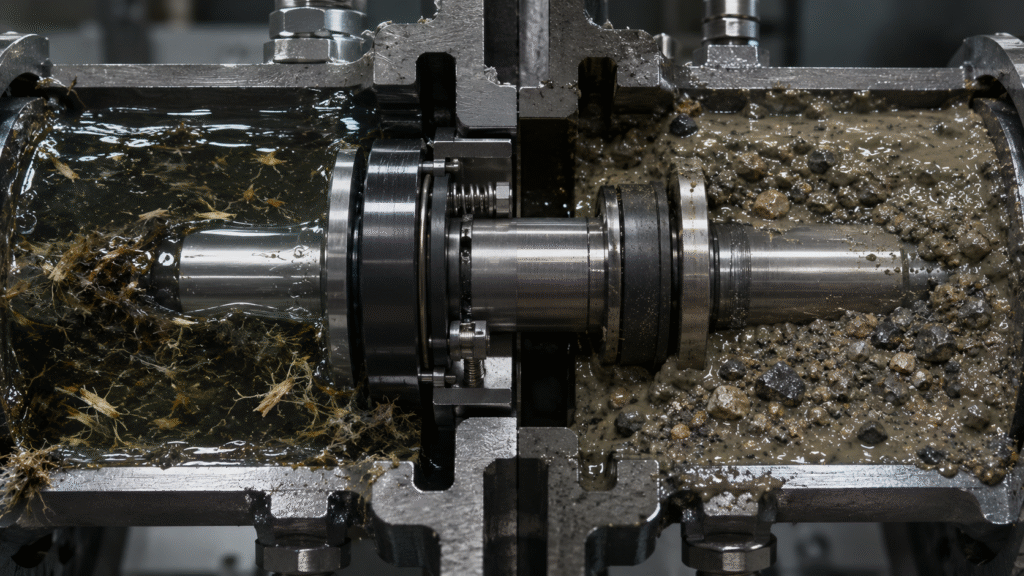
Engineers often group wastewater and slurry together as “dirty service,” but that label hides important differences. Wastewater may carry soft fibers, grease, detergents, fine sand, chlorides, and changing chemical contamination. In contrast, slurry may contain a high concentration of dense mineral solids that are hard, sharp, or difficult to keep suspended.
Because these fluids behave differently, the same face pairing can perform very differently. A fibrous sewage stream may block springs without causing severe face abrasion. Meanwhile, a mineral slurry may erode faces and metal parts while also settling inside the seal chamber. Consequently, “dirty water” or “slurry” is never enough information for reliable wastewater mechanical seal materials selection.
Start With the Solids, Not the Material Name
First, define solids concentration, particle size, hardness, shape, and specific gravity. Next, identify whether particles are fibrous, mineral, soft, sharp, rounded, or irregular. Settling tendency also matters because heavy solids can pack around the seal during shutdown and interfere with movement at the next startup.
Consider impact separately from abrasion. A stream containing hard but fine particles creates different risks from one carrying larger, dense particles. In addition, solids concentration changes how easily particles enter clearances and disturb the lubricating film. Therefore, selecting a hard face without understanding particle behavior can solve one problem while leaving several others untouched.
How Solids Damage Mechanical Seals
Abrasive wear is only one failure mechanism. Particles can enter the interface and scratch a softer face, but they can also hold the faces apart. As a result, leakage may increase even before deep wear becomes visible during routine maintenance inspection.
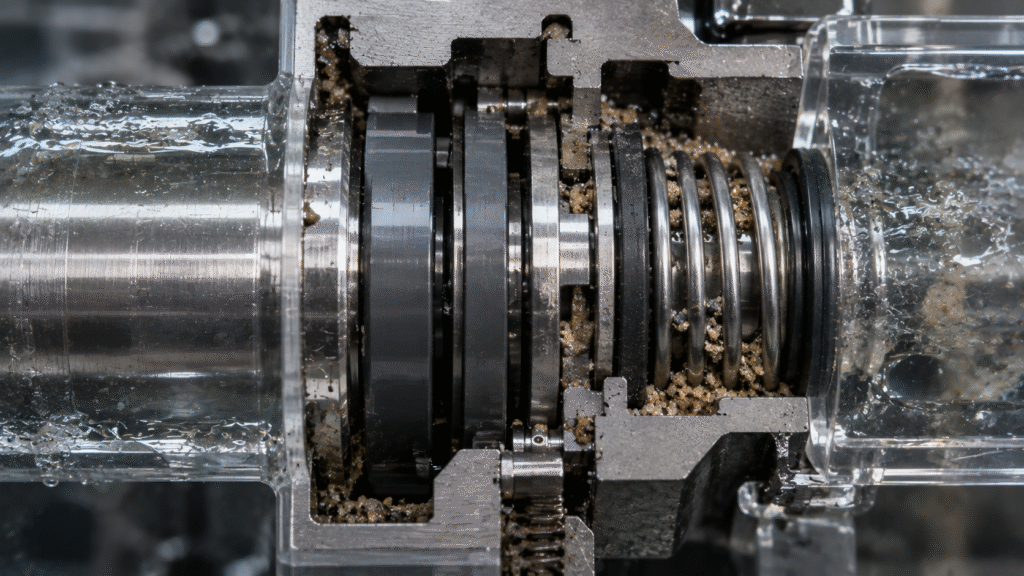
Solids can also block springs, jam dynamic secondary seals, erode sleeves, and plug the seal chamber. Fibers may wrap around components or collect in narrow spaces. Heavy particles may settle after shutdown and restrict movement during restart. Therefore, the complete seal must tolerate contamination, not just the visible face materials.
For severe solids service, review previous failures together with fluid data. Deep grooves may indicate abrasive contamination, while blocked spring areas suggest solids accumulation. However, each clue needs confirmation from the pump, seal design, operating history, and actual process conditions.
Carbon, Ceramic, SiC and TC in Dirty Service
When evaluating wastewater mechanical seal materials, do not exclude carbon automatically. It can remain practical in treated wastewater, light contamination, clean oil chambers, or some upper seal positions. Carbon also offers favorable running behavior against a harder mating face. However, heavy abrasive product-side service can wear carbon rapidly when particles continuously enter the interface.
Ceramic can suit mild, cleaner water duties and selected wastewater conditions with limited abrasion. Nevertheless, it should not become the default for heavy slurry. Silicon carbide often becomes an important candidate because it combines high hardness, wear resistance, and strong chemical resistance. Yet brittleness, exact grade, lubrication, particle size, and pump condition still require review.
Tungsten carbide offers high toughness and mechanical robustness. Therefore, it may have advantages where abrasion occurs together with impact or heavy mechanical loading. However, its binder chemistry matters in corrosive service. A dedicated silicon carbide vs tungsten carbide comparison is the better place for a detailed one-to-one material decision.
When Hard/Hard Seal Faces Make Sense
When wastewater mechanical seal materials include hard/hard faces, common pairings include SiC/SiC, TC/TC, and SiC/TC. These combinations can reduce rapid soft-face wear in abrasive service. However, harder does not automatically mean more reliable. Fluid lubrication, startup behavior, face loading, cooling, solids behavior, and seal geometry still control whether the pairing works.
For moderate wastewater, Carbon/SiC may remain a reasonable option when solids are limited and lubrication is stable. In contrast, a hard/hard pair can run poorly if the faces lack an adequate liquid film. Therefore, the choice should match both contamination and lubrication rather than following a hardness ranking.
Why Tungsten Carbide Is Not a Fix for Pump Vibration
Tungsten carbide may provide higher mechanical toughness than many silicon carbide grades. However, that property does not turn TC into a repair for a damaged pump. Severe vibration, worn bearings, shaft runout, misalignment, or unstable hydraulic operation can destroy any mechanical seal.
If failure evidence suggests machine movement, inspect shaft runout and misalignment before changing face materials. Likewise, correct pump cavitation and vibration at the hydraulic or mechanical source. A tougher face may survive a specific impact condition better, but it should never hide a repairable equipment defect.
Elastomer and Metal Compatibility in Wastewater
Wastewater mechanical seal materials also include secondary seals, and wastewater chemistry can change during operation, cleaning, or contamination events. Oils, detergents, oxidizing cleaning chemicals, chlorides, temperature, and chemical-cleaning cycles can all affect secondary seals. Therefore, elastomer selection should use the complete exposure history rather than only the normal wastewater description.
Do not identify NBR, EPDM, FKM, or other elastomers by color. Used compounds can darken, swell, harden, or become stained. For a detailed comparison, use the mechanical seal elastomers guide with actual chemical, concentration, exposure, temperature, and complete cleaning-cycle data.
Metal components need the same attention. Springs, retainers, sleeves, glands, and fasteners can suffer corrosion, chemical attack, and erosion. However, this application guide does not require a complete metal-grade encyclopedia. Confirm the metal grade against wastewater chemistry, chloride exposure, solids, temperature, and required mechanical strength.
Submersible Pump Upper vs Lower Seal Materials
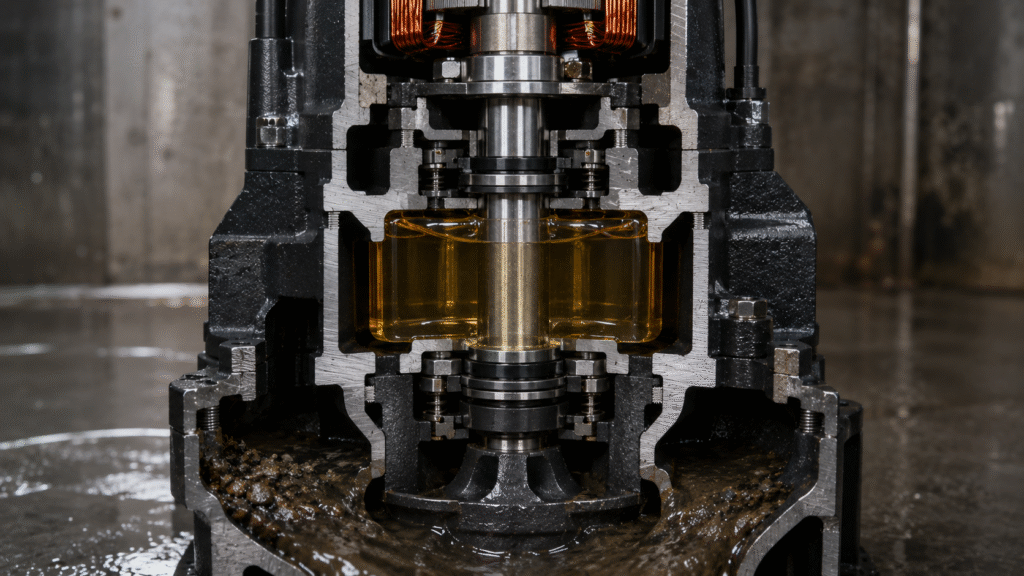
When selecting wastewater mechanical seal materials for submersible pumps, remember that many designs use an upper seal, a lower seal, and an oil chamber between them. Those two sealing positions can experience very different environments. The lower product-side seal may contact sewage, grit, or suspended solids. Meanwhile, the upper seal may operate in a cleaner lubricating oil chamber.
Therefore, the upper and lower seals should not automatically use identical materials. The pump design, seal position, oil condition, and expected contamination path all matter. Flygt replacement mechanical seals, for example, include separate upper, lower, and cartridge arrangements across different pump models.
Milky oil can suggest possible product entry into the oil chamber, but it is only a diagnostic clue. The technician should inspect both seal stages, oil condition, bearing condition, and the actual leakage path before deciding which material or component caused the failure.
When Seal Design Matters More Than Face Material
In difficult solids service, wastewater mechanical seal materials are only part of the reliability decision, because design can matter more than changing SiC to TC. Large clearances, protected springs, external flush, solids exclusion, double seals, barrier fluid, oil chambers, and suitable seal-chamber geometry can prevent contamination from controlling the seal.
For example, a slurry-focused design may keep springs away from the product and provide room for particles to move through the chamber. John Crane Type 5860 slurry seal documentation illustrates how protected springs and slurry-specific geometry address problems beyond face hardness. Therefore, always review material selection together with the seal arrangement.
A double seal or barrier system may also help when lubrication is poor or product exclusion is required. However, support systems need correct pressure, cleanliness, cooling, and circulation. Premium face materials cannot compensate for a blocked flush line or contaminated barrier fluid.
Material Considerations for Different Wastewater and Slurry Conditions
| Service condition | Factors to evaluate |
|---|---|
| Treated wastewater | Remaining grit, lubrication, cleaning chemicals, temperature, seal position |
| Municipal sewage | Fibers, sand, grease, debris, spring protection, plugging risk |
| Abrasive wastewater | Solids concentration, particle hardness, particle size, face wear, erosion |
| Fine mineral slurry | Hardness, concentration, chemistry, lubrication, seal-chamber circulation |
| Coarse or heavy slurry | Particle mass, impact, settling, shaft condition, protected seal design |
| Corrosive slurry | Carrier-fluid chemistry, face grade, TC binder, elastomers, wetted metals |
| Oil-contaminated wastewater | Hydrocarbon type, elastomer compatibility, lubrication, cleaning cycle |
| Submersible pump service | Upper/lower seal position, oil chamber, product entry, bearing condition |
This table is a decision aid, not a material prescription. Still, check wastewater mechanical seal materials against operating conditions, solids behavior, lubrication quality, chemical exposure, startup conditions, and the original pump or seal design before final approval and procurement release.
What the Failed Seal Can Tell You
| Failure evidence | Possible diagnostic clue |
|---|---|
| Deep grooves | Abrasion or contamination |
| Chipped hard face | Impact, installation damage, solids, or shaft movement |
| Blocked spring area | Solids accumulation or poor solids exclusion |
| Swollen elastomer | Possible chemical incompatibility |
| Milky oil | Possible product entry into an oil chamber |
| Uneven running track | Check runout, alignment, mounting, and shaft movement |
These observations are clues, not final diagnoses. A chipped hard face does not automatically prove that the face material was wrong. Likewise, uneven wear should trigger equipment checks before technicians install a tougher material, because machine movement may be the real cause.
Wastewater and Slurry Seal Material Checklist
Before selecting wastewater mechanical seal materials, record the full pump model and seal position. Then document the liquid, temperature, pressure, solids concentration, particle size, hardness, shape, specific gravity, settling tendency, and cleaning chemicals. Also record oil contamination, chloride exposure, and any support fluid.
Next, inspect lubrication conditions, seal-chamber design, spring protection, and previous failure evidence. Check bearings, shaft movement, alignment, and cavitation symptoms before blaming the faces. Finally, confirm face grades, elastomer compatibility, metal compatibility, and whether the existing seal arrangement suits the solids service.
FAQ
Are SiC/SiC Faces Always Best for Wastewater?
No. SiC/SiC can be a strong candidate in abrasive service, but wastewater varies widely. Treated wastewater, oily sewage, fibrous service, and submersible oil-side positions may need different combinations. Lubrication, seal design, chemistry, and pump condition remain part of the decision.
Should Heavy Slurry Always Use TC/TC?
No. Tungsten carbide can provide useful toughness, especially where impact is important. However, also consider slurry chemistry, TC binder, lubrication, particle behavior, seal geometry, rotating mass, and startup conditions. Some applications may use SiC/SiC, SiC/TC, or another approved arrangement.
Can Carbon/SiC Work in Wastewater Pumps?
Yes. Carbon/SiC can remain reasonable in moderate wastewater, treated effluent, cleaner chambers, and some upper seal positions. However, abrasive product-side exposure can wear carbon quickly. Therefore, the actual solids load, lubrication, and seal position determine whether the pairing remains suitable.
Do Upper and Lower Submersible Seals Need the Same Materials?
Not necessarily. A lower seal may contact sewage or abrasive solids, while an upper seal runs against oil or a cleaner chamber. Dual-seal wastewater pump documentation shows why those locations can use different face combinations. Always confirm the specific pump design before changing materials.
Conclusion
Never select wastewater mechanical seal materials from a fixed formula. Wastewater, sewage, and slurry differ in solids concentration, particle behavior, chemistry, lubrication, settling, and impact. Therefore, the useful question is not “Which material is best?” but “Which risks does this specific seal position need to manage?”
Start with solids and fluid chemistry, then evaluate faces, elastomers, metals, pump condition, and seal design together. Hard/hard faces can be valuable, but they do not replace lubrication or equipment repair. When technicians define the application correctly, material selection becomes a controlled engineering decision rather than a guess based on hardness.